
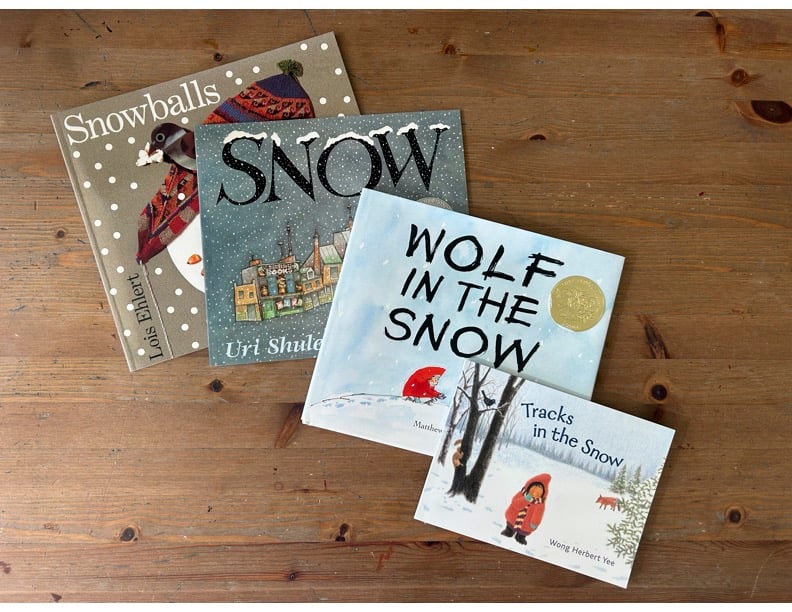
As the days shrink to their shortest length and the winter chill seems here to stay, there’s nothing better than finding a cozy corner in which to read a book. That’s why we’re launching our Twelve Days Giveaway, with twelve delightful books, in three sets of four to enjoy. Their unifying theme? Snow!—and, of course, beautifully illustrated picture books!
The first bundle of four we’ve curated is perfect for primary and early elementary readers. Because the words in these stories are sparse (or for one story, nonexistent), reading the illustrations is key. As the saying goes, a picture is worth a thousand words—so take a close look along with your students at the wonderful sketches, collages, watercolors, paintings, and words that collaborate to tell the story, and get reading!
HOW TO ENTER:
Enter once—or come back daily to boost your chances!
You can also earn bonus entries by:
- Following us on Instagram, Facebook, Pinterest, or YouTube
- Uploading your Blackbird & Company photos or videos (no faces required!)
- Completing quick extra actions inside the contest portal
Here’s the scoop about the books in the primary bundle:
Tracks in the Snow by Wong Herbert Yee
Tracks in the Snow tells the adorable story of a little girl who sees prints in the snow outside her window. She wonders what kind of creature could have made these tracks and follows them throughout the snowy woods.
We chose this tiny book not only because of the sweet and whimsical storyline, but because of the little girl’s tenacity and inquisitiveness. She poses a question about the world around her—who or what made these tracks?—and doesn’t stop until she solves the mystery.
Character is one of the first literary elements students are equipped to unpack at the Earlybird level. As you read this story with your student, ask: What are the little girl’s character traits? Is she brave or scared? Is she curious or disinterested? How do you know? You might be surprised at your student’s insights!
Wolf in the Snow by Matthew Cordell
Wolf in the Snow begins as a little girl walks home from school and loses her way in a snowstorm. In the same wintery landscape, a helpless wolf pup is separated from his pack. The little girl and the wolf pup stumble across one another and search for the way home together in the forest and snowy plains. Is the girl and pup’s friendship enough to save them both?
The illustrations in Wolf in the Snow are so masterful that they don’t require words to tell the story—no wonder this book won the 2018 Caldecott Award! Onomatopoeia (words that represent sounds) are the only scraps of writing in this piece, like when the wolves go “hooooooooowwlll” or the owl says, “screech!” As you read this book with your student, bring up a conversation about mood. Mood is how a story makes you feel, and Matthew Cordell creates mood almost solely through pictures! How does each scene make you feel? How can you understand the little girl’s feelings from the illustrations?
After reading and discussing, consider challenging your student to draw a picture that conveys a certain mood, using no words except for onomatopoeias.
Snow by Uri Shulevitz
As one snowflake falls, then another, the boy with the dog knows what that means: it’s snowing! No matter how many times the people around him or the radio or the television say it isn’t snowing, the snow won’t listen to them.
We chose Uri Shulevitz’s Snow because of the boy’s faith that it would snow in the face of everyone else disagreeing with him. Despite grandfather with beard and man with hat and woman with umbrella explaining how the snowflakes are too few or how the snow will melt, the boy knows better and trusts himself. His optimism is rewarded when snow blankets the city and whimsical Mother Goose characters join him in celebrating the winter wonderland. As you read, ask: Has there ever been a time when you have known something to be true but other people disagreed with you? How did you handle it? Is it easy to trust yourself?
Snowballs by Lois Ehlert
The narrator knows a big snow is coming; it’s finally time to use the materials they’ve been collecting. They create a whole family of snowmen. When the sun comes out, the snowballs shrink and melt. Ehlert wraps up the book by including collage elements and an explanation of how snow is made.
One of the reasons we love this book is because of its interdisciplinary content. Ehlert combines the art of collage with the science of snow. After reading Snowballs with your student, cut out three circles of white paper and stack them to create a snowman. Looking to Ehlert’s examples for inspiration, collect a myriad of objects you can find around the house—like buttons, cashews, scraps of paper and fabric, string, plants, coins, socks—and arrange them on a piece of blank paper to decorate the snowman.
We’ll plan to draw 3 winners on December 30 and announce them on December 31—a fun way to close out the year and start the new one with great books in hand. So stay tuned!
And remember, more actions = more chances for you to win! Click through and enter to win today!
~Claire