
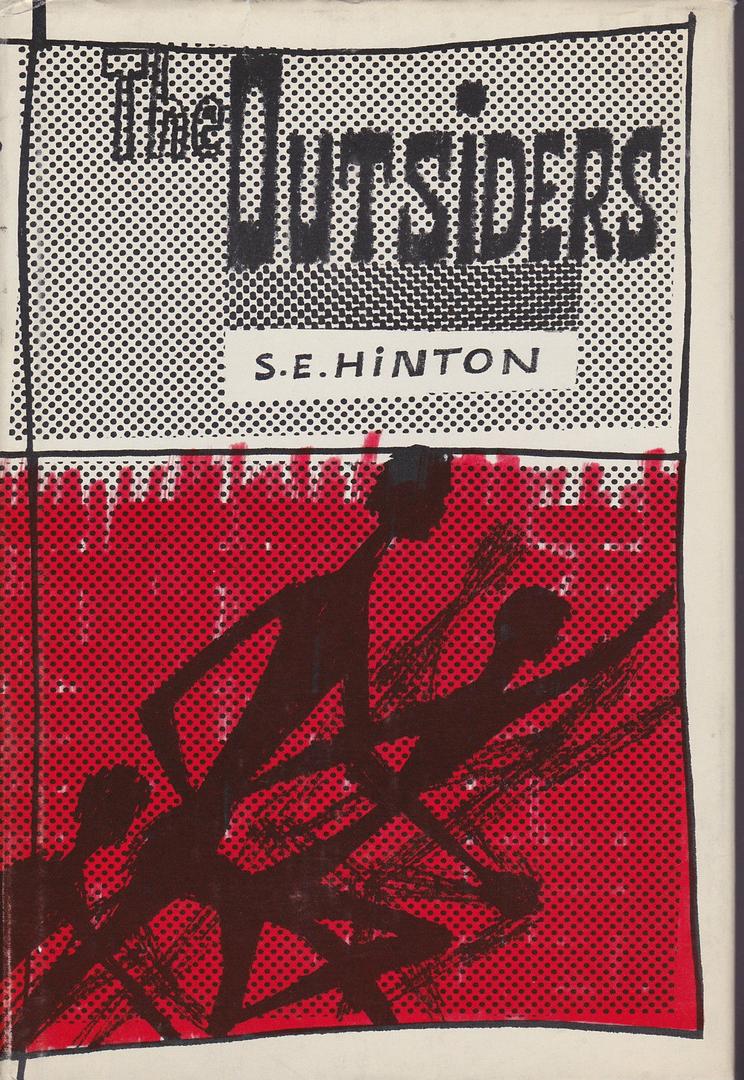
Over the course of five weeks, in the Level 4 Integrated Literature and Writing units, high school students are led on a journey through an exceptional work. Not only will they journey through, but they will document the journey, creating a weekly journal that explores, characters, themes, symbols, motifs, and vocabulary. The journal will also include a synopsis of the week’s reading and a weekly personal reflection. All of this, to prepare for the crafting of a culminating essay.

Back in the 60s, fifteen-year-old S.E. Hinton—Susan Eloise—began writing The Outsiders. The book was published when she was 18 and has been in print ever since. Back in the 90s it was surprisingly ranked #38 on the American Library Association’s Top 100 Most Frequently Challenged Books. But in 2019, the BBC listed the book as one of the top hundred most influential.
Now I love it when an idiom is used in a fresh way. So it tickles me that Kate, a current 9th grade student working through Honors English, was able to incorporate one of my favorites into her essay—alive and kicking. This one was, once upon a time, a sales pitch used by fishermen. Think 1800s. Think nets filled with flopping fish pulled onto a pier to sell. This is an alive and kicking offering, for sure! Fresh, indeed!
The idiom in Kate’s Thesis Statement was a teaching moment during the edit stage of the writing process. Kate first wrote: “The theme of loyalty, the symbolic switchblades, and the shrinking of differences to similarity keep this story relevant.” When she and her teacher were working through the editorial process, the idiom felt like a very natural improvement. This is REAL writing. This is the space where the mentor and the apprentice read and discuss and edit. All real writers learn through mentorship. Never is “imagination” or “originality” or “voice” the result of a consumable worksheet. Authentic essays spring from the heart that is drawn into a process—brainstorm, draft, re-read, conference with a mentor, polish. And here, you will read the result of a student who engaged in such a process.
Thank you, Kate, for reminding us that S.E. Hinton’s BIG idea is still alive and kicking!
The Gold Below the Surface
Have you ever been judged before someone really got to know you? In The Outsiders, by S.E. Hinton, the Socs and the Greasers are separated by wealth and reputation. The theme of loyalty, the symbolic switchblades, and the transforming of differences to similarity, keep this story alive and kicking.
For the Greasers to survive, they must rely on loyalty to one another. Every day, the streets are dangerous for the Greasers. S.E. Hinton uses the ongoing conflict between the Greasers and the Socs to demonstrate this danger, “Greasers can’t walk along too much, or they’ll get jumped” (2). The Greasers rely on each other for protection. Being loyal means sometimes having to sacrifice. Johnny protects Ponyboy at the church fire, “We put it out before you got burned. That jacket saved you from a bad burning, maybe saved your life” (94). Johnny courageously sacrifices his life because of his loyalty to his friend Ponyboy. Johnny rescuing Ponyboy not only demonstrates the loyalty of a true friend, but the true devotion of the Greasers toward one another.
Switchblades are weapons that symbolize both violence and protection. The Greasers live in a tough environment. They rely on violent switchblades for power, “Ya kill’em with switchblades, too, ya, kid” (83). Daily life is filled with rivalry, where the switchblades represented hostility. Getting the news that Johnny will be dying, breaks Ponyboy. But Johnny’s last words stick with him forever like a switchblade to the heart, “Stay gold, Ponyboy, stay gold…”(148). In the last seconds of his life, Johnny, protecting his friend, instructs Ponyboy how to live life. Receiving his last words of guidance, Ponyboy can move forward.
Despite all of the differences between the Greasers and the Socs, they are amazingly alike. After all, having differences doesn’t mean we humans aren’t similar. Despite the Greasers and the Socs differences, both groups are more alike than meets the eye, “It seems funny to me that the sunset she saw from her patio and the one I saw from the back steps was the same one” (1). Seeing the same sunset demonstrates similarity. Not knowing what Johnny’s future is going to look like, or if he even will have a future, is very scary. Worrying about what might happen to Johnny in the near future, Ponyboy comes face to face with mortality, “The blood was draining from my face and Darry put an arm across my shoulder and squeezed hard…even if he lived, he’d be crippled for the rest of his life” (102). All these thoughts are running through his mind. Sunsets and death lead readers into understanding that the Greasers and the Socs have much in common.
Throughout The Outsiders, S.E. Hinton, uses the simple theme of loyalty, symbols like switchblades and staying gold, and striking motifs of sunsets and death, to create a hauntingly realistic tale that is relevant here in the 21st century. Ultimately, judging someone before getting to know them creates walls that divide. Getting to know someone before judging enables us to discover someone as a whole, and this will always surprise the heart.
Works Cited
Hinton, S.E. The Outsiders. Viking Press, 1967.
~Kimberly
DON’T FORGET TO PLAY BINGO!
Download your Summer Bingo for free on Printshop HERE and submit a picture of your completed bingo sheet below to enter the raffles. Bingo will run June 1st through August 31st—so print out your bingo sheet and get to crossing off squares!