
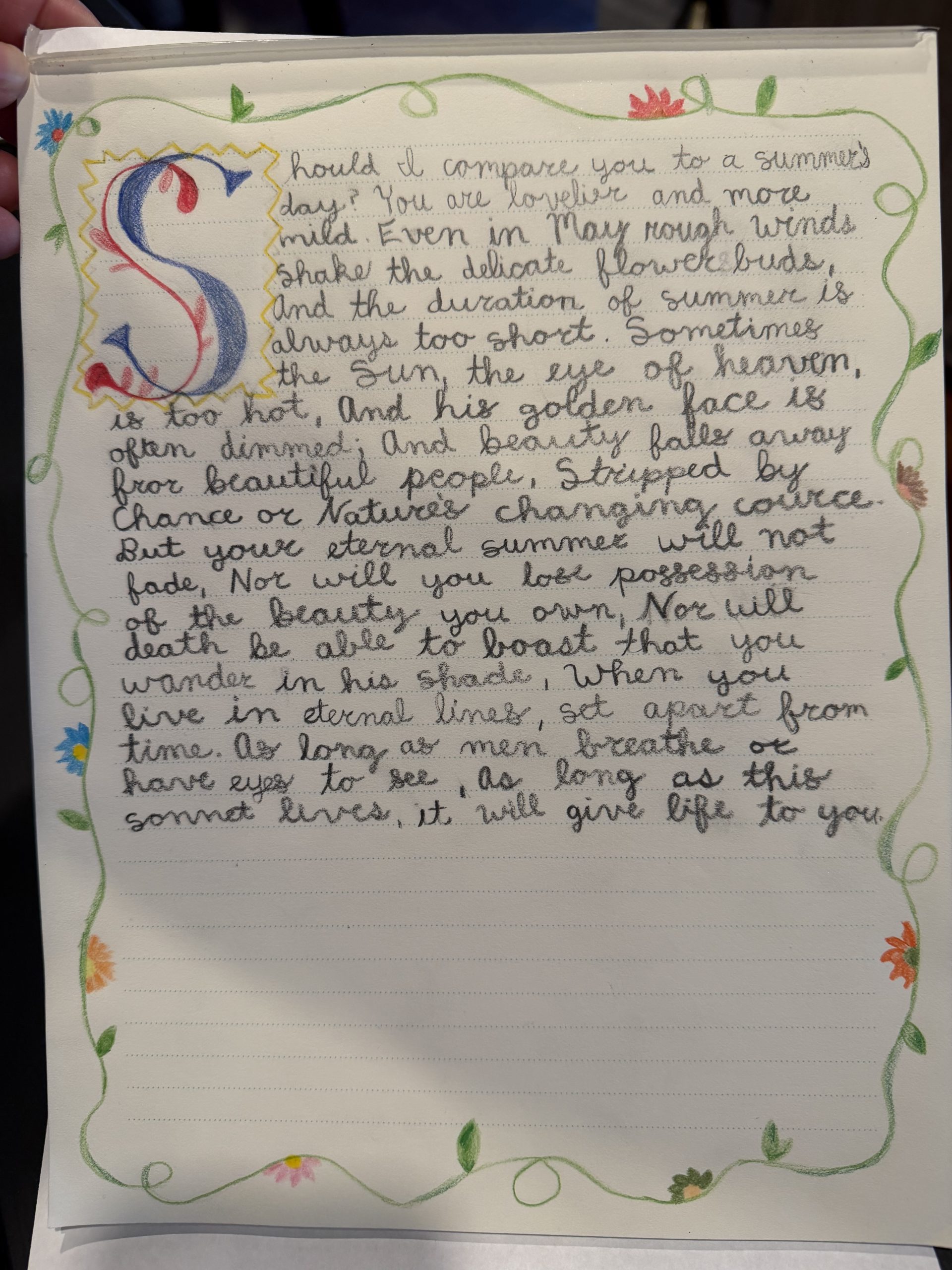
One of the significant milestones for student writers is the ability to connect the dots. A big part of becoming educated is acquiring knowledge. In English Language Arts as with all the humanities, students engage in reading and learning from books. Shakespeare is the bedrock of storytelling. We believe a must for students to gain a richness of language alone. Our Operation Lexicon guides students into the vast array of words unique to Shakespeare’s work. This is a great unit to begin in summer before diving into his sonnets and plays larger work.

Here again, our student Kate, during the spring semester demonstrated that she is enlarging her fund of knowledge and understands how to connect dots. One of her projects included diving into the works of Shakespeare. She learned about his life and touched the surface of his work.
To begin, she did a close reading of one of his well known sonnets, considering both its content and form. After creating the beautiful final project above to showcase the sonnet—a slowly copied work—she read a beautifully illustrated version of Romeo and Juliet. Now she was ready to dive into the world of Shakespeare’s play.
What is tremendous is the connections she made as she enlarged her fund of knowledge and connected the dots in her culminating essay.
Romeo and Juliet are Everywhere
Was any of it worth it? Shakespeare’s nearly 500-year-old play portrays two lovers, Romeo and Juliet, who tragically fall in love despite the deep, destructive resentment between their families. The language tricks, film adaptations across different time periods, and devastating consequences make this play an important work of art.
Shakespeare uses language tricks to add ironic humor to this tragedy. Romeo’s fickle love, ended his love towards Rosaline enabling him to suddenly fall in love with Juliet, setting the tragedy into motion. After Benvolio insists Romeo abandon his obsessive crush on Rosaline, Romeo responds hyperbolically: “Yet tell me not, for I have heard it all. Here’s much to do with hate but more with love. Why then, O brawling love, O loving hate!” (Folger lines 160-168a). It’s silly how Romeo’s feelings for Rosaline changed so quickly, turning into an obsession over Juliet. It’s wild that Romeo is compared to an attractive book holding a bad story, illustrating the complexity of what lies below the surface. Juliet compares Romeo to a beautifully bound book containing a dark heart after he kills Tybalt: “Was ever a book containing such vile matter so fairly bound? O, that deceit should dwell in such a gorgeous palace” (Folger lines 83-85a). Juliet’s statement is both amusing and disturbing regarding her obsessive passion. Shakespeare’s use here of complicated and tricky word play is effective.
Franco Zefrelli, Baz Luhrmann, Rogers and Hammerstein, and even Michael Jackson have reshaped Shakespeare’s play, “Romeo and Juliet,” for film. Baz Luhrmann’s 1996 film brought the story of Romeo and Juliet to life for me with of the casting of Leonardo DiCaprio, the modern setting, and the ’90s styling. While Robert Ebert loved Franco Zefarelli’s 1968 film, “I believe Franco Zeffirelli’s Romeo and Juliet is the most exciting film of Shakespeare ever made,” I don’t agree. I found the film dull. The 1968 film was theater-like, traditional, and Romeo dies first! Nobody can criticize Leonard Bernstein’s music or Stephen Sandhein’s lyrics, which was created for the theater, toured worldwide, and later became the famous 1961 film. This clever adaptation is set in New York’s Upper West Side, where, like The Outsiders, gangs are feuding (the Sharks and the Jets). I found the connections of West Side Story and Romeo and Juliet, and The Outsiders interesting, especially where all three stories encountered complicated relationships, conflict, and overwhelming emotions. And then there is Michael Jackson’s 1982 music video, “Beat It,” yet another adaptation where hostility increases quickly between rivals. Here Michael Jackson steps in, advocating for peace, using music and choreography to communicate powerfully. I wonder how Shakespeare might view all these adaptations?
Let’s talk tragedy. To begin, the fact that the Montagues and Capulets keep their feud going on and on and on to a point in time that no one actually remembers how it started is foolish, destructive, and clear evidence of how pride definitely comes before a fall! It’s frustrating and isolating for Romeo and Juliet, who could not share the fact that they were actually married with their loved ones. In the end, it took the tragedy of death to bring the feud to an end and to bring these families to their senses. How can anyone not connect to Romeo’s and Juliet’s obsessive love for each other and their heartbreaking death? Family conflict, love, and unfortunate spontaneous decisions do not always end well. Tragedy is real and happens every single day. Beware of holding onto grudges!
From 1597 to 2026, Shakespeare’s Romeo and Juliet has informed and influenced millions upon millions of us humans, but the idea was inspired by an earlier work by an English poet, Robert Brooke, who was inspired by an Italian poet named Matteo Bandeblo. There is nothing new under the sun, but Shakespeare made this tragic tale his own inspired by artist who came before him. Retelling Shakespeare’s classic redefines the timeless tragedy for every new generation. I wonder who will come next.
Work Cited
Jackson, Michael. “Beat It.” 1983. YouTube, Michael Jackson – Beat It (Official 4K Video)
Romeo and Juliet, Directed by Baz Luhnmann, 1996.
Shakespeare, William. “Romeo and Juliet.” Folger Shakespeare Library, https//folger.edu/shakespeares-works/romeo-and-juliet/.
Shakespeare, William and Zwerger, Lisbeth. Romeo and Juliet. Michael Neugebauer Publishing, 1996.
West Side Story. Directed by Robert Wise and Jerome Robbins, 1961.
~Kimberly
DON’T FORGET TO PLAY BINGO!
Download your Summer Bingo for free on Printshop HERE and submit a picture of your completed bingo sheet below to enter the raffles. Bingo will run June 1st through August 31st—so print out your bingo sheet and get to crossing off squares!