
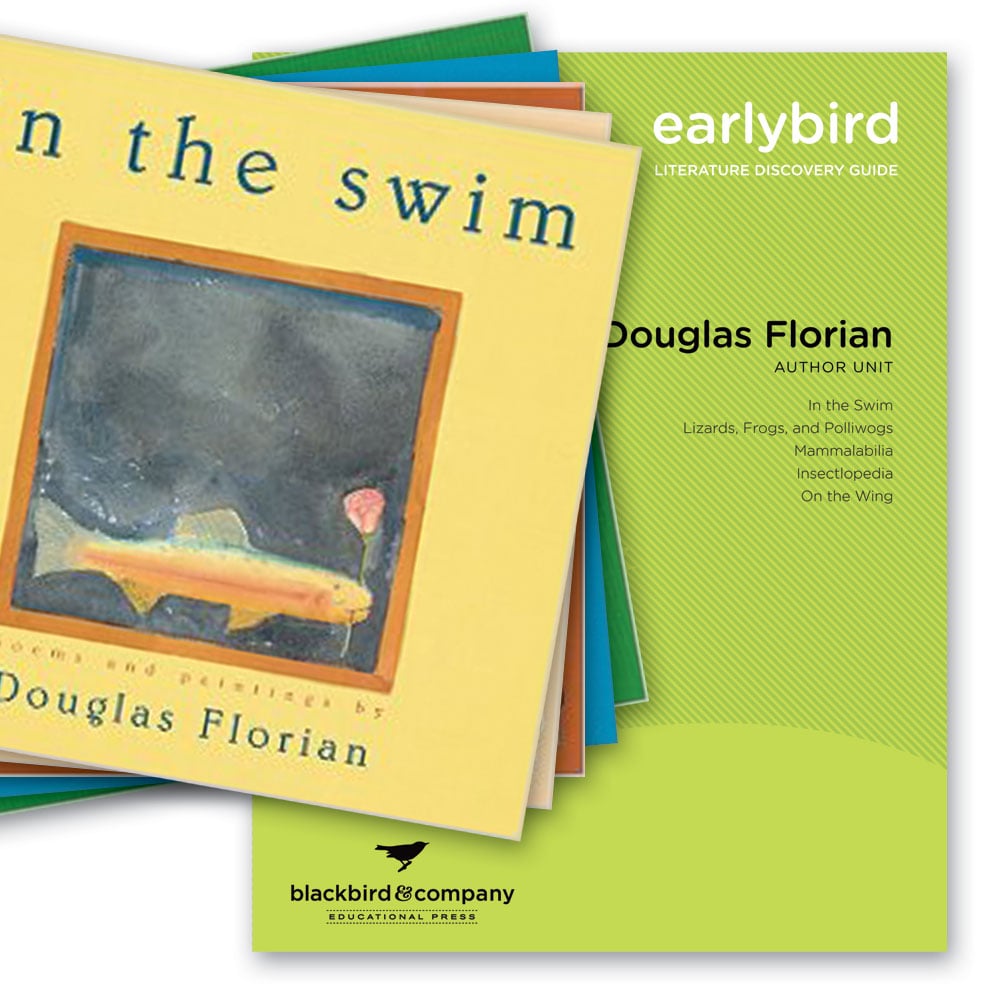
Week 1: In the Swim
Vocabulary
- spurt: to splash out quickly
- slimy: slippery and gooey
- colt: a young male horse
- regal: magnificent
- The frog’s skin has a slimy feel.
- My older brother likes to brag about how high he can jump.
- A spurt of water came out as I turned on the hose.
- The mother horse ran around the corral with her colt.
- Lucy’s red velvet cape made her look regal.
Vocabulary Usage in the Book
- In sporty spurts/It love to flutter/In its vain search/For peanut Butter. (Pg. 41)
- A snake is not/So smooth or slimy. (Pg. 13)
- You’re not a colt/Nor mare/Nor filly. (Pg. 17)
- Grand and gray/The regalray/Slyly glides/Upon its prey. (Pg. 24)
- We don’t wish to brag or boast/But we can fly along the coast. (Pg. 30)
Comprehension
- The catfish does not wish to be a cat because it is content to be a fish. (Pg. 6)
- Some people mistake eels for snakes. (Pg. 13)
- Sea horses don’t eat oats. (Pg. 17)
- Starfish do not have a brain. (Pg. 21)
- Flounders wait at the bottom of the sea on their smooth white side. (Pg. 25)
- Sharks do not fear the other fish. (Pg. 26)
- The fly fish can soar above a wave. (Pg. 30)
- The anglerfish has set a trap with its dangling, fleshy flap. (Pg. 34)
- The skinny skate are flat as plates. (Pg. 37)
- Jellyfish have tentacles that can paralyze. (Pg. 41)
- The tetra is a very small, minute, petite fish. (Pg. 46)
Week 2: Lizards, Frogs, and Polliwogs
Vocabulary
- rare: very uncommon
- roam: to go from place to place
- prey: animal’s live food
- dwell: to live or stay
- oval: a round shape, not a circle
- The roasted turkey was served on an oval shaped plate.
- The sleeping zebra became the lion’s prey.
- At the zoo we saw many rare types of snakes.
- Rabbits like to dwell in dark, small burrows.
- When we go to the beach, we like to roam and search for shells.
Vocabulary Usage in the Book
- Like glue it sticks and rarely falls. (Pg. 10)
- Across the ceiling it may roam/But don’t you try this in your home. (Pg. 10)
- With thirty feet to squeeze your prey, Python, you take my breath away! (Pg. 25)
- And if I wheeze/ Or sneeze,/Or cough,/The shell I dwell in/Won’t fall off. (Pg. 9)
- Brown with oval orange spots. (Pg. 45)
Comprehension
- Skinks are lizards that slink through grass. (Pg. 6)
- The tortoise is born with a shell. (Pg. 9)
- The gecko can climb up walls without falling. (Pg. 10)
- The poet does not want to be an iguana because they have spiny tails. (Pg. 14)
- The Komodo dragon is the largest lizard on Earth. (Pg. 18)
- The Gila monster has poison in his jaws. (Pg. 24)
- The python squeezes its prey. (Pg. 25)
- Chameleons are able to change color and are hard to find. (Pg 26)
- Polliwogs yearn to turn into a frog. (Pg. 30)
- The midwife toad carries eggs on its back. (Pg. 33)
- Red-eyed tree frogs hatch from eggs. (Pg. 41)
- Under their chins, spring peepers have a thin balloon to sing. (Pg.46)
Week 3: Mammalabilia
Vocabulary
- odd: strange or different
- grace: beauty and elegance
- trek: to take a journey on foot
- femur: a leg bone
- dine: to eat
- The ballet dance moved across stage with grace.
- During the summer, my uncle is planning to trek across the southwest United States.
- The old truck made an odd sound when we tried to start it.
- Mike plans to dine with his grandparents on his birthday.
- I broke my femur when I fell off my horse.
Vocabulary Usage in the Book
- Aardvarks are odd. (Pg. 6)
- A gentle giant/Blessed with grace… (Pg. 14)
- Rubber-necker/Double-decker/Cloud-checker/Star-trekker. (Pg. 37)
- In Madagascar leaping lemures breeze through trees without breaking femurs. (Pg. 34)
- On bark and leaves/It love to dine. (Pg. 45)
Comprehension
- The Bactrian camel has two humps. (Pg. 9)
- Coyotes are famous for their howl. (Pg. 13)
- The beaver stops streams by building dams. (Pg. 17)
- Otters love water. (Pg. 25)
- Elephants mostly eat grass. (Pg. 29)
- In Madagascar lemurs swing through trees. (Pg. 34)
- The giraffe has a double-decker, cloud-checker, star-trekker neck. (Pg. 37)
- The hippo swim by day to keep cool and eats grass at night. (Pg. 38)
- Boars are closely related to the pig. (Pg. 41)
- During the winter bear goes to sleep until spring. (Pg. 42)
- Porcupines like to eat bark and leaves. (Pg. 45)
- Tigers have fur that is striped. (Pg. 46)
Week 4: Insectlopedia
Vocabulary
- pupa: an inset in a cocoon
- dainty: delicate
- glide: to move very smoothly
- tip: the very end of something
- wince: to shrink back
- I watched the colorful marble slowly glide across the tabletop.
- The caterpillar transformed in a cocoon after eating a bunch of parsley.
- Touching the hot iron caused me to wince.
- Karen softly touched the baby mouse with the tip of her finger.
- My baby sister picked a bouquet of little dainty flowers.
Vocabulary Usage in the Book
- A pupa,/And checks out: Madame Butterfly – (Pg. 6)
- I am a widow-/I always wear black/From my eight dainty legs/To my shiny round back. (Pg. 18)
- We whirl,/we twirl,/we skate,/we glide. (Pg. 22)
- They skip/On tips/Of twigs/With ease. (Pg. 30)
- When blackbirds attack him,/From poison they wince. (Pg. 34)
Comprehension
- The hungry caterpillar will rest in a pupa becoming a butterfly. (Pg. 6)
- Dragonflies eat flies and bees. (Pg. 9)
- The praying mantis sits upon a twig. (Pg. 17)
- The black widow’s fangs carry venom. (Pg. 18)
- The Ioth moth’s spots ward off birds. (Pg. 21)
- Whirligig beetles twirl and glide on pond or lake. (Pg. 22)
- Wheeils are pests that drill holes in bolls of cotton. (Pg. 25)
- The walking stick is an insect that looks like a twig or stalk. (Pg. 26)
- Hornets are insects that build a pulpy paper nest. (Pg. 29)
- Mosquitos are rude insects that feast on you skin. (Pg. 33)
- Crickets make noise by rubbing each wing. (Pg. 41)
- The mayfly flies in May or June. (Pg. 46)
Week 5: On the Wing
Vocabulary
- hue: color
- hover: to float above
- mimic: to copy or imitate
- huddle: to stand close together
- crimson: dark red
- The tropical fish were a vibrant hue of green.
- On cold nights, we huddle close together.
- We watched the hummingbird hover over a flower.
- For fun, the twins often mimic each others movements.
- The ripe cherries were a crimson color.
Vocabulary Usage in the Book
- With feather of greenish hue/No doubt I’m difficult to view. (Pg. 9)
- Barely bigger than your thumb,/See it hover, hear it hum… (Pg. 14)
- My voice can mimic anything. (Pg. 25)
- …All huddled together/For warmth and protection,… (Pg. 33)
- For endless hours,/Serene we soar/Or glide/Or wheel/And what is more/Our crimson chests/We can inflate. (Pg. 13)
Comprehension
- The dippers are birds that are able to swim. (Pg. 10)
- Frigate birds are able to inflate their red chest. (Pg. 13)
- Hummingbirds are the size of a thumb. (Pg. 14)
- Roadrunners like to eat toads. (Pg. 21)
- The hill mynah can talk and sing. (P. 25)
- Royal spoonbills have noses shaped like a spoon. (Pg. 26)
- Emperor penguins gather on ice packs. (Pg. 33)
- The hawk’s eyes are keen and mean. (Pg. 34)
- The weavers build spacious nests using twigs and leaves. (Pg. 41)
- The stork has a bill as sharp as a knife or fork. (Pg. 42)
- The nightjar likes to hunt insects during the night. (Pg. 46)