“You can’t fit a square peg into a round hole”, my friend shared this idiom when I was trying to teach my daughter to read the traditional way I had been taught, despite her learning differences.
I remember feeling insulted. Then hurt. Then really, really sad. But during this process of feelings, I began opening my eyes, hearing and seeing my daughter and the beautifully different way she learned and approached the world. What was even more amazing was I started to discover the way I learned. Again, I went through feelings of pain and grief, for the little girl—me—that was not really seen or heard. For the little girl I was so hard on while I was in school, because I couldn’t understand why I couldn’t “get” certain things. I have lived through a lot of labels—most were given to me by me.
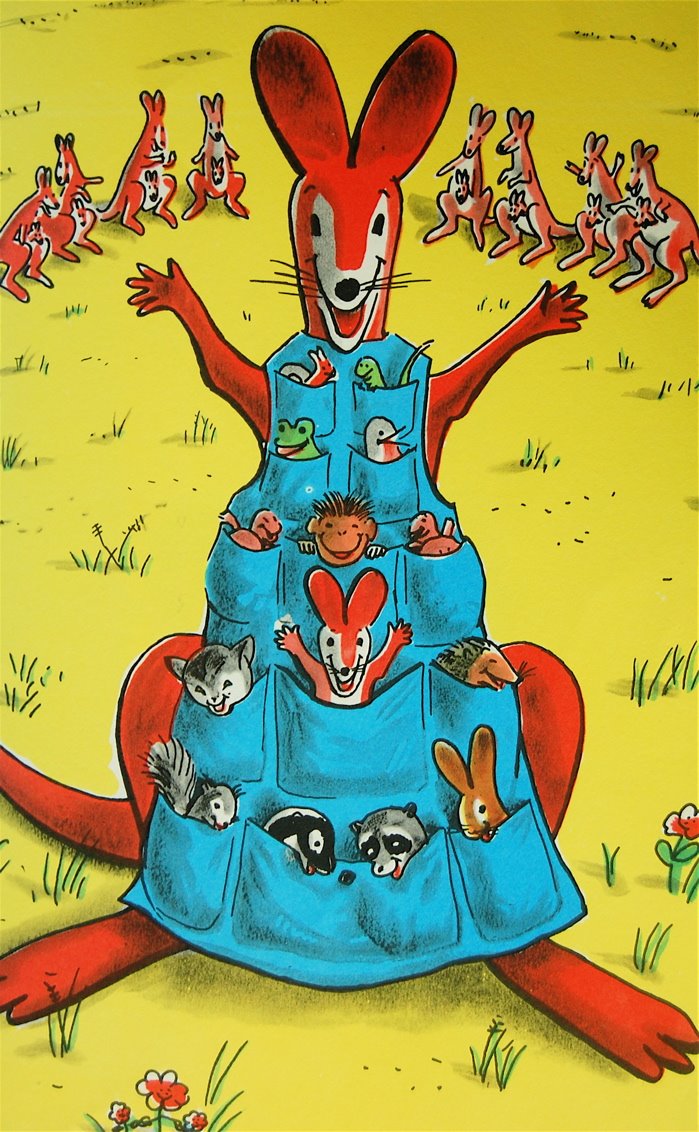
I was recently given the book, Katy No Pocket, by Emmy Payne. I had never read the book but it looked so familiar to me. I realized the illustrator is the author/illustrator of Curious George, who I grew up loving. I passed on that love to my children.
Katy, the Kangaroo, is sad—she has no pocket to carry her son, Freddy. She watches all the other mothers being able to pick up their children and carry them in their pocket. Katy cries. Her son Freddy cries. And then Katy has an idea. She is going to ask other animal mothers how they carry their babies. She starts with the Alligator that carries her child on her back. Katy tries this but realizes her sons’ legs are too short to wrap around. The monkey tells her to hold her baby in her arms, but that can’t work for her because her arms are too short. The search continued—lion cubs walked, birds were pushed out of their nest and flew. None of these worked for Katy. So, Katy went to visit the wise owl who told her to visit the city and buy a pocket. Katy did as the owl suggested. And who does she see walking down the street? The man with the apron with many pockets for his tools!
And, to the delight of children and adults alike, the man happily hands over his apron, dumping all the tools out of the pocket right there on the street! Katy is so happy. Her son Freddy pops right into a comfortable pocket in the front and she hops away.
When she returns home, she realizes she had enough pockets to help care for other young animals when they needed a lift or their moms are busy. Katy is generous.
And the story ends happily ever after because now, “SHE HAS MORE POCKETS THAN ANY MOTHER KANGAROO IN THE WORLD.”
I relate to this story of feeling different and searching for the answer. I am a differently-abled person. I have one arm. I wasn’t born without it, I lost it in an accident when I was 14 years old.
Every time I would do something new after I lost my arm, I would have to think of a new, creative way of to tackle the task. There was not a road map or someone to ask. I don’t know about you, but I haven’t met many amputees. Still, I gained confidence over the years after I lost my arm, realizing I would figure things out. Most of the time it simply took time and practice.
When I found out I was going to be a mom for the 1st time, it was 18 years after I lost my arm and I found myself really scared. I was studying other moms, and I saw them struggling with 2 arms, how in the world would I do this with one. My whole pregnancy, I watched, listened, read, and interviewed other moms looking for my missing pocket.
I had a friend who directed me to a support group for amputees. It was there that I met another mom, who had one arm and recently had a child. She starting writing to me and sharing what she did. To date myself, we became pen pals. I still have her letters and pictures to this day in my daughter’s baby album. She gave me my first apron, so to speak, but I had to make it mine. I bought and did some of the things she suggested. But I also did what came instinctually to me. Along the way I found apron extensions, I had a collection of slings that became my other arm to help hold my babies. I always had a canvas bag or a purse that rested across my body that held a drink or snacks. And like Katy, I found I could help by carrying other moms’ little ones as need be when I had an extra pocket.
I stopped looking outward for answers and looked within.
I stopped comparing what other people’s pockets looked like and started appreciating and sharing mine.
Flash forward to where we began….. mother of a child with learning differences. I realize I was doing many of the same things I did on my physical journey of finding my pockets. I was watching, listening, reading, and interviewing other moms on what their kids could do when it came to reading and writing. My beautiful daughter was coming up short. After traveling to mom to mom, asking what they did, someone directed me to the city. Maybe, just maybe, someone had my apron. I had my daughter evaluated, I learned that her learning differences had names. Her journey, her pocket, was going to look different. No one could give me the template or pattern. I stopped trying to copy someone else and instead met my mentors, learned some strategies, tips, listened to my daughter, and followed my own instincts. I found my apron extensions and tuned the rest of it out! In time, after working with my daughter, I can, at last, at share what I learned. I have some extra pockets for other moms out there still searching.
You can’t fit a square peg into a round hole, but you can create a place for the peg to fit. Blackbird & Company introduced to me the process of differentiation. I was able to place my daughter in the level that would meet her where she was at and build on those skills to ultimately build her confidence. In simple terms this means taking material and adapting it to meet your student where they are in their learning journey. Scaffolding them along the way, giving them training wheels, building stamina until they can take off and fly. I could break material into smaller sections for my daughter, dive deep into discussion, start with dictation and copy work, using the book as a teacher, a mentor, motivating her to write by using the personal writing prompts. My daughter learned to have a voice and knew what she had to say mattered.
Stories can help us learn about ourselves, make sense of our experiences, grow into who we want to be. The stories we tell ourselves about ourselves can sometimes clip our wings and at other times help us soar. We don’t need to learn or write like everyone else, there is no one “right” way. We need to find our own pockets, do our important work, and find our own voice in our own way.
“A bird doesn’t sing because it has an answer; it sings because it has a song.”
~Maya Angelou
~Clare B