
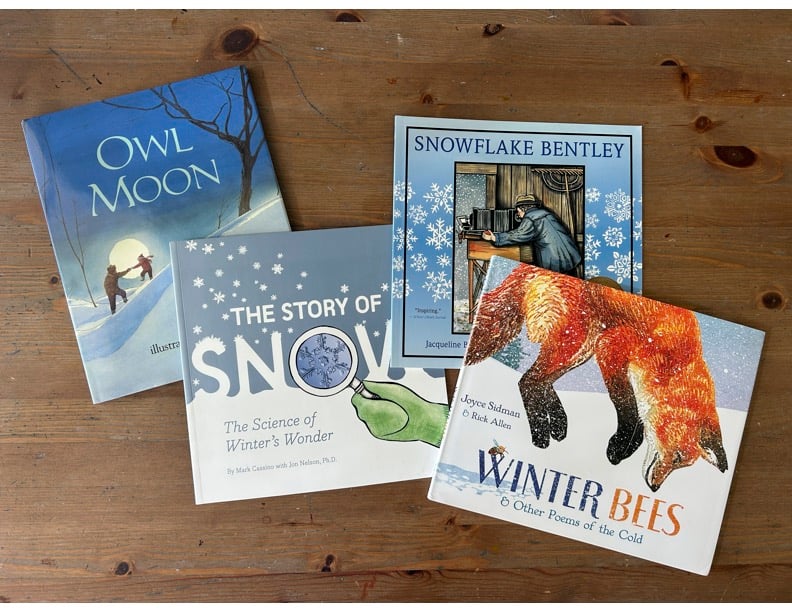
Welcome, folks, to the last few days of giveaway! You’ve experienced the sweetness of primary picture books and the elegance of elementary’s, so get ready for the magic of middle school’s illustrated stories! Though some middle schoolers might object that they’re too old for picture books, no one is too old to feed their fund of knowledge though visual wonder and well-crafted words—and our slew of middle school illustrated books do just that. From the delicate prose of Owl Moon to the scientific wonder of The Story of Snow, every reader can learn something new in these four lovely texts.
Read on for a synopsis of each book and for ways to use them as springboards for learning.
The Story of Snow by Mark Cassino with Jon Nelson, Ph.D.
When snow starts to fall, we’re often caught up with what that means for us—but what if snow itself had a story? In The Story of Snow, Cassino outlines how snow crystals form, starting with a cold speck that accumulates water vapor, freezes into ice, and grows into different shapes like stars, plates, and columns. Like humans, snow crystals have a lot of variation; no two are alike.
We chose this story because although the winter season can be dreary at times, there’s also a lot of natural wonder to be found there. The photographs of snow crystals within The Story of Snow are so detailed and delicate that one can’t help but feel dazzled by their elegance. The best part of the snow crystals? That they’re completely unexaggerated! After reading this book, turn to pages 32-33 to learn how to capture your own snow crystals in the next snowstorm or ski trip. Or, if snow isn’t in your near future, take a moment to cut your own snowflakes out of white paper, the six points of the paper snowflake paralleling how real ones form!
Owl Moon by Jane Yolen
When you go owling, you have to be quiet. And make your own heat. And be brave. At least, that’s what Pa always says. On the narrator’s first owling expedition with Pa, she follows her father into the cold, snowy, nighttime expanse of forest, silent and observant. “Whoo-whoo-who-who-who-whooooooo,” Pa calls. Sometimes you find an owl when you go owling, sometimes you don’t. Which kind of time will this one be?
Jane Yolen’s beautiful poetry and John Schoenherr’s soft, evocative illustrations dance together to create a peaceful, serene mood reminiscent of owling. The expertly crafted atmosphere makes the reader want to speak in a hushed voice, evokes feelings of awe at the splendor and solitude of this elusive bird. Once you’ve read this book with your student, set them out on a research journey to learn more about the Great Horned Owl. Research this creature’s habitat, food, and physical traits. Look up a video of the Great Horned Owl’s call and try your hand at it!
Winter Bees by Joyce Sidman and Rick Allen
Winter in the north is no joke. As temperatures drop below freezing and snow blankets the ground, each animal and plant must adopt a survival strategy to weather the extreme conditions. From the tundra swan’s 2,000 mile migration to the garter snake’s “hibernaculums” to honeybees’ hivebound huddle, each organism finds a creative way to make it to spring.
Winter Bees marries poetry to nonfiction prose on each page. Sidman gives us two lenses through which to marvel at the tenacity of nature: poems that capture the heart behind each creature and prose that communicate information. Between the two, readers leave with a deep appreciation for nature and a little bit more knowledge.
After reading Winter Bees, have your student write a free verse poem about an animal they’re interested in. Next to the poem, have them write a few complete sentences of facts about the animal. The prose and nonfiction should complement each other!
Snowflake Bentley by Jacqueline Briggs Martin and Mary Azarian
Wilson Bentley was born in 1865 in Jericho, Vermont. As a boy, he loved snow and found it beautiful. His mother gave him an old microscope, which he used to study ice crystals and other natural objects. When Willie was seventeen, his parents spent their savings and bought him a camera with its own microscope. Using this new tool, Willie photographed snow crystals and studied snowstorms; the photographs would be his gift to the world.
Picture book stories don’t have to be fantastical tales; they can also be biographies! And Snowflake Bentley is the perfect example. The story of Snowflake Bentley’s tenacity and pursuit of natural beauty is inspiring because it’s real. Illustrating his journey shows that even lived experiences can take on a magical quality—they’re not just relegated to fiction. After reading this book, discuss these questions: What qualities in the natural world are you interested in studying? What do you think the people in Bentley’s town thought about his interest in snow? What character traits helped Bentley become the leading expert on snow?
And with that, enjoy these lovely, snow-themed picture books! We hope you come to cherish them as much as we have.
We’ll plan to draw 3 winners on December 30 and announce them on December 31—a fun way to close out the year and start the new one with great books in hand. So stay tuned!
And remember, more actions = more chances for you to win! Click through and enter to win today!
~Claire