Posted on

How to Encourage Elementary Writers


How do students in 3rd Grade who are brand new to the paragraph form and still mastering foundational skills become unencumbered idea makers?

Incrementally and inspired by idea making, of course!

Writing is a creative habit that begins with an idea and ends with words on the page.

Over time, as students move into upper elementary (4th and 5th grade), with our CORE, they will become engaged in the work of learning to re-read their work, becoming friends with the red pen. Self-editing is courageous! Engaging in this process will bring shape to ideas which is precisely what enables them to press into and enjoy the process of writing.

And this habit, built over time, motivates students to write well!

Let’s explore how our CORE Integrated Literature and Writing units produce exceptional writers! Gain insight, tips, and encouragement.

Click through to watch a recording of the August Professional Development sessions with Mrs. B & Ms. Clare:

How to Edit Elementary Student Writing! 


~Kimberly


Posted on 1 Comment

How to Encourage Primary Writers

And the ability to tame an idea begins with some foundational skills introduced and practiced in the primary grades—Kindergarten, 1st, and 2nd!

Our Grade Level Collections include everything you need to introduce and reinforce phonics for reading and writing, plus a multitude of creative opportunities for idea making to motivate students in this important work.

Click through to watch a recording of the August Professional Development session with Mrs. B. & Ms. Clare. Be inspired this fall:

How to Encourage Primary Student Writing! 


~Kimberly

Posted on 1 Comment

The 5-Minute Conference

Five minutes are not to be scoffed at! It is amazing what can be accomplished during a 5-minute one-on-one writing conference with a student writer. Here’s how:

  1. Have the student read the rough draft aloud. Your job is to protect and promote the student writer’s idea. This is accomplished by listening and caring! It was tempting to ask this CORE Level 2 student to add more details to this tiny paragraph, but in listening (and in knowing where this student was in the process of skill acquisition), I realized that this type of “ask” would certainly be discouraging. So, first and foremost, do everything to listen and encourage.
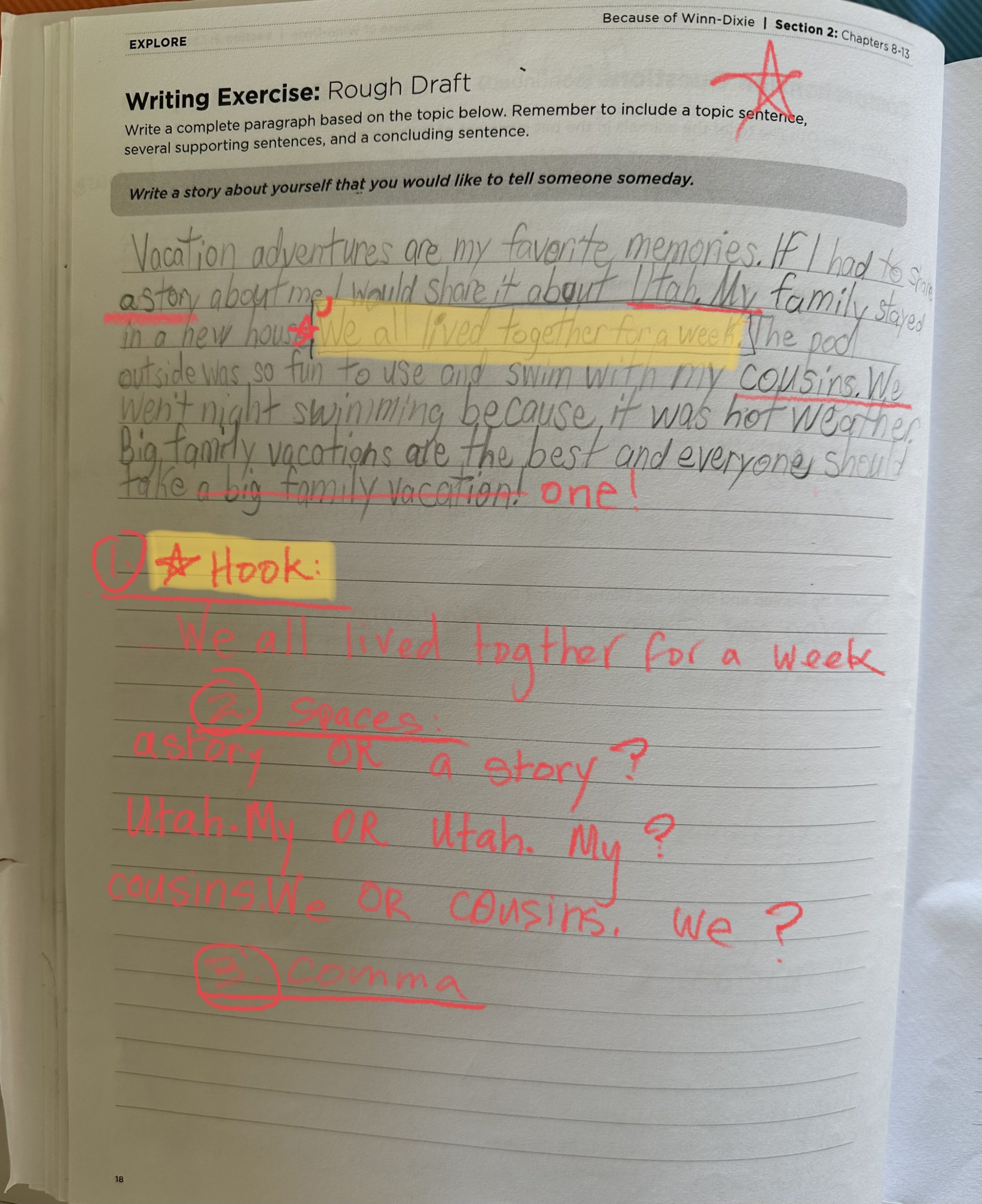
  2. Now choose your battles. I’m always on the lookout for opportunities to help students open their paragraphs with a sentence that will draw the reader into the idea. This paragraph needed a HOOK. Often students, once they begin flowing into an idea, will have a sentence that, with a little rearranging, is transformed into a terrific hook. This is the case with this Section 2 paragraph inspired by Because of Winn Dixie by Kate DiCamillo. While there is nothing wrong with the first sentence, it is certainly more intriguing to begin: We all lived together for a week.
  3. A simple skill that young writers can learn easily during the 5-Minute Conference is to leave space on the page—space between words, space between sentences, space at the margins. A trick I’ve learned is to remind students why space matters and I do this by demonstrating somewhere within the rough draft white space. As example I might say and write: “Do you mean ‘yummyapples’ or ‘yummy apples’ here?”
  4. There are no misspellings here, but there is an opportunity to add a comma in a sentence that is made up of a dependent and an independent clause. “The word ‘if’ is the clue, “I say to my student, “Can you hear where I pause after the word ‘me’ in this sentence?” And then I plop a red comma down, right where it should be: If I had to share a story about me, I would share about Utah.
  5. The twist at the end is set perfectly for a simple OMIT edit. I simply point out that the phrase “big family vacations” is used twice in this sentence and suggest omitting the last phrase and replacing it with a single word: one. The student loved this idea!

Not only were skills introduced, I guarantee these skills were mastered during this meaningful 5-Minute Conference.

[As an aside, just to prove my point, I read this student’s work and the above post aloud to myself. This took 3.5 minutes!

FIVE minutes, once a week will make all the difference in the world!


~Kimberly

Posted on

Editing Level 1 Writing, Part 2

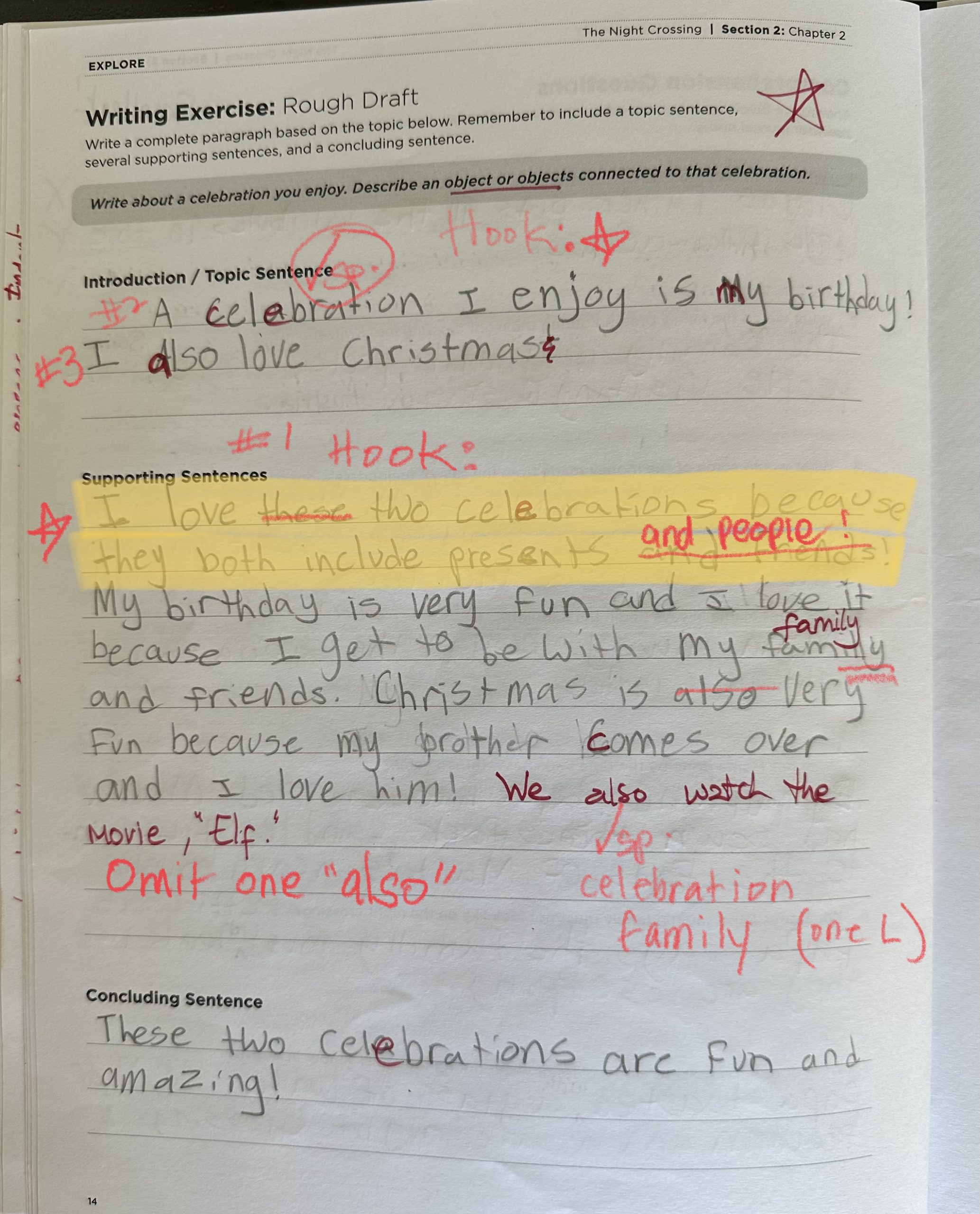
Here again is an example of a 3rd grade student’s weekly writing, this time tied to the story, The Night Crossing. While it was pointed out that the student didn’t describe an inanimate “object or objects” tied to Christmas or birthdays, it is clear in the writing that it is the people who make the celebrations special, even though the idea of “presents” is offered. These are the things that are important to notice as we shelter the ideas of young writers.

At this point in the year, this was the third Level 1 journal for this student, I had the student join me at my desk and read aloud what she wrote as I made little notes directly on her rough draft.

The HOOK

Often times, the student has crafted a terrific hook a sentence or two into the writing (sometimes we stumble upon it at the very end!). This one happened to be the second sentence. Instead of combining the two thoughts she wrote as topic openers, we decided to rearrange and punch the sentence with a little alliteration:

I love two celebrations because they both involve presents and people.

In doing so, I got to share with her the fact that writers love to inject sound into writing and, that putting words that begin with the same consonant together is called alliteration. And then I chanted: “Peter Piper picked a peck of pickled peppers…!” This lesson will likely stick more so than working through an unrelated worksheet exercise on alliteration. Why? Because this is the student’s original idea, it is meaningful, relevant.

Misspellings and Capitalizations

In this paragraph there are two misspellings. I noted them with a check mark and corrected them in a list in the white space of the rough draft. Capitalization mistakes were simply corrected as the student read and a reminder was made to copy capitalization correctly in the final draft.

What else…?

Instead of delving too deep into content changes, at Level 1, try to encourage details in the form of additions. What else do you do on birthdays? What else do you do to celebrate Christmas?

Omissions

Because the student used the word “also” in the “what else” idea, I suggested omitting “also” in the previous sentence.

Next week we might focus on word choice. For example, the concluding sentence, the TWIST at the end, might become more interesting with some added specificity of “fun” and “amazing” activities. But for this week, battles have been chosen! It’s time for the student to polish this little idea.

Ultimately, the goal with Level 1 writers is to shelter the idea of the young writer with editorial feedback to grow skills.


~Kimberly

Posted on

Editing Level 1 Writing, Part 1

There is a wide range of ability encountered when it comes to Level 1 writers as this post will demonstrate. Students entering the third grade who have been using our curriculum, have been introduced to the whole of phonics (for reading and writing), have acquired a large sight vocabulary (for reading and writing), and have been introduced to all four types of sentences—statement, question, command, exclamation. By the end of the second grade these students are confidently writing journals and simple stories. These students have been introduced to constructing the “Hook” in Storymaker, and understand it is the first sentence that gets any story started! These students are ready to embark on CORE Level 1.

But what happens when students jump into the program at CORE Level 1 who have not been using our curriculum?

When students encounter the weekly writing element in each section, they will be supported with a gentle scaffolding on the page to remind them that a paragraph has an introductory “topic” sentence (the HOOK), 3 supporting sentences, and a conclusion (the TWIST at the end).

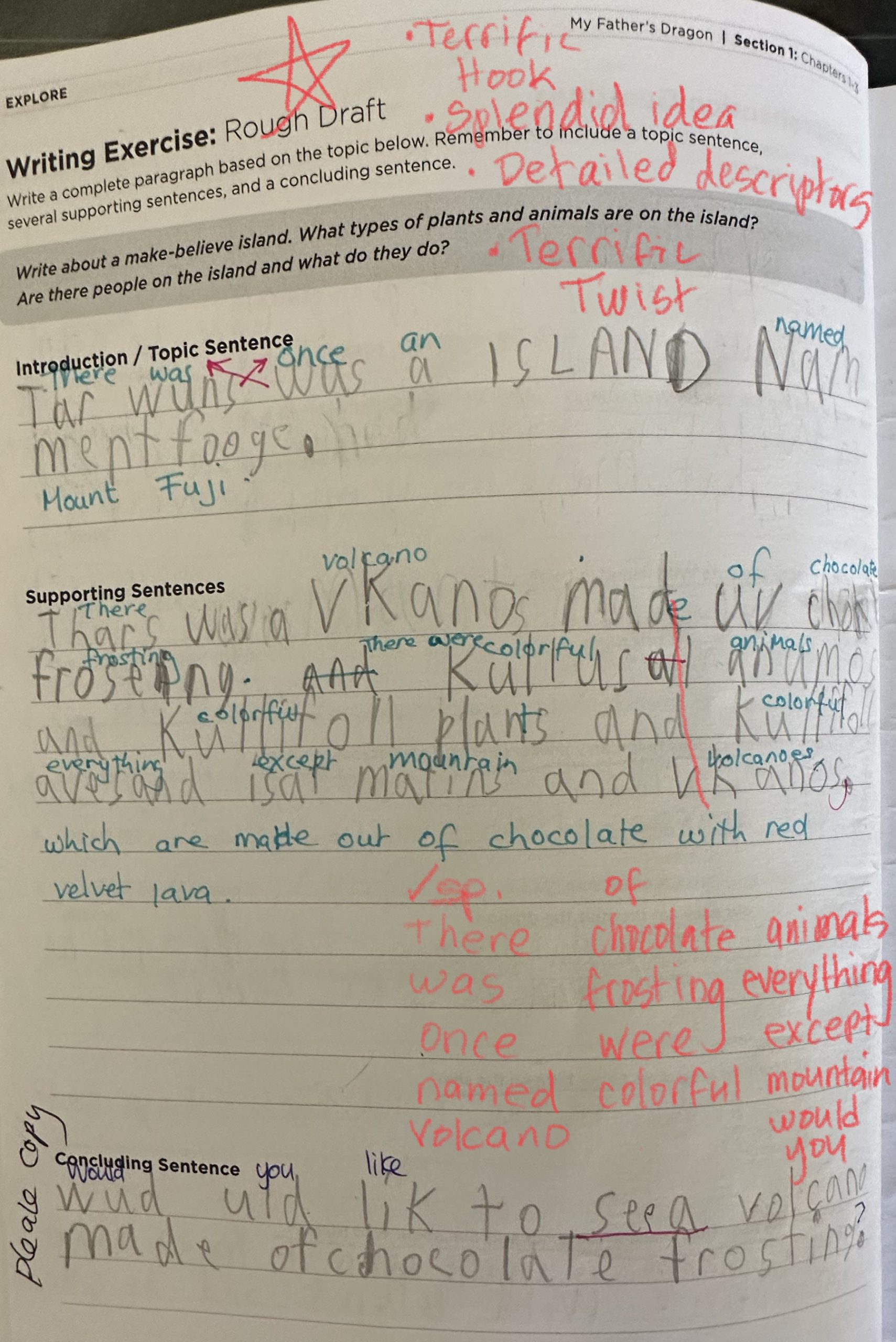
This student, who jumped into CORE Level 1 from another program straight out of 2nd grade, is a dyslexic child who was simultaneously remediating phonics. It was important to encourage him to write his ideas even though his skills were limited.. This process would only solidify burgeoning skills. Because he was eager and imaginative, this student had no problem using the phonics he had mastered to communicate a darling idea inspired by My Father’s Dragon!

Here’s what we see:

  • Able to copy the word island from the prompt
  • Able to encode consonant and short vowel sounds
  • Able to encode a few sight words: was, and, made, to

Most important is the fact that, despite being on tippy toes with skills, this student tenaciously pressed into composing a really outstanding idea!

How we approach the edit at this level:

With a young writer, it is best to write suggestions (which takes no longer than 5 minutes!) before sitting side-by-side with the student. Then we talk about what we just read. FOUR positives were offered in this case: 1) Terrific HOOK! and 2) Splendid idea! and 3) Terrific descriptors! and 4) Terrific Twist! Then and only then, after offering genuine positives (always possible to find), do I offer constructive edit suggestions. The most significant edit offered was to correct the spelling. In the last body sentence, I asked the child to tell me more about what the mountains and volcanoes were made of and simply wrote what was spoken. Next, I asked the student  to copy the paragraph with edits. This copy work exercise, because it is tied to an authentic idea, tends to improve the application of phonics skills not yet mastered, more than memorizing rules. This student, by the end of 3rd grade, was moving toward using conventional spelling more often than not.


~Kimberly

Posted on

Writing is NOT Calculus!

When we teach a student calculus, we are teaching them to attend to small parts of a larger form. The word calculus comes from the Latin, meaning small pebble.

When teaching our students to write, we should begin by teaching them writing is an art form!

So why have we turned the art of writing into a calculus?

Great writing never begins with capitalization, punctuation, or grammar!

Great writing begins with an IDEA!

This is the rule of art: Form Follows Function

Writers must focus first on the function or purpose of writing—the idea. Once the idea is drafted in rough form, the writer digs back in and applies mechanics—corrects misspelling, capitalization, punctuation, embellishes word choice, improves syntax, and so on. Writing is a process.

So, let me clarify, I’m NOT saying don’t teach capitalization, punctuation, or grammar.  I’m simply saying that primarily focusing on mechanics over and above actually constructing ideas will never produce exceptional writing.

The best way to learn to write is to WRITE.

Who, when asked to write a sentence about an apple, will begin like this: “I will need an interesting adjective, an adverbial phrase, plus a dependent and independent clause,” with a deep dive into grammar and mechanics and rhetoric? NO! You will pick up your pencil and you will write your idea! Once you get an idea on paper, you will, as time permits, reread and polish that idea—improving word choice here and there, possibly rearranging phrases, correcting spelling and capitalization and so on. Writing, like all art forms, requires that the writer engage in a process.

For the past 30 years, in addition to educating my own children (who are now thriving adult readers and writers), I’ve guided countless students through our CORE Literature and Writing Discovery Guides. And what I’ve learned is this:

The key to success over time?

Choose your battles.

Each week in the CORE Literature and Writing Discovery Guides, students will encounter a writing prompt inspired by the week’s reading. These prompts will require different types of responses utilizing different types or domains of writing—narrative, observational, imaginary, persuasive, and so on.

The weekly writing prompt will:

1) Allow students to write their ideas in a vast array of writing domains.

2) Move students through the process of constructing ideas, from draft to polished form.

3) Motivate students to engage in the work of idea making.

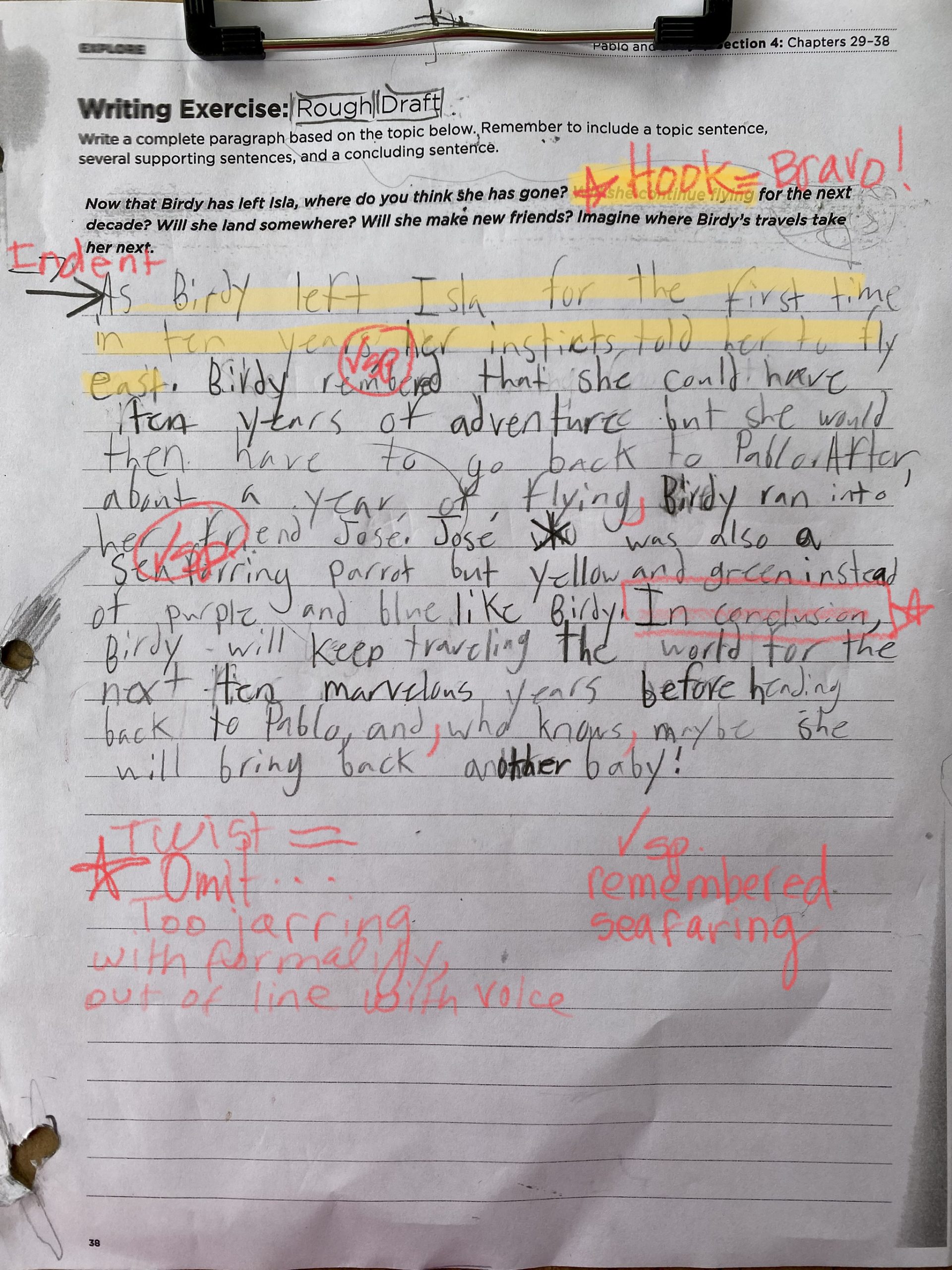
The best writing teacher is a mentor who encourages the student’s idea. This 4th grade student is responding to the Section 4 prompt in the Pablo and Birdy student guide. You can see by simply reading, that this young writer cares about the idea being constructed. You can see by examining the effort  made to communicate the idea coherently. Like any construction zone, this is messy, there are sections scratched out, there is scribble in the margin, there is darkened in pencil where spelling is being considered by the student writer. This is all GOOD!

How to Conference One-on-One:

During the 5-minute conference (keep it pithy), have the student read aloud what is written on the page. Use your red pen to make edits and suggestions as the work is being read aloud. For this paragraph, I focused on the following 4 topics:

The HOOK

This is something that is a focus each week, teaching students to open their idea with a sentence that moves beyond a “topic opener” toward a sentence that actually HOOKS the reader into the idea. This writer, who had been working in our CORE for over a year, opened this with a really well constructed, informative sentence—a terrific hook! What’s so great about this sentence? Consider that less experienced writers might write something like this:

Birdy left Isla to fly away.

This sentence is a very flat statement, lacking the detail that engages readers to read on. But this type of simple sentence is often where young writers begin. The goal of the teacher is never to re-write the hook, but rather to encourage the student to add details. Why did Birdy fly away? Where did Birdy fly? In the sentence written by this student, there is also a bit of intrigue in the phrase “for the first time in ten years” that makes the reader sense a bit of courage in the act of flying away!

As Birdy left Isla for the first time in ten years, her instincts told her to fly east.

Indentation

The indentation is a small, but constant reminder.

Spelling

I typically don’t make writers look up misspellings in a dictionary, but rather create a checklist in one of the white spaces on the rough draft. As the student reads I am checking misspelled words, then, as I discuss what I’ve discovered after the read, I make the corrected spelling list. There are two misspellings in this paragraph.

Twist at the End

The TWIST at the end has a bigger purpose than concluding. The last sentence of an idea should keep the idea in the reader’s mind to ruminate and ponder. With the phrase “in conclusion” at the beginning of this student’s Twist, the reader is jarred from the flow of the lovely narrative. Something about this phrase is out of sync with the rest of the voice. The phrase is formulaic. Simply omitting it transforms the last sentence:

(In conclusion,) Birdy will keep traveling the world for the next ten marvelous years before heading back to Pablo, and, who knows, maybe she will bring back another baby!

This statement is actually a rhetorical question, so the exclamation mark at the end is acceptable.

Imagine now this sentence with different syntax:

For the next ten marvelous years before heading back to Pablo, Birdy will keep traveling the world, and, who knows, maybe she will bring back another baby!

This rearranging was not offered because I felt the student’s sentence (minus “in conclusion”) was lovely as is. However, it’s always good to imagine possibility and to have many tricks up your sleeve!

Ultimately, if you can read, if you can enjoy an idea, and if you can be delighted in the potential of language, then roll up your sleeves and get into the garden!


~Kimberly

Posted on

Treasure Trove of Words

Exploring vocabulary is so much more than an activity to check off the list! Words are the building blocks of language, are what we humans use to communicate our ideas, and each one holds certain specificity.

Specificity is a pairing of  the word “specific” (clearly defined) + the suffix “ity” (quality or state of being).  So, this word, which arrived on the scene via the French word spécifique back in the 1600s, means  to hold a special quality.

With this in mind, using a handheld dictionary becomes an adventurous treasure hunt. Students working in our CORE Literature and Writing Discovery Guides will, each week, explore a handful of singular words from the week’s reading. There are many skills embedded into this complex activity beyond the obvious, vocabulary development. The act of searching for a word in an alphabetized catalog reinforces spelling skills, strengthens the ability to problem solve, and fortifies focus. Of course, this process of working for meaning and applying new knowledge, more than anything else, sets this word into stone in the mind’s eye, and places it into a growing treasure chest of words.

This student, who was working in a Level 2 unit tied to Inside Out and Back Again, did a terrific job looking up each word in a held-by-hand Oxford English Dictionary. All of the definitions were copied accurately. Next came the difficult part, using each new word in a new way.

By the time students reach this level (4th and 5th grade), they have worked through Earlybird and Level 1 units and have had this exercise modeled for them. Still, using a word in a new context is a really difficult writing skill. But it is a skill that will empower students to write their ideas with specificity!

Notice the way this student used the word “flecked” below. Even though the definition of the word is correct, the sentence demonstrates the meaning has been confused with the word “flicked” meaning to propel something with a sharp movement. One way to support the student, is to provide an example: flicked the flecked stone. Another trick, is to send the student back to the dictionary to copy the phrase that is used to demonstrate the word in a context. Here the phrase was: whitecaps flecked the blue sea. Encourage the child to craft the phrase into an original sentence. For example: Yesterday at the beach whitecaps flecked the blue sea.

Here’s a peak at the Vocabulary Section from our Level 2 Guide tied to Because of Winn Dixie completed by an end-of-year 4th grader who is delightfully engaged in the treasure hunt and confidently using new words in golden ways!

Using our Earlybird through Level 3 CORE Literature and Writing Discovery Guides, students will explore more than 100 words per year, adding significant treasure that possesses specificity. This will serve them well as they engage in the work of constructing their ideas!


~Kimberly

Posted on

Person, Place, Thing: Writing Beyond the Noun

WE ARE HAPPY TO WELCOME OUR BRAND NEW UNIT:

Advanced Composition: Person, Place Thing as Long Form Research

Our unique scaffolding guides 11th and 12th grade students over the course of 30 weeks, each step of the way, in the process of researching and writing a long-research paper. This creative non-fiction project is an opportunity for high school students to participate in literary writing before heading to college.

While students will use the scaffolding twice (in both 11th and 12th grade), each paper will be unique depending on the topics chosen. Each year students will choose a theme that they will explore through a person, a place, and a thing. For example, our student sample explores the theme of tragedy via Abraham Lincoln, Terezin, and escalators. Another student might want to explore joy via Henri Matisse, Disneyland, and the yo-yo. Still another might tie hope to Emily Dickinson, the library, and feathers. The possibilities are endless! And because the topic is the student’s choice, and the work is scaffolded incrementally, the 30-week project is not overwhelming. Quite the contrary, students will rise into this work!


So click through to pick up your brand new copy just in time for the coming school year.

Posted on

Let’s Talk Grammar

Grammar is simply the study of how words combine to form sentences. Words are like putty, they can change purpose depending on how they combine with other words in the context of a sentence. Grammar is complex and essential.

But grammar does NOT come first.

So let’s talk grammar.

Once upon a time I had a conversation with a fellow educator who believed that, if we simply gave young children quality art supplies—Windsor Newton paints, sable brushes, stretched canvas—and let them explore, they would create little masterpieces. Certainly not the kind that would hang in the Louvre, but she truly believed children would learn art-making via materials. This is NOT the case.

Learning an art form involves work.

Work is the only path to beauty.

There is no shortcut.

Visual arts, music, dance, woodwork, knitting, weaving, and more fall into this category. Each art form is founded with unique elements of grammar. Line, shape, texture, value, and color are the grammar of visual art. Melody, harmony, rhythm, texture, timbre, and dynamics are the grammar of music. Body, action, space, time, and energy for dance. Within each art form, the artist who has mastered the grammar, is able to use that grammar to bring shape to an original idea. Think Mona Lisa. Think Beethoven’s 5th Symphony. Think Balanchine’s Nutcracker. Think Shakepeare’s Romeo and Juliet. All these works of art began with an original idea. Writing is an art form that always begins with an original idea.

Art is never born of grammar first.

Art is always idea first.

Grammar is simply at the disposal of the artist. Form follows function. Function is rooted in the idea itself. Function is the reason the art maker is motivated to make art. Form, or grammar, simply enables the artist to bring shape to the idea.

When it comes to writing, who of us, when we want to write an idea in sentence form, ask: “Which preposition should I begin with and which verb would best demonstrate the action of the noun?”

No one, right?

Rather, being honest to our idea, we writers grab hold of its ethereal nature and courageously lift our pencil, scribbling the shape of our idea as best we can. Because we have read widely, learned to appreciate words, have a good understanding of grammar as tool, we can courageously craft. Once we have a sentence on paper, we are able to re-read, edit, and polish. This is the process of writing. This is art making.

Elements of English Grammar:

The Alphabet / Phonics – the building blocks, 26 letters that independently and in combination imitate the 44 sounds of spoken English

Words / Parts of Speech – noun, verb, adjective, adverb, article, preposition, conjunction, pronoun

Clauses – both dependent, independent

Punctuation – period, question mark, exclamation point, comma, semicolon, colon, em dash, en dash, hyphen, parentheses, brackets, braces, apostrophe, double quotation marks, single quotation marks, and ellipsis

Syntax – The way that writers arrange words and phrases in a sentence adds poignancy and pleasing poetic flavor.

The moon whimsically sang as the stars twinkled a tune in the night sky.

Whimsically, the moon sang as the tune of the stars twinkled in the night sky.

Even more, changing the position of even one word, can change the meaning of the entire sentence.

Only Sandra eats oats. 

Sandra only eats oats. 

Pablo Picasso once said, “Learn the rules like a pro so you can break them like an artist.”

It takes many, many years to use the rules like a pro, this does not mean that all those years should be spent entirely memorizing rules. Students of writing should be writing more than participating in grammar exercises disconnected from meaningful ideas. Students of writing should be actively engaged in the art of idea making followed by the exercise of learning how grammar might best serve their idea. Form follows function.


~Kimberly

Posted on

Around the Campfire: Essays and Tigers and Poetry, Oh My!


Let’s talk middle school.

In our CORE materials for middle school—Level 3 Reading & Writing Discovery Guides—students will continue the good work of writing ideas  they began in the Level 1 & 2 units.  With Blackbird & Company, your middle school students will develop the skills and confidence that will prepare them for high school reading and writing.

Tip #6

LOVE the red pen.

All writing comes into being through a process:
1. First comes the IDEA. Without an idea, the writer will simply stare at the blank page.
2. Once there is an idea in the mind of the writer, the pencil steps in to translate thoughts to words on the page.
3. When the pencil’s work is complete, the job of the writer is to become a reader. Encourage your students to RE-READ everything they write.
4. Empower students to use the RED pen as they re-read. Teach them to use strong words, to fearlessly re-arrange, and not be afraid to strike through.
5. Polish the draft, preferably in cursive…

Tip #7

Write in cursive!

Writing with a pencil by hand is a foundational skill. But it’s also a beautiful endeavor. I have fond memories of learning to form the ABCs in cursive. This work was quiet, slow, and mysterious. Yes, mysterious. My grandmother, who raised me, wrote little notes by hand and left them in various places around the house to my great delight. Her cursive was one of a kind, a lovely extension of her loving self.  It was not like any other by-hand note I’ve ever encountered in life. That’s the thing about penmanship. Penmanship is personal.

Tip #8

Essays are ideas!

An essay by definition is an attempt or endeavor. An essay is an exploration of an idea, a meandering journey like following a river. An essay is an opportunity to simultaneously explore an idea and to navigate your reader through its wonder. Great essays have the power to encourage, empower, and enlighten. For this reason essay writing should never be treated as a mechanical endeavor, but rather,  a pathway for the writer to communicate the depths of the heart and mind.

BIG ideas can be communicated through a range of forms. The essay is a specific form. But often students hear the word and suddenly experience writer’s block! Some become frozen by fear. This should not be the case! Remind students, an essay is simply an opportunity to explore an idea in more depth.

Introduction to Composition: The Essay, for  middle school students, provides the scaffolding that will enable students to shape meaningful essays.

Tip #9

Read poems // Write poems

T.S. Eliot said: “Genuine poetry can communicate before it is understood.”

Poetry is a close cousin to visual art. Poetry is an opportunity to paint—to paint with words. Writing poetry helps students not only learn that words have specificity, but that sometimes less is more. Writing poems help students discover, when it comes to words, possibility is vast. But the best lesson learned is this: it is always better to SHOW versus tell.

The snow is white.

Or

Winter wind gently lifts sparkling flakes, little rainbows floating and drifting around my head.

Your middle school students will discover the delight of reading poetry and the craft of writing poems as they are guided through Exploring Poetry.


~Kimberly