
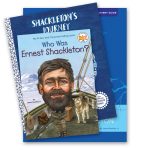
IMPORTANT: Comprehension questions will be in chronological order as you read through the story. Page numbers are approximate, and will vary with different editions of the book.
Section 1: Early Life
Character Lexicon
- adventurous: willing to take risks or try out new methods, ideas, or experiences
- imaginative: having or showing creativity or inventiveness
- self-aware: having conscious knowledge of one’s own character and feelings
- hardworking: (of a person) tending to work with energy and commitment; diligent
- leader: the person who leads or commands a group
Comprehension Questions
- A log on the lawn of his house in Ireland, was Ernest’s first ship. (Ch. 1, pg. 6)
- The Boys Own Paper, gave Ernest some of his adventure ideas. (Ch. 1. pg. 9)
- Ernest got his first apprenticeship in 1890 at the age of sixteen. (Ch. 1, pg. 12)
- Ernest sailed to the countries of Chile, India, and Mauritius. (Ch. 2, pg. 14)
- Emily Dorman and Shackleton shared the similarities of being part of a large family, and sharing a love of poetry and museums. (Ch. 2, pgs. 16 – 17)
- The event that changed Shackleton’s life was reading an article that appeared in a newspaper about Scott’s expedition to the South Pole. (Ch. 2, pg. 17)
- On Scott’s expedition Third Lieutenant Shackleton oversaw the ship’s supplies and the crew’s entertainment. (Ch. 3, pg. 19)
- After the expedition was completed Scott and Shackleton were rivals, Scott felt that Shackleton had not been strong enough for the trip and Shackleton felt Scott was not a good enough leader. They did not part as friends. (Ch.3, pg. 27)
Section 2: Life’s Work
Character Lexicon
- determined: able to make a firm decision and being resolved not to change it
- faithful: remaining loyal and steadfast
- pragmatic: dealing with things sensibly and realistically
- despondent: in low spirits from loss of hope or courage
- dissatisfied: not happy or content with something
Comprehension Questions
- Ernest convinces Emily that a second trip to Antarctica will benefit the family as he will earn a fortune when he returns by writing a book and giving talks. (Ch. 4, pg. 34)
- Shackleton and his men were 97 miles from the South Pole when they planted the British flag. (Ch. 4, pg. 41)
- In March 1912, Shackleton heard the news that Roald Amundsen had reached the South Pole, this news changed Shackleton’s plans, he now planned to walk across the entire continent of Antarctica! (Ch. 5, pg. 45)
- Ernest renamed the ship Endurance because it was part of his family motto, “By endurance we conquer.” (Ch. 5, pg. 50)
- In Argentina, Shackleton and Endurance unexpectedly picked up a young stowaway, Perce Blackboro. (Ch.6, pg. 53)
- The Endurance was trapped in ice and unable to continue its journey. (Ch. 6, pg.59)
- On November 21st, 1915, the power of the ice crushed Endurance and caused it to sink. (Ch. 6, pgs. 63 – 64)
Section 3: Later Life and Legacy
Character Lexicon
- courageous: not deterred by danger or pain; brave
- unwavering: steady or resolute
- role-model: a person looked to by others as an example to be imitated
- persistent: continuing firmly or obstinately in a course of action despite difficulty or opposition
- restless: (of a person or animal) unable to rest or relax as a result of anxiety or boredom
Comprehension Questions
- Once the warmer weather had melted the ice and revealed the water, Shackleton and his crew planned to use the lifeboats to reach nearby islands. (Ch. 7, pg. 66)
- After working hard all-day Shackleton and the crew played soccer and had dogsled races. (Ch. 7, pg. 66)
- The crew hunted seals and penguins to eat. (Ch. 7, pg.70)
- Shackleton packed 27 crewmembers into the three lifeboats. (Ch. 8, pg. 74)
- Although the crew landed on Elephant Island this did not help them as it was uninhabited. (Ch. 8, pg. 77)
- After 36 hours of continuous hiking Shackleton, Crean and Worsley heard the sweet music of a steam whistle blowing from a whaler’s camp. (Ch. 10, pg. 87)
- Schools began to study the life of Ernest Shackleton in the late 1990s because his leadership and teamwork skills were considered so good that many corporations used his ideas. (Ch. 11, pgs. 96-97)