IMPORTANT: Comprehension questions will be in chronological order as you read through the story. Page numbers are approximate, and will vary with different editions of the book.
Section 1: Early Life
Character Lexicon
courageous: not deterred by danger or pain; brave
mischievous: showing a fondness for causing trouble in a playful way
inquisitive: curious or inquiring
unique: being the only one of its kind; unlike anything else
stoic: a person who can endure pain or hardship without showing their feelings or complaining
Comprehension Questions
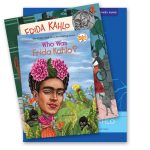
The words that Frida kept in her head and heart throughout her life were, “Viva la vida!” “Long live life!” (Who Was Frido Kahlo? pg. 1)
As a child Frida was curious to learn about the history, art, and architecture of her country and about nature and science. (Ch. 1, pg. 8)
As a child Frida recovered from polio, but it stunted the growth of one of her legs and because of this she was given the nickname “peg leg.” (Ch. 1, pg. 11)
Frida had a photographic memory, which meant that she could picture something in her head after she had seen or read it and this helped her earn good grades. (Ch. 2, pg. 13)
Although both her father and grandfather had been photographers, Frida loved science and math and hoped to become a doctor. (Ch. 2, pg. 15)
Frida was expelled from school because of the crazy things she did to Diego Rivera, a teacher at her school. She called him “old Fatso,” stole food from his lunch box, and put soap on the stairs to see if he would fall. (Ch. 2, pg. 23)
While recovering from the terrible streetcar accident, Frida borrowed her father’s paints and taught herself to paint. (Ch. 3, pg. 29)
Frida liked to paint things and people that were familiar to her and she wanted to paint things she loved about her country. (Ch. 3, pg. 31)
Section 2: Life’s Work
Character Lexicon
bold: showing an ability to take risks; confident and courageous
compassionate: feeling or showing sympathy and concern for others
homesick: experiencing a longing for one’s home during a period of absence from it
passionate: showing or caused by strong feelings or a strong belief
industrious: diligent and hardworking
Comprehension Questions
When the artist Diego Rivera saw Frida’s self-portrait, he described her as talented and original. (Ch. 4, pg. 40)
When Frida and Diego fell in love, her father called them the “elephant and the dove,” because Diego was so big and round and Frida was small and delicate. (Ch. 4, pg. 42)
After Frida and Diego were married, she didn’t paint much as she believed it was her job to take care of him as he was working such long hours. (Ch. 5, pgs. 47-48)
Living in New York with Diego and having a good time was upsetting to Frida because it was the Depression, and many people were unemployed and hungry. (Ch. 5, pgs. 56-57)
Frida did some of her paintings on metal or wood rather than on canvas as painting on these was popular in Mexican folk art and she wanted to show the importance of her country and culture in her art. (Ch. 6, pg. 64)
Frida was unable to have children because of the injuries she had received from the streetcar accident. (Ch. 6, pg. 65)
Julian Levy saw Frida’s work at the National Autonomous University of Mexico and he asked her if she would like to exhibit her work in his gallery in New York City. (Ch. 6, pg. 68 – 69)
Section 3: Later life and Legacy
Character Lexicon
resourceful: having the ability to find quick and clever ways to overcome difficulties
fearful: feeing afraid; showing fear or anxiety
independent: free from outside control; not dependent on another’s authority
fragile: easily broken or damaged
flamboyant: (of a person or behavior)tending to attract attention because of their exuberance, confidence
Comprehension Questions
At the opening of her exhibit Frida dressed in traditional Mexican clothing and jewelry and wore bright colored ribbons in her hair. She looked like a piece of artwork herself. (Ch. 7, pg. 72)
Frida didn’t want to be labeled a surrealist because she never painted dreams but painted her own reality. (Ch. 7, pg. 74)
The Louvre purchased a painting by Frida, making her the first 20th-century Mexican artist to have a painting purchased by the museum. (Ch. 8, pg. 83)
When Diego visited Frida in hospital in San Francisco, they realized that they missed each other terribly and decided to remarry. (Ch. 9, pg. 90)
Frida taught 12 classes a week at the newly established School of Painting and Sculpture. (Ch. 9, pg. 92)
To help herself deal with the pain and boredom of recovering from more surgeries, Frida started to keep a diary. (Ch. 9, pg. 94)
Although very sick, Frida wanted to attend her first solo exhibit in Mexico, so her bed was loaded onto the truck and set up in the center of the gallery. (Ch. 9, pg. 96)