
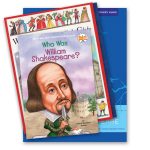
Section 1: Early Life
Character Lexicon
- enigmatic: difficult to interpret or understand; mysterious
- hardy: robust; capable of enduring difficult conditions
- fickle: changing frequently, especially as regards one’s loyalties, interests, or affections
- creative: relating to or involving the imagination or original ideas, especially in the production of artistic work
- hardworking: (of a person) tending to work with energy and commitment; diligent
Comprehension Questions
- When Will was only a few months old the black death hit the town that he and his family lived in but they survived. (Ch. 1, pg. 7)
- Will went to school six days a week and a school day was twelve hours long! (Ch. 1, pgs. 18 – 19)
- In school Will learned to read and write in Latin, perform in plays and debate. (Ch. 1, pgs. 20 – 21)
- After William finished school, it is thought he might have become an assistant teacher, a clerk for a lawyer or become an apprentice in his father’s leather business. (Ch. 1, pg. 25)
- William’s marriage to Anne Hathaway was unusual as there was an age difference between them. Anne was eight years older than William. (Ch. 2, gs. 26 – 27)
- No one knows exactly why Shakespeare left his family, but it could have been he was kicked out of town for hunting rabbits on someone’s land or that he joined a troupe of actors as a way to make money for his family. (Ch. 2, pgs. 28 – 29)
- The years 1585 – 1592 are known as William Shakespeare’s lost years as nothing is known about what he was doing during this time. (Ch. 2, pg. 30)
Section 2 Early Career
Character Lexicon
- bold: showing an ability to take risks; confident and courageous
- unique: being the only one of its kind; unlike anything else
- fortunate: favored by or involving good luck or fortune; lucky
- observant: quick to notice things
- talented: having a natural aptitude or skill for something
Comprehension Questions
- Theaters became popular in London because Queen Elizabeth I loved plays and often had troupes perform at court, which made theater going an acceptable pastime in London. (Ch. 3, pgs. 40 – 41)
- To write his verse flow Shakespeare used blank verse also known as iambic pentameter. (Ch. 3, pgs. 41 – 42)
- Shakespeare’s first jobs when he joined the theater were tending theatergoers’ horses, selling theater tickets, prompting and helping actors with their lines. (Ch. 3, pgs. 43 – 44)
- Most playwrights at this time wrote about ancient Greece and Rome whereas Shakespeare wrote about English kings and wars. (Ch. 4, pg. 49)
- Shakespeare’s characters made his plays interesting by writing complex characters who had flaws, goodness and traits that made the human and relatable. (Ch. 4, pg 54)
- While theaters were closed because of the plague, Shakespeare took up his quill and began writing poetry. (Ch. 5, pg. 62)
- William Shakespeare was able to write full-time because of the patronage of the Earl of Southampton and the publication of poems by John Harrison. (Ch. 5, pgs. 63 – 64)
Section 3 Later Career
Character Lexicon
- entrepreneur: a person who organizes and operates a business or businesses, taking on greater than normal financial risks
- courageous: not deterred by danger or pain: brave
- determined: having made a firm decision and being resolved not to change it
- resourceful: having the ability to find quick and clever ways to overcome difficulties
- brave: ready to face and endure danger or pain; showing courage
Comprehension Questions
- When William joined the Lord Chamberlain’s Men, he invested his money into the troupe and became part owner as well as an actor and a playwright. (Ch. 6, pg. 66)
- Shakespeare’s theater troupe moved to The Curtain because although they owned the theater building, they did not own the land and the landlord raised their rent to an amount they could not afford. (Ch. 6, pg. 71)
- Queen Elizabeth I enjoyed the character of Falstaff so much that she asked Shakespeare to write a play around him. The play he wrote was The Merry Wives of Windsor. (Ch. 6, pg. 75)
- During the Christmas season of 1598, Shakespeare and his workman dismantled the theater that was his and reassembled it on land in Southwark and named it The Globe. (Ch. 7, pgs. 76 & 78)
- The flags atop The Globe told the people which type of play was being performed. A black flag announced a tragedy, white a comedy and a red a history play. (Ch. 7, pg. 78)
- The Tempest is a significant play because it is the last play he wrote alone and the only play in which he didn’t borrow the story from someone else. (Ch. 8, pg. 97)
- Even though Shakespeare lived over four hundred years ago his plays and poetry still make us laugh, cry and dream. (Ch. 8, pg. 100)