

I’ve never met a child who doesn’t have imagination. But, tragically, I’ve met many a child who is deprived of the tools that allows the imagination to play via pencil on paper.
I occasionally cross paths with older students struggling to read. But when it comes to crossing paths with students who are struggling to write, I am bombarded!
I wholeheartedly believe that we should be teaching students phonics for BOTH reading and writing from an early age. We should be offering our kindergarten students beautiful books and the best technology for learning—the pencil!
Ted Hughes opens the tale of The Iron Giant like so: “How far had he walked? Nobody knows. Where had he come from? Nobody knows. How was he made? Nobody knows”.
The sentences are simple. True. However, in this gorgeous opening, the author creates an atmosphere of mystery. We want to read on. There is rhythm in the way he ordered his Question / Statement pairs.
Our 3rd graders should be reading and considering wonderful passages such as this one. And these passages should be sparking ideas in their mind.
Our methodology begins in kindergarten and progresses through high school. Students will begin their English Language Arts journey learning and practicing and mastering phonics for both reading and writing. In the second grade they will be equipped to begin a tradition of reading great stories independently, journaling ideas along the way. By the time the child reaches 3rd grade, it’s time to read gentle literary chapter books like The Iron Giant and journal their way through the story, composing a hearty paragraph sparked by imagination every single week.
But what happens when the student is not taught the important relationship between reading and writing? What happens when a child’s imagination is left behind gasping for breath?
Recently I received the following writing sample from an upper elementary student. The teacher shared that this sweet human told her she had no idea how to use paragraph form and that she went on to ask, “Should I use punctuation?”
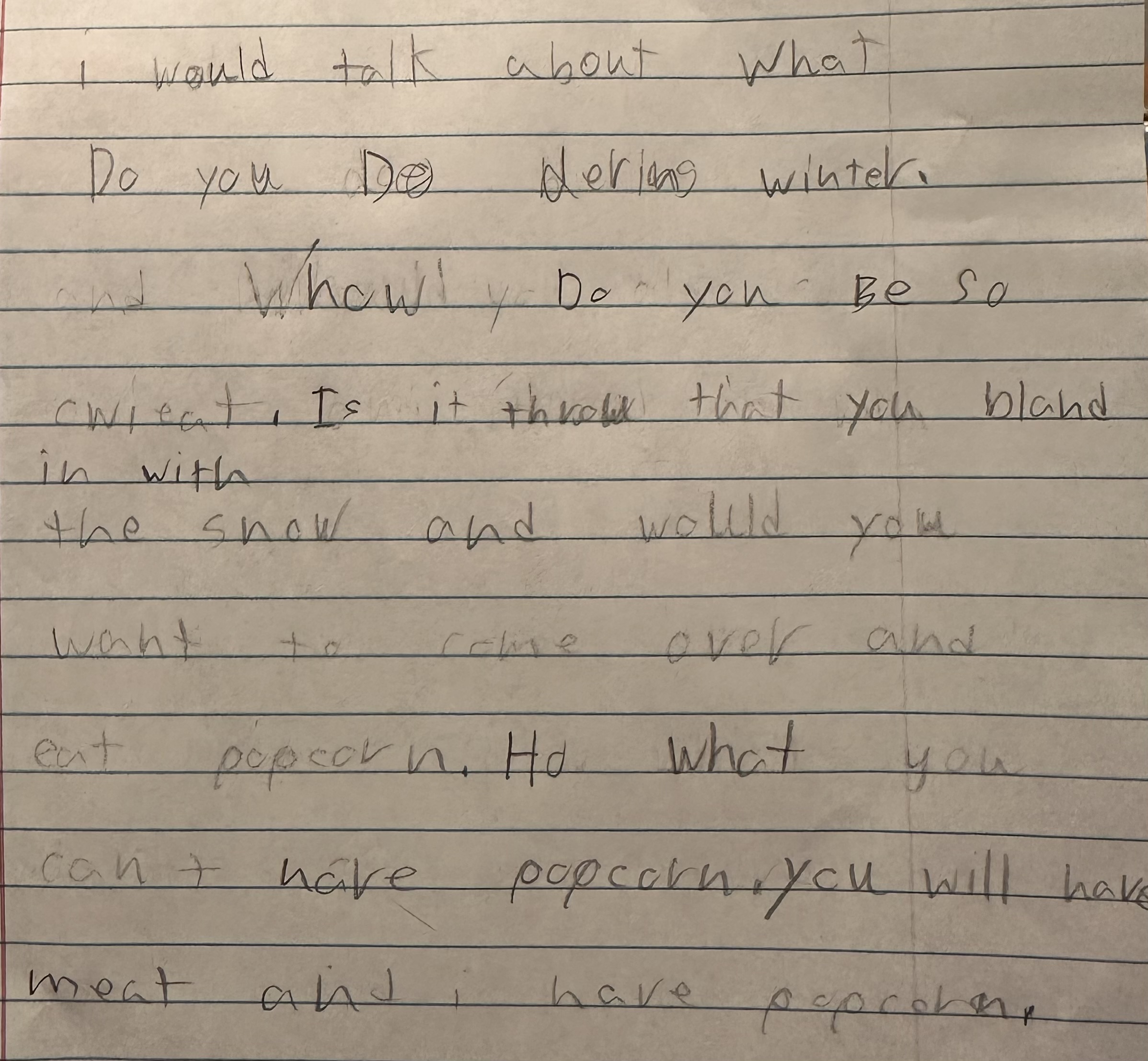
Like many students around this country of ours, this student fell through the cracks in public school so her parents moved her to a private school. Finally, right before she will enter middle school, her parents are putting her in the good hands of a teacher who will make a difference. “This student has never been seen,” that’s how Jennifer put it. This teacher will make a difference because 1) She understands the tools required to read and write and think well; 2) She understands that remediation requires individualization, mentorship, and community; and 3) She, like me, believes that curiosity leads to imagination and imagination sparks creativity and creativity leads to motivated students.
Work is GOOD. Every student has important work. This important work is the work of learning to write ideas.
So what happens next for this student?
The Wonderful World of Phonics
She will be guided on an amazing journey.
Examining the writing sample above, I will venture to say there are holes lingering from the 1st grade! This student has likely mastered consonant and short vowel sounds. But I see no evidence that she has mastered consonant blends or digraphs. I see evidence of simple sight word mastery: and, the, have. There are the “W” words: would, what, with, want. We see a handful of phonograms: or, ea (though even those seem to be learned visually, “popcorn”). This passage opens with the singular pronoun “I” uncapitalized! What I don’t see are concise sentences. I don’t see the variety of vocabulary I’d expect from a student in the spring before middle school. I don’t see a BIG idea. What I DO see is squelched potential.
The goal is for Jennifer to place this student into the remediation program right at the point where there is no evidence of mastery. I’m guessing she will need to begin with consonant blends.
Our toolkit of phonics includes all the tools needed to engage students in the process of remediating both reading and writing skills. It provides the teacher with all the tools necessary to guide the student into the wonderful world of phonics. Our curriculum, rooted in Orton-Gillingham wisdom, is user friendly and affirming for the older student who needs additional direct instruction and independent practice to shore up skills. We’ve included all you need to know about phonics, a placement guide, plus lesson guidance each step of the way.
Once Jennifer has this student working systematically at her personalized level, she will begin practicing phonics for reading and writing. After a few short weeks this student will be placed in a Level 1 CORE (grade 3) Integrated Literature and Writing unit and begin applying what she is learning. A few weeks after that, she will begin One True Sentence: Parts of Speech to learn the wonderful roles words play as she constructs sentences.
Every journey has a beginning. I’m thankful for teachers like my friend who dare to lead such expeditions.
C.S. Lewis said, “You can make anything by writing.”
Think about it.
Not if you don’t know how.
~Kimberly