Posted on

Let’s Edit Together.

Many teachers and parents hit a wall editing student work—it can seem so subjective! The last thing any of us want is to discourage our budding writers. But editing doesn’t have to loom large like a specter of educational despair. YOU are equipped for this task, and we are here to help with some quick online resources.

Earlier this week, we took a look at the Blackbird & Company Writer’s Checklists, which detail what to highlight in a 5-minute editing conference. But today we’re going one step further.

Drum roll please….

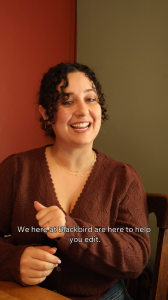
Introducing our new Editing Tutorials!

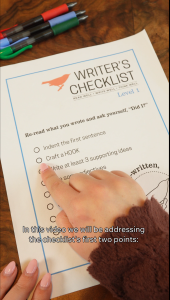
These videos look at real samples of student work and model how we would edit them with the Writer’s Checklists. Check out our first batch of tutorials centered around Level 1 edits on all our social media platforms (Instagram, Facebook, Youtube, Pinterest). Our first five videos explore how to edit:

  1. Hook and Indent
  2. Mechanics
  3. Supporting Ideas and Adjectives, Example 1
  4. Supporting Ideas and Adjectives, Example 2
  5. Twist


With examples of dos and don’ts for each checklist bullet, we’ll give you practical tips on how to edit student work. And stay tuned for our Level 2 and 3 tutorials—they’ll be following shortly.

Every teacher edits differently. No matter your editing style, however, the most important part of a red-pen edit is (1) to help our students’ ideas shine, and (2) to empower them to keep writing. We don’t edit to crush their spirits or to force them to conform to an outline. No! We edit because our students’ ideas deserve to gleam and shimmer in the sun like a cracked geode. We edit because we believe that our students are capable of so much more than they know. 

Browse these editing tutorials for a little inspiration and direction. YOU are more than ready to pick up that red pen!

~ Claire S.

Posted on

Get ready to edit…taking a look at the Writer’s Checklist.

When many of us are faced with a piece of student writing, these thoughts instantly start to fly:

“What do I comment on?”

“What should I expect of my student based on their age?”

“How can I teach my student to self-edit?”

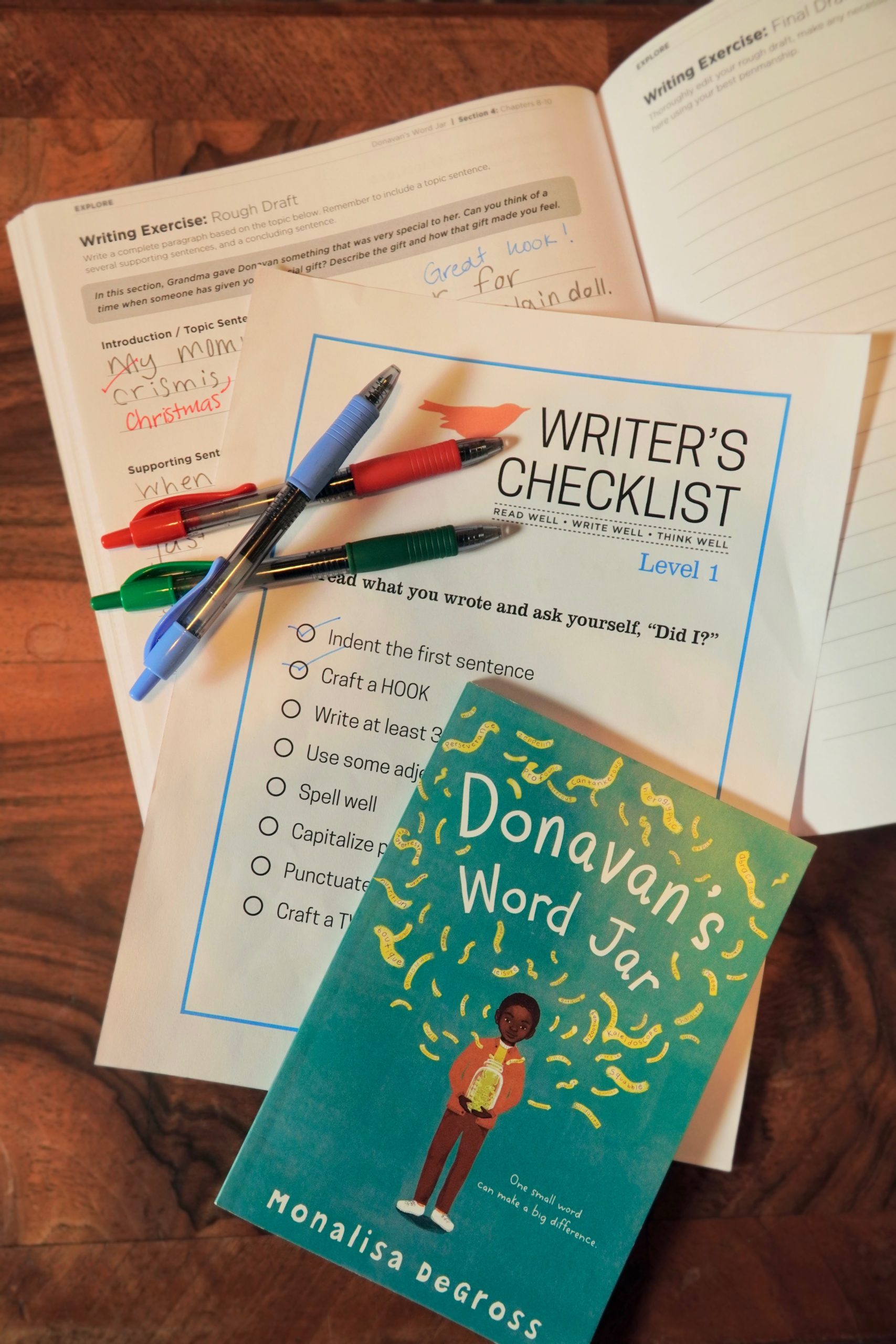
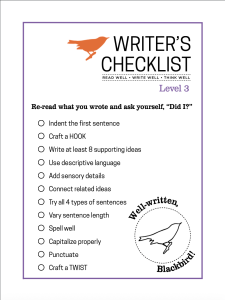
That’s where the Blackbird & Company Writer’s Checklists come in. For Levels 1, 2, and 3, we offer free downloadable checklists on Print Shop that walk you through what edits to make at each level. The 5-minute conference just got easier!

For example, at Level 1, we look for writing three supporting ideas and using some adjectives. By Level 2 we upgrade to writing five supporting ideas, connecting related ideas, and trying out all four sentence types. By Level 3, the hope is that the student can soar and write eight supporting ideas, add sensory details, and vary sentence length. With a little scaffolding, students can climb the ladder to authentic writing!

These checklists aren’t just for teachers and parents—they’re also a wonderful resource to hand to students so they can start practicing the art of the self-edit.

So this school year, print out a stack of Writer’s Checklists. They just might streamline the editing process for both you and your students.

Well-written, Blackbird!

~ Claire S.

Posted on

It’s the dawn of a new school year—who do you choose to be?

Over the last four years or so, I’ve gotten into running, a hobby I’ve always avoided like the plague. This sport has taught me a lot, first and foremost that running is HARD. But it has also shed light on something else: the relationship between identity and goals. 

Here’s what I mean. There’s a difference between people who say they’re “trying to go on runs” versus those who say, “I’m a runner.” The difference boils down to identity. The first group hasn’t incorporated running into their identity while the second group has. When I made the shift from “trying to go on runs” to seeing myself as a runner, I didn’t immediately get faster or run longer. The difference was mental. Motivating myself to run became easier, my running habits became automatic. And that consistency spurred growth. Now, I even kind of enjoy runs sometimes!

Identity-based change doesn’t end with running—it also has everything to do with becoming a writer. 

At this juncture, with the sun setting over summer and rising on the school year, it’s the perfect time to examine identity and goals. This year, who do we want to be? What do we want to achieve? How do we teach our students to intentionally set goals?

One answer lies within the theory of Identity-Based Motivation (IBM) proposed by Dr. Daphna Oyserman, a psychology professor at USC (here’s the article if you’re curious about psychology like I am). She explains the link between our identities and our motivation. Because we prefer to act in ways that are consistent with our identity, we interpret difficulties that arise when we do identity-consistent actions as important or meaningful. The struggle seems worth it. On the other hand, when we do something that doesn’t align with our identity, we see difficulty as a sign that we’re in the wrong place, the struggle proving we don’t belong. 

So for example, when I view myself as a runner, the hardship I experience has meaning because it’s pushing me to become more of who I am. When I saw myself as someone just trying out running, however, every obstacle became proof that I wasn’t cut out for this sport.

The same goes for writing. For a writer, the challenge of getting ideas on the page is important because it shapes the person to become more of who they are. For the “I’m not good at writing” or “writing is boring” student, the struggle inherent in writing is discouraging.

Therefore, our goal isn’t to shape students into people who write sometimes. We want our students to be WRITERS.

Identifying as a writer doesn’t mean you have it all figured out. As Thomas Mann said, “A writer is someone for whom writing is more difficult than it is for other people.” Being a writer means you have something to say—and each student is brimming with wonderful, colorful, vibrant ideas, if only they have the means to express them. 

This year, let’s lean into identity to drive action. Every student is a writer—and we can’t let them forget it.

~ Claire S.

Posted on

Print Shop Highlight: The Art of the Sentence

Within a paragraph, beautiful sentences steal the show. They glide across the page like a ballerina twirling across a stage; you can’t help but keep your eyes glued to every clause, every comma, every figure of speech. 

These sentences don’t materialize out of thin air, however. Beautiful sentences and flowy paragraphs seem so effortless because writers have learned lessons they don’t often verbalize—or perhaps don’t even know they know!

Although developing one’s voice is a process of trial and error and practice, we’ve developed a line of worksheets to help demystify what makes great writing great. Introducing: The Art of the Sentence.

So far we have released three worksheets (downloadable on Print Shop) within The Writing Mentor line that explore how to craft great sentences. The Art of the Sentence worksheets go as follows:

In about three pages, each worksheet follows a Learn, See, Do structure to scaffold students from learning about sentence length, to seeing examples, to writing intentional sentences themselves. 

We can’t wait to offer more Art of the Sentence worksheets soon to explore ideas like writing an intriguing hook. Keep your eyes peeled for our upcoming goodies!

Let’s take our students’ writing to the next level—we’ll meet you at Print Shop!


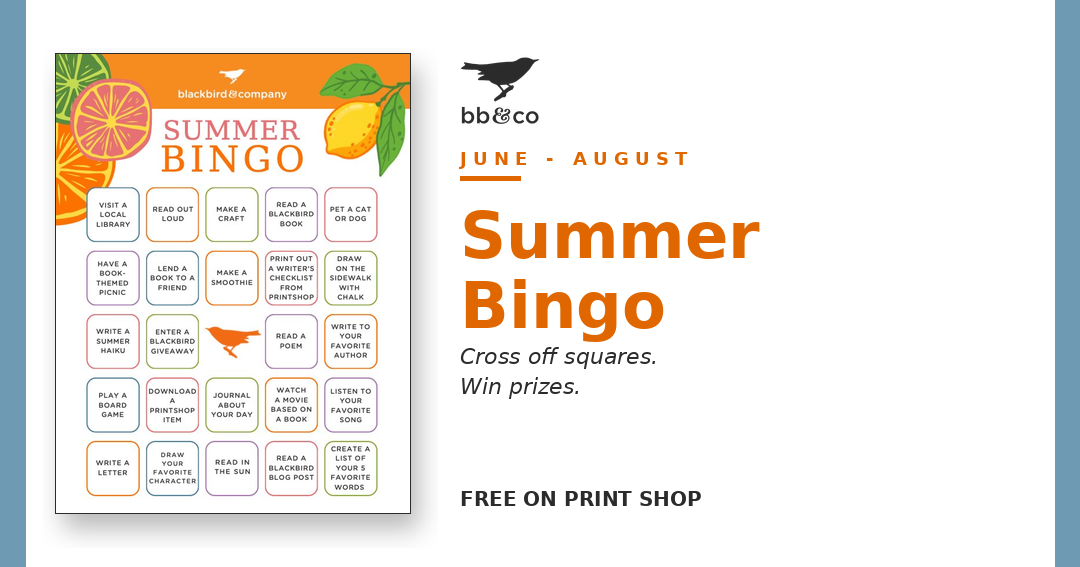
DON’T FORGET TO PLAY BINGO!

Download your Summer Bingo for free on Printshop HERE and submit a picture of your completed bingo sheet below to enter the raffles. Bingo will run June 1st through August 31st—so print out your bingo sheet and get to crossing off squares!


Summer Bingo!

Posted on

You aren’t teaching literature alone: Introducing Reader’s Guides

Leading young minds through literature can be intimidating—teachers are forced to ask the big questions, like, “What are the themes of this story?” and “How can we learn from these characters?” And that’s not even mentioning the pivoting we have to be prepared for when our students pull questions seemingly out of nowhere!

This is why out of all our wonderful Print Shop materials, the More for Teachers: Reader’s Guides are my personal favorite. 

What is a Reader’s Guide, you may ask? Great question!

Our Reader’s Guides are a helping hand we extend to teachers and parents, supplementing the guidework students complete in our CORE Literature Discovery  guides. We do the research on the book so you don’t have to!

Each guide includes:

  • Stats (like reading levels) and themes
  • About the Author
  • About the Book
  • Section Synopses
  • Seven Tips for teaching the story!

For example, in the Seven Tips for The Iron Giant, we highlight repetition, figurative language, symbolism, philosophy, and genre in a few pages so that teachers can point these elements out to their students. We aim to make complex literary ideas accessible, to give you some food for thought as you take on the challenge of educating.

So far, we’ve released Reader’s Guides for:

  • All 6 titles from the 3rd Grade Level Collection (Woohoo!)
  • 4th: Charlotte’s Web
  • 5th: Grayson
  • 6th: The Wanderer
  • 7th: The Folk Keeper
  • 8th: Bridge to Terabithia

Think of this as a sampler platter. More is on the way.

So the next time you crack open a literary book, don’t forget its Reader’s Guide. May you be empowered to teach with confidence!

DON’T FORGET TO PLAY BINGO!

Download your Summer Bingo for free on Printshop HERE and submit a picture of your completed bingo sheet below to enter the raffles. Bingo will run June 1st through August 31st—so print out your bingo sheet and get to crossing off squares!


Summer Bingo!

Posted on

The big Print Shop drop is coming up—get ready for The Writing Mentor

Poetic devices can turn prose into poetry.

Sprinkle in alliteration or oxymoron or polysyndeton and all of a sudden, a sentence is more than just a sentence. It’s art. 

But how does one teach the art of writing this sentence? Well, the One True Sentence: Tools of Style workbooks are a great place to start. Each workbook explores twenty devices that skillful writers have at their disposal. 

Sometimes, however, writers need more time to sit with these new techniques, time to contemplate and learn and practice. That’s why we created The Writing Mentor print-outs for our Tools of Style workbooks. Each downloadable 3-5 page worksheet (found on Print Shop) supplements a specific lesson from the workbook. With every lesson, students have a chance to learn, practice, and get creative. 

Zooming in, students will: 

  • Learn from a great writer’s example of the poetic device. We’ll break it down for you.
  • Practice with scaffolded activities where students identify the poetic device and write their own with guidance.
  • Get creative by unleashing their inventiveness, be it through writing beautiful sentences, composing short poems, or drawing imaginative pictures.

What better way to learn about amplification than by writing your own amplified sentences—or to practice anaphora than by writing an anaphoric poem about yourself? 

Download a Writing Mentor: Tools of Style worksheet starting on July 20th to cultivate the writer within!

DON’T FORGET TO PLAY BINGO!

Download your Summer Bingo for free on Printshop HERE and submit a picture of your completed bingo sheet below to enter the raffles. Bingo will run June 1st through August 31st—so print out your bingo sheet and get to crossing off squares!


Summer Bingo!

Posted on

On Scarcity

Scarcity is not always a bad thing. Of course, when it comes to natural resources—water and food—scarcity creates a problem. 

But scarcity also might mean that something is unique, precious.

Sometimes scarcity might prevent waste. I work tirelessly to purchase fresh vegetables that will be used completely. Too often, when I was younger, lettuce and celery and carrots would wilt, berries would mold before I had a chance to prepare them for my family. Exercising scarcity has helped me solve this problem.

I have a dear friend, a bonafide artist, who has made a pact with herself to not only work through all the materials in her studio, but to also see what might become of trash combined with a bit of imagination. Trash to ephemera—recycle, reuse, repurpose. Sandra’s “Sunset Clouds Over SLO” (oil on repurposed cardboard, 4 x 4) fits the bill whimsically. 

Beautiful things can be created unexpectedly!


Coming this July, Blackbird & Company will be expanding its offering to support primary students (TK, K, 1st, and 2nd) in gaining the skills that are often overlooked in our electronic era.

Cutting, pasting, coloring, painting, folding, and making, actually set the stage for higher learning. More significantly, the activities we are providing will seem on the surface to be toss-able.  However, offering elevated art supplies plus a little nugget of knowledge, and, there is is!

Voilà, ephemera!

I smile remembering the piggy banks of olden times, likening our Print Shop for Primary being pennies and nickels and dimes and quarters that little minds are adding to their fund of knowledge.

Our concept of offering Print Shop for Primary ABCeDarian style, constrains and connects learning to the 26 letters of the alphabet where all of the English language originates. These 26 letters, organized individually or in combination creates the 44 sounds we humans use to communicate. This truly is an awesome example where scarcity is maximized. 

Following in August, right after our July Print Shop drop, we will be introducing our ABCeDarian Activity Box.

This kit will include books and projects across domains of learning—anatomy, animal life cycles, color theory, fine art, craft, the alphabet, and much more. Everything in the box will promote independent learning, fine motor skills, focus, patience, and offer information to build the fund of knowledge. Simply stated, the ABCedarian box is certain to delight!

But here’s the thing: We are only making 50! Yes, FIFTY! Because of the handmade nature of the ABCeDarian Activity Box, we decided to treat it very special. That’s scarcity for you! Watch for the release next month when Print Shop for Primary goes live.

Posted on

ABCeDarian Activity Box

Coming Soon!

Blackbird & Company will be expanding its offering to support primary students (TK, K, 1st, and 2nd) in the art of gaining skills that are often overlooked in our electronic era.

Cutting, pasting, coloring, painting, folding, and making actually set the stage for higher learning. More significantly, the activities we are providing will always offer a little nugget of knowledge tied to A and b and C!

This kit will include books and projects—anatomy, animal life cycles, color theory, fine art, butterfly craft, the alphabet, and much more. Everything in the box will promote independent learning, fine motor skills, focus, patience, and offer information to build the fund of knowledge. Simply stated, the ABCeDarian Activity Box is certain to delight!

But here’s the thing: We are only making 50! Yes, FIFTY! Because of the handmade nature of the ABCeDarian Activity Box, we decided to treat it very special.

Watch closely for the release next month when Print Shop for Primary goes live.

Don’t miss out!

~Kimberly

HAVE YOU STARTED PLAYING SUMMER BINGO?

Download your Summer Bingo for free on Printshop HERE and submit a picture of your completed bingo sheet below to enter the raffles. Bingo will run June 1st through August 31st—so print out your bingo sheet and get to crossing off squares!


Summer Bingo!

Posted on

Submit to Reveal now—July 1st is right around the corner!

Everyone has a story to tell.

Everyone has an idea or an experience or a perspective so unique that it demands to be shared. 

That’s the magic of Reveal. Reveal is the finger on the pulse of our student community. When I read this journal, I catch a glimpse of the hearts of our students because with every piece of writing comes a sliver of the author’s soul. Writing carries power! It’s personal!

Reveal (our Blackbird & Company literary journal) is how we highlight students’ unique voices and big ideas. Check out the Reveal 2024 and Reveal 2025 editions to see for yourself.  

But don’t wait too long—submissions for Reveal 2026 close July 1st! 

Submit your student’s work here to give them a chance to be featured in this upcoming issue. 

May these printed words spur on your creativity!


DON’T FORGET TO PLAY BINGO!

Download your Summer Bingo for free on Printshop HERE and submit a picture of your completed bingo sheet below to enter the raffles. Bingo will run June 1st through August 31st—so print out your bingo sheet and get to crossing off squares!


Summer Bingo!

~ Claire S.

Posted on

Hop on a summer reading safari!

One of my favorite parts of summer is the freedom this season offers.

While it’s wonderful to explore literature through a structured curriculum, there’s a different kind of wonder in meandering through the literary jungle on your own, going wherever the wind and your whims take you. So what better time to traverse genres and worlds and stories than during this upcoming summer? Put on your safari hat and jump in the Jeep; it’s time to explore.

To get inspiration for which books to crack open as I lay at the beach, I asked Blackbird & Company teachers for recommendations. Take a look at these books and see if any strike a spark within your soul—personally, I can’t wait to bushwack  through these new worlds!

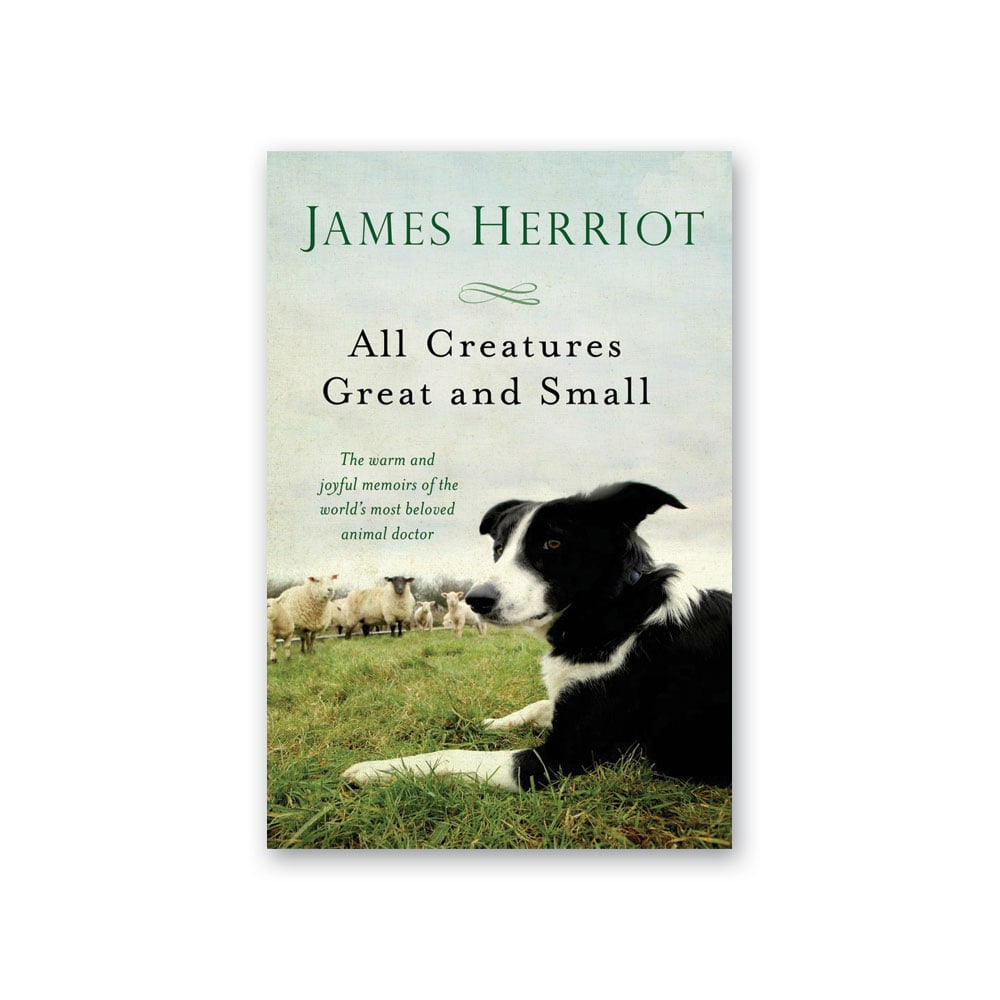
Ms. Cathi: The Keeper of the Bees by Gene Stratton-Porter

When I was young, I used to spend the night with my great-grandma in her tiny apartment. She had a wonderful collection of Reader’s Digest hardcover anthologies that was an early delight because I could devour an entire story in just one night, quietly snuggled in the bed next to her while she slept. She also had a collection of Gene Stratton-Porter books that eventually attracted my attention and kept me engaged for much longer than just one night of reading.

My favorite in the collection is The Keeper Of The Bees. Full of beautiful descriptions of nature, both human and botanical, I was drawn into the story of human tragedy, passion, heroic self-sacrifice, pure virtue, and devoted love on display amongst vibrant colors of flowers, trees, stormy clouds, and of course, bees.

I pull this favorite from my shelf once per year for a reminder of my Memaw’s legacy of rich reading she placed into my hands. I always read with tears and finish with a full heart as I am reminded of how wonderful life can be when not just lived, but shared lovingly with others around us.

          ~ Ms. Cathi

Ms. Lori: Five Children and It by Edith Nesbit

One of my all-time favorite romantic comedies is You’ve Got Mail. A great truth is revealed in this movie by the main character, Kathleen Kelly when she says, “When you read a book as a child it becomes a part of your identity in a way no other reading in your whole life does.” I was an avid reader as a child and each one of those books is not only seared in my memory, but they also molded my future literary tastes. I enjoy all genres—historical fiction, adventure, mystery—but fantasy/science fiction is my absolute favorite. I escaped into the world of Narnia through a wardrobe with C.S. Lewis, walked Middle Earth with J.R.R. Tolkien, and flew into outer space do battle against an alien race with Orson Scott Card. 

But what started it all was a book my librarian aunt read to me as a 4-year-old, Five Children and It, by E. Nesbit. This delightful, magical fantasy revolves around five siblings who come upon a sand-fairy buried in a gravel-pit. Now, don’t be thinking Tinkerbell, this sand-fairy is ugly and grumpy, and grants wishes grudgingly, and all wishes turn to stone at sunset. As you can imagine the children become involved in a series of adventures with unintended consequences. It is all great fun, so much so that the future author Edgar Eager was inspired to write a book for children based on it called Half Magic. His book is wonderful, but I highly recommend that you read the book that started it all, Five Children and It.

          ~ Ms. Lori

Ms. Clare: Wonder by R. J. Palacio

My favorite summer reads are the books you can read over and over again and still uncover something new in, be moved to tears by, remember something lost, and be reminded of the kind of person you want to be in the world. That is what the story of Wonder does for me. Mr. Tushman, the principal in the story, reminds us in his end of the year speech, to be “kinder than is necessary”—that we can make the world a little better and maybe, just maybe someone may recognize in us the face of God glimmering in human form.

Download your Summer Bingo for free on Printshop HERE and submit a picture of your completed bingo sheet below to enter the raffles. Bingo will run June 1st through August 31st—so print out your bingo sheet and get to crossing off squares!


Summer Bingo!


Summer Bingo!


Let the summer inspiration begin!

~ Claire S.