Posted on

Let’s Talk Grammar

Grammar is simply the study of how words combine to form sentences. Words are like putty, they can change purpose depending on how they combine with other words in the context of a sentence. Grammar is complex and essential.

But grammar does NOT come first.

So let’s talk grammar.

Once upon a time I had a conversation with a fellow educator who believed that, if we simply gave young children quality art supplies—Windsor Newton paints, sable brushes, stretched canvas—and let them explore, they would create little masterpieces. Certainly not the kind that would hang in the Louvre, but she truly believed children would learn art-making via materials. This is NOT the case.

Learning an art form involves work.

Work is the only path to beauty.

There is no shortcut.

Visual arts, music, dance, woodwork, knitting, weaving, and more fall into this category. Each art form is founded with unique elements of grammar. Line, shape, texture, value, and color are the grammar of visual art. Melody, harmony, rhythm, texture, timbre, and dynamics are the grammar of music. Body, action, space, time, and energy for dance. Within each art form, the artist who has mastered the grammar, is able to use that grammar to bring shape to an original idea. Think Mona Lisa. Think Beethoven’s 5th Symphony. Think Balanchine’s Nutcracker. Think Shakepeare’s Romeo and Juliet. All these works of art began with an original idea. Writing is an art form that always begins with an original idea.

Art is never born of grammar first.

Art is always idea first.

Grammar is simply at the disposal of the artist. Form follows function. Function is rooted in the idea itself. Function is the reason the art maker is motivated to make art. Form, or grammar, simply enables the artist to bring shape to the idea.

When it comes to writing, who of us, when we want to write an idea in sentence form, ask: “Which preposition should I begin with and which verb would best demonstrate the action of the noun?”

No one, right?

Rather, being honest to our idea, we writers grab hold of its ethereal nature and courageously lift our pencil, scribbling the shape of our idea as best we can. Because we have read widely, learned to appreciate words, have a good understanding of grammar as tool, we can courageously craft. Once we have a sentence on paper, we are able to re-read, edit, and polish. This is the process of writing. This is art making.

Elements of English Grammar:

The Alphabet / Phonics – the building blocks, 26 letters that independently and in combination imitate the 44 sounds of spoken English

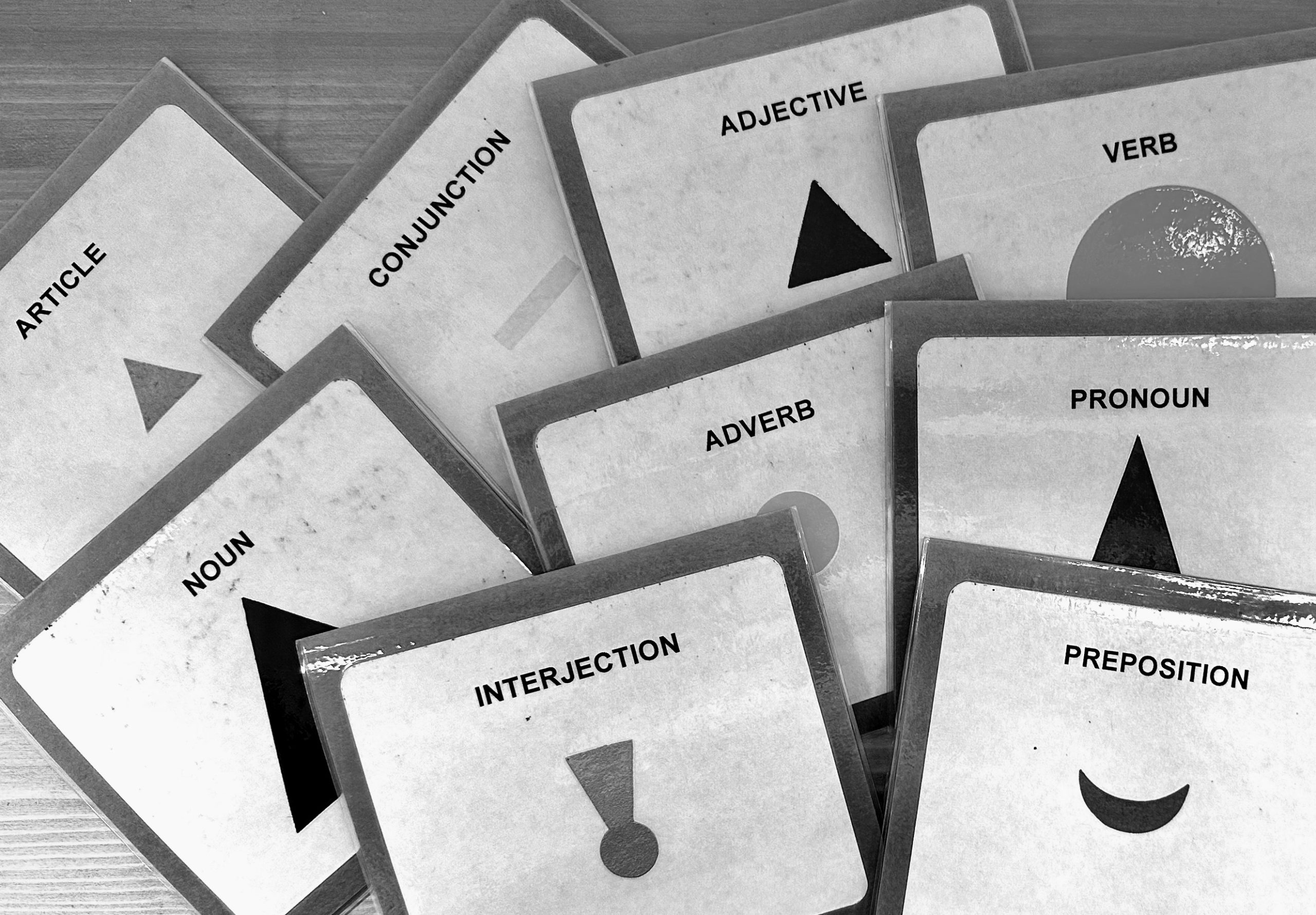
Words / Parts of Speech – noun, verb, adjective, adverb, article, preposition, conjunction, pronoun

Clauses – both dependent, independent

Punctuation – period, question mark, exclamation point, comma, semicolon, colon, em dash, en dash, hyphen, parentheses, brackets, braces, apostrophe, double quotation marks, single quotation marks, and ellipsis

Syntax – The way that writers arrange words and phrases in a sentence adds poignancy and pleasing poetic flavor.

The moon whimsically sang as the stars twinkled a tune in the night sky.

Whimsically, the moon sang as the tune of the stars twinkled in the night sky.

Even more, changing the position of even one word, can change the meaning of the entire sentence.

Only Sandra eats oats. 

Sandra only eats oats. 

Pablo Picasso once said, “Learn the rules like a pro so you can break them like an artist.”

It takes many, many years to use the rules like a pro, this does not mean that all those years should be spent entirely memorizing rules. Students of writing should be writing more than participating in grammar exercises disconnected from meaningful ideas. Students of writing should be actively engaged in the art of idea making followed by the exercise of learning how grammar might best serve their idea. Form follows function.


~Kimberly

Posted on

Around the Campfire: Essays and Tigers and Poetry, Oh My!


Let’s talk middle school.

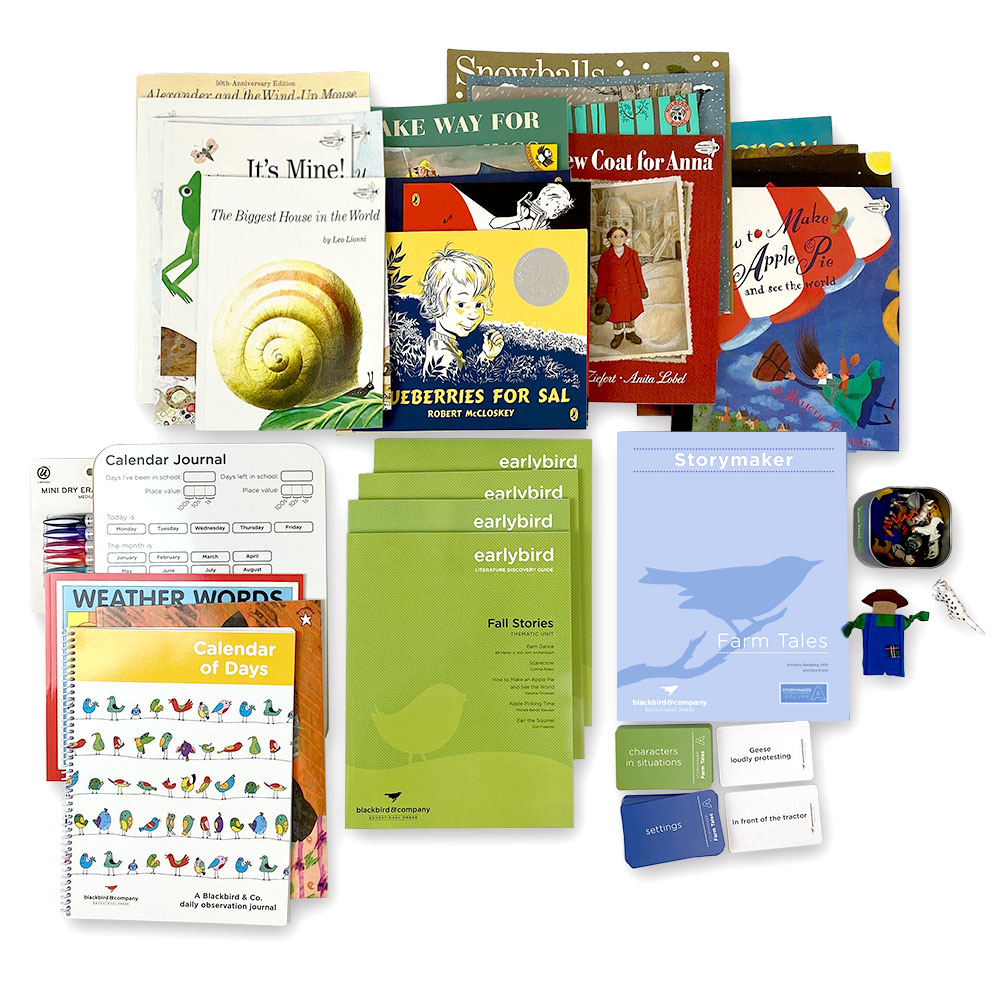
In our CORE materials for middle school—Level 3 Reading & Writing Discovery Guides—students will continue the good work of writing ideas  they began in the Level 1 & 2 units.  With Blackbird & Company, your middle school students will develop the skills and confidence that will prepare them for high school reading and writing.

Tip #6

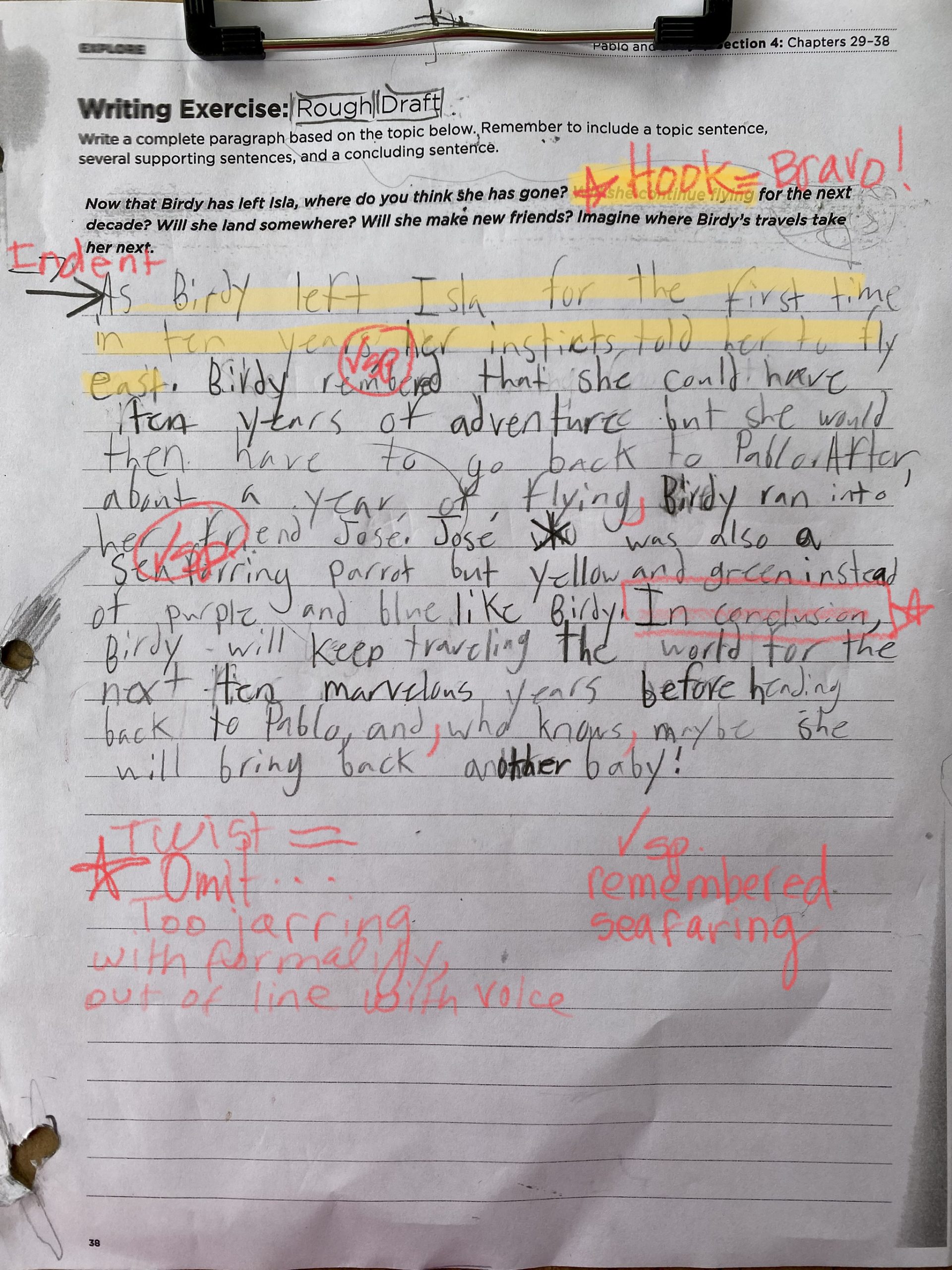
LOVE the red pen.

All writing comes into being through a process:
1. First comes the IDEA. Without an idea, the writer will simply stare at the blank page.
2. Once there is an idea in the mind of the writer, the pencil steps in to translate thoughts to words on the page.
3. When the pencil’s work is complete, the job of the writer is to become a reader. Encourage your students to RE-READ everything they write.
4. Empower students to use the RED pen as they re-read. Teach them to use strong words, to fearlessly re-arrange, and not be afraid to strike through.
5. Polish the draft, preferably in cursive…

Tip #7

Write in cursive!

Writing with a pencil by hand is a foundational skill. But it’s also a beautiful endeavor. I have fond memories of learning to form the ABCs in cursive. This work was quiet, slow, and mysterious. Yes, mysterious. My grandmother, who raised me, wrote little notes by hand and left them in various places around the house to my great delight. Her cursive was one of a kind, a lovely extension of her loving self.  It was not like any other by-hand note I’ve ever encountered in life. That’s the thing about penmanship. Penmanship is personal.

Tip #8

Essays are ideas!

An essay by definition is an attempt or endeavor. An essay is an exploration of an idea, a meandering journey like following a river. An essay is an opportunity to simultaneously explore an idea and to navigate your reader through its wonder. Great essays have the power to encourage, empower, and enlighten. For this reason essay writing should never be treated as a mechanical endeavor, but rather,  a pathway for the writer to communicate the depths of the heart and mind.

BIG ideas can be communicated through a range of forms. The essay is a specific form. But often students hear the word and suddenly experience writer’s block! Some become frozen by fear. This should not be the case! Remind students, an essay is simply an opportunity to explore an idea in more depth.

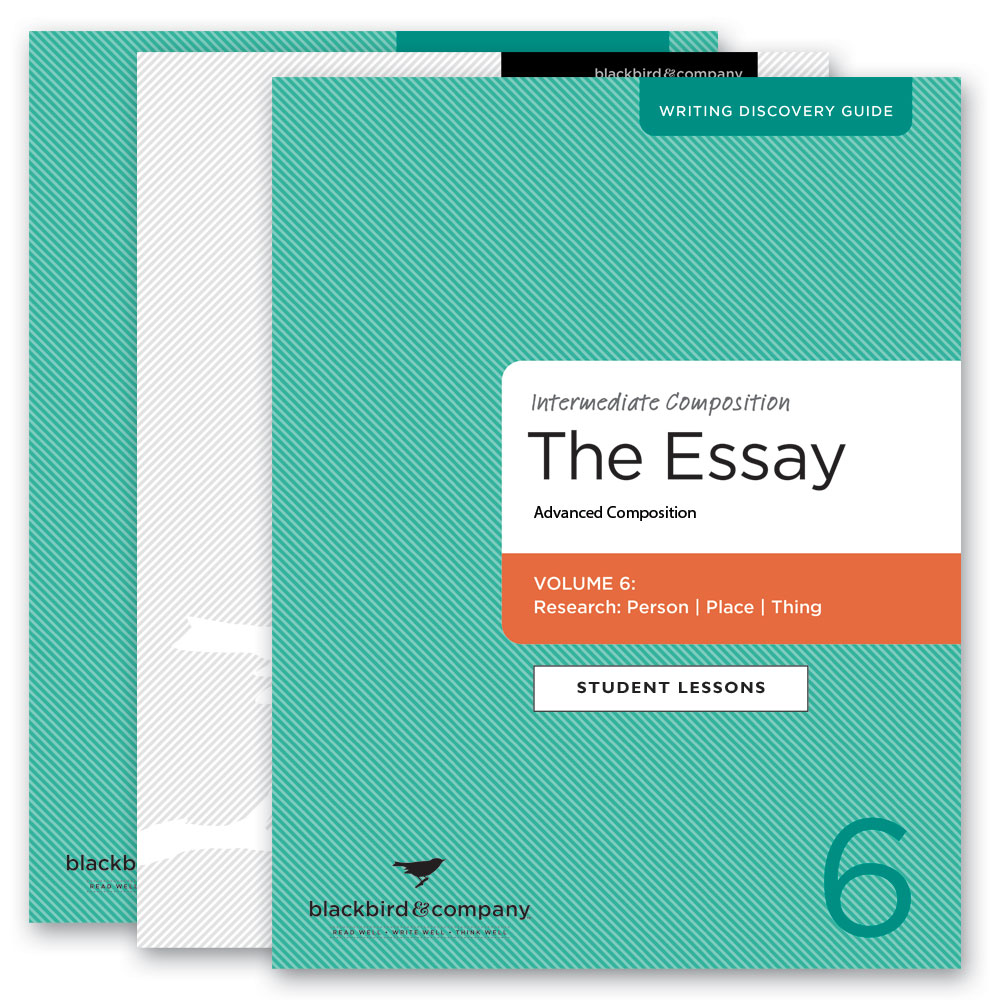
Introduction to Composition: The Essay, for  middle school students, provides the scaffolding that will enable students to shape meaningful essays.

Tip #9

Read poems // Write poems

T.S. Eliot said: “Genuine poetry can communicate before it is understood.”

Poetry is a close cousin to visual art. Poetry is an opportunity to paint—to paint with words. Writing poetry helps students not only learn that words have specificity, but that sometimes less is more. Writing poems help students discover, when it comes to words, possibility is vast. But the best lesson learned is this: it is always better to SHOW versus tell.

The snow is white.

Or

Winter wind gently lifts sparkling flakes, little rainbows floating and drifting around my head.

Your middle school students will discover the delight of reading poetry and the craft of writing poems as they are guided through Exploring Poetry.


~Kimberly

Posted on

Written by Hand

Writing with a pencil by hand is a foundational skill. But it’s also a beautiful endeavor. I have fond memories of learning to form the ABCs. This work was quiet, slow, and mysterious. Yes, mysterious. My grandmother, who raised me, wrote little notes by hand and left them in various places around the house to my great delight. Her hand was one of a kind, a lovely extension of her loving self.  It was not like any other by-hand note I’ve ever encountered in life. That’s the thing about penmanship. Penmanship is personal.

Sadly, digital teaching tools have pushed handwriting instruction to the back seat. But writing by hand is multi-sensory, connecting hand-eye coordination and memory. Writing by hand, the art of encoding language, strengthens the ability to read (decode) language. Writing by hand slows us down so that we might engage with and bring shape to our ideas.

This past Sunday, January 23, was the birthday of John Hancock—the first person to sign the Declaration of Independence. I can see his strong, courageous calligraphy in my mind’s eye. His is the one famous signature that my elementary classmates and I committed to memory. So it is fitting that here at the end of January each year we celebrate the art of handwriting connected to this larger than life signature!

So at the dawn of 2022, may you pick up a pencil, craft your very own John Hancock, marveling at each individual stroke that defines your hand.

Want to learn more about printed letterforms?

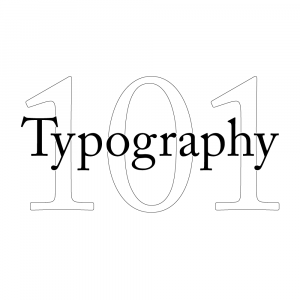
Take a look at our free worksheet: Typography 101

Typography 101

Posted on

The Art of Crafting a Letter

Thanksletter
The potential of the letter is expansive. Its form is deftly suited for all occasions.

Letters bridge.

Letters are common ground.

Letters are a gift.

But our slapdash digitalized pace has fashioned handcrafted letters out of style.

Let’s face it. Letters are a gift we scarcely know how to handle.

As a writing mentor I’m at odds with the pervasive mechanistic approach to writing that cultivates dread and squelches the writer’s voice.

The work of writing is first and foremost an art form. I want my apprentices to marvel at the potential of language to transcend communication.

Words, crafted well, echo in the heart.

I am always seeking new ways to engage young writers with the finer of art of crafting words, making every effort to inspire through writing meaningful exercises. My goal is to cultivate curiosity and motivate young writers to engage in the complex process of writing that will produce something that echoes their heart. When young writers are empowered that their ideas are meaningful, they raise an authentic voice. Grammar and mechanics are secondary to voice.

I’ve come to discover in my own process as a writer and, after twenty years of mentoring, that writers who value their voice will not only focus on the difficult work of unpacking the rules of writing—grammar and mechanics—but will also integrate and apply that work. 

Might the art of letter writing be revived?

This said and the Thanksgiving season upon us, I’m giving my writing apprentices a gift that I want to share with you, a gift in the form of a challenge:

This week, craft a letter of Thanksgiving. This week give words.

Here are some tips that will help your writing apprentices get started: 

1. Riff on another writer’s work.

To begin the Thanksgiving letter, encourage writers to begin by listing some facts about Thanksgiving. Next, read Abe Lincoln’s 1863 Thanksgiving Proclamation. Think about these words being written in the midst of Civil War. How are these words relevant in 21st Century America? Now have them read Lincoln’s first sentence closely. Instruct writers to use Lincoln’s quote at the start of the letter and to do the work of translating the sentence, “I think Abe Lincoln meant ___________.”  Finally, challenge the writers to use the phrases “blessings of the fruitful fields” and “healthful skies” to create a personal metaphor of thanksgiving. What might they represent in the apprentice’s world? Riffing on the work of a master mentor such as Abe Lincoln promotes specificity of language, here, the fruit will take the form of gratitude. 

“The year that is drawing towards its close has been filled with the blessings of fruitful fields and healthful skies.” – Abe Lincoln

2. Utilize parallel writing.

Begin with an interesting quote:

“I would rather sit on a pumpkin, and have it all to myself, than be crowded on a velvet cushion.” – Henry David Thoreau

Find a pattern and craft a sentence of your own your own:

I would rather _________________________ than _________________.

I would rather consider the diversity in a pile of freshly raked fall leaves than wander aimlessly in a grumble of boredom.

3. Make your letter beautiful.

Writing is a process that begins with an idea.

Ideas must be forged to words on a page.

Never skip steps.

Rough drafts matter!

But once your drafting is done, once every word is as it should be, then (and only then) dive into the work of making your words shine on the page. Writing is gift and a gift is never wrapped until it is complete.

Once upon a time writers were apprenticed in the art of handwriting, were compelled to practice the basic shapes and orientation of letterforms. Once, writers were required to master a script, establish a hand—slant and flourish—one that was both legible and lovely. Now, there is not much value placed on this work.

Must the art of handwriting become yet another artisanal extracurricular? Engaging in the process of beautifying forces the young writer slow down to focus on words and phrases in a way that typing can’t, promotes the self-edit to a whole new level. I ask my apprentices often, “Isn’t a handwritten document more precious than a computer generated one?”

– Kim

Posted on

Connect the Dots: Craft a Letter


What do the circulatory system, WW1, the life-cycle of a star, Samuel Adams, great characters from exceptional stories, and a single spring from the workings of an ink pen have in common?

Why human potential, of course.

Interdisciplinary endeavors provide the grand opportunity to perch students high above the realm of facts and mechanics, inspiring them to weave connections across disciplinary boundaries as they reflect on common themes, symbols, and purpose.

What better way to fortify learning?

An interdisciplinary endeavor challenges students to weave new knowledge to what is previously known. Challenges students to assemble and construct as they learn ignite curiosity.

And so letter writing is a tradition in my writing workshops. Letters crafted by hand. From the pencil markings scratched on paper to polished draft. The kind that take nearly an hour to read, to seep in and savor. Letter writing empowers student writers to share the connections they are making. Interdisciplinary connections. Connections at the intersection of acuity, creativity, and and ingenuity. But most important, engaging in the art of letter writing demands authenticity. Letter writing requires writers to raise their voice.

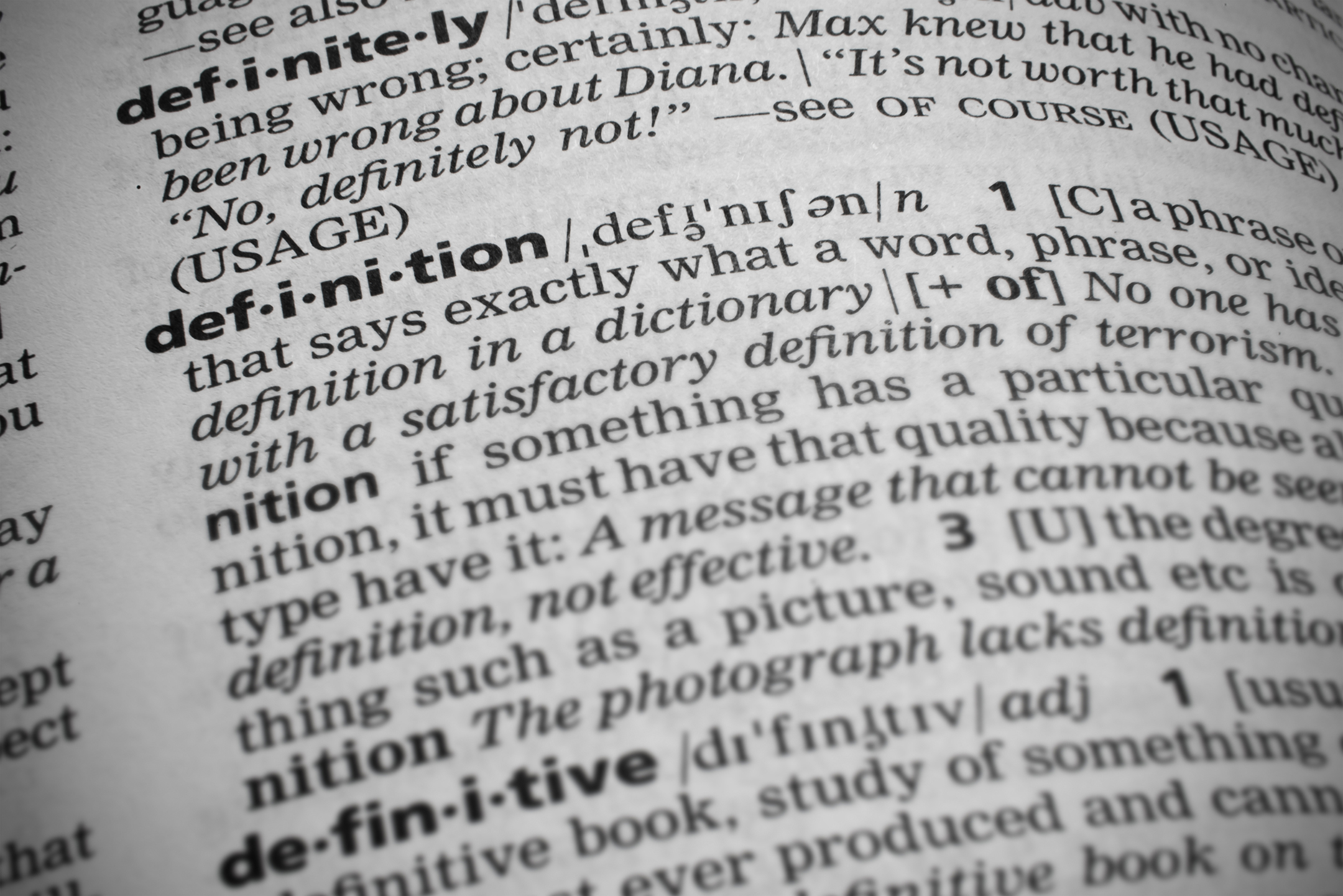
This year, letter writing at the Guild coincided with a wonderful Miss Lori (our Historian in Residence) lesson. When introducing students to The Committees of Correspondence, she first asked for a definition of the word correspondence and was met with the chirp of crickets. Not one could conjure a working definition.

“What does it mean to correspond?”

Crickets.

I imagine she stopped for a bit of word study before proceeding: “To correspond is to communicate by exchange of letters. Correspondence is a letter or letters that passes between correspondents (the letter writers).”

“Ohhhhhhhhhh!”

This set the stage for Miss Lori to continue, “The American Revolution would have never succeeded if it weren’t for letter writing.”

Think Samuel Adams. Back in 1772, he organized a network of letter writing—The Committees of Correspondence—to keep colonists informed of British actions against the colonies, and to plan a concerted response. Letter writing united the 13 colonies and girded their loins for revolution.

Letter writing is a terrific domain to teach a writing truism: one idea leads to another. And when it does the reader is engaged, intrigued, mesmerized.

At the Guild, letter writing exercises are a grand opportunity to inspire young writers to connect the dots, dots that they might not have imagined could be connected. And as the correspondents weave this disparate knowledge to one, they bring permanence, relevance, and significance to what is learned.

Trust me, it requires courage to weave the circulatory system, WW1, the life-cycle of a star, Samuel Adams, great characters from exceptional stories, and a single spring from the workings of an ink pen to a cohesive letter of consequence. But the task is worth the effort. So pull out some paper, think about this past year’s learning, connect the dots.

Letter writing is kindly, generous, revolutionary.


-Kim

Posted on

Courage is a Gift

complete second grade language arts

What better way to learn about courage than from a character in a book!

Our Earlybird Winter Literature and Writing and Discovery Guide features Brave Irene by William Steig. Irene demonstrates love and courage by helping her sick mother in the dead of winter deliver an important package.

We love stories that highlight girl heroines! For more on this theme, a fun read aloud might be Elizabeth Blackwell: Girl Doctor (Childhood of famous Americans).

Keep the conversation going. What does it mean to be brave?


-Sara

Posted on

Discover Research: Elemental Journal

Elemental_journal_bnd_LRG

Get to know the elements!

Chemistry is much more than complicated theories and experiments in the lab. Chemistry is the foundation of literally everything we know. But for our children, chemistry is at best a daunting subject, at worst downright boring. Mention the word chemistry and they will run! 

Honestly, chemistry is no more daunting than any other subject to be mastered. And chemistry is certainly NOT boring! Developing an imaginative view of chemistry is the key to unlocking its wonders.

This discovery journal will guide students on a wonderful voyage through the mysteries of the periodic table. Over the course of a year students curiosity will be piqued as they will research and catalog their findings of 42 of the 144 known elements. Elemental Journal is an interesting and broad introduction into the fascinating realm of chemistry.

Purchase now through October 1 for back-to-school and use the code FALL RESEARCH for a 10% discount! 


-Kim

Posted on

Write for Real

The exchange always goes something like this:

“I can’t teach writing.”

“Yes you can! If you have ever been inspired by words on a page, then you can teach writing.”

If you can read and ask questions when you read something that is not clear, you can be a writing mentor. Whether we are reading a newspaper article, a scientific journal, a novel, or a poem, who wants to read words that are void of ideas?

Great writing begins with an idea crafted to words on a page by a courageous writer.

Madeline L’Engle in, Walking on Water: Reflections of Faith and Art, confides, “I am grateful that I started writing at a very early age, before I realized what a daring thing it is to do, to set words on paper, to attempt to tell a story, create characters.”

The most important thing we can do when it comes to teaching a child to write is to value their imagination and to teach them to do the same.

In my book, Habits of Being: Artifacts from the Classroom Guild I’ve collected snapshots from my experience teaching my own children and students in my Guild to demonstrate just what happens when they engage their curiosity.

Ask yourself, “Do I want my child to write formulaically or to write for real?”

Teaching children to write for real begins by teaching them to believe that their ideas are important enough to do the work of shaping words on a page.

Teach your children to become storytellers. Regardless of domain—fiction to non-fiction—great writing tells a story. Writing is a wonderfully tedious process. Provide writing opportunities that teach children the cardinal rule of real writing: Imagination first. After all, imagination is the seat of great ideas. When children discover that their imagination is valuable and relevant, they will work diligently to refine their voice. Purpose helps writers develop habits of being that motivates them to move through the writing process:

  1. Come up with an idea
  2. Write your idea
  3. Re-read and refine your idea
  4. Have someone else re-read and refine your idea
  5. Polish your words on the page

Moving from reading and recognizing ideas, to engaging in personal expression through writing, develops an awareness of the world at large. When students are encouraged to engage in the process of writing, they will discover the power of words.

Great writing is work connected to the soul. Great writing brings shape to imagination. Great writing evokes, engages, and inspires human curiosity.

Students who engage in the process of real writing will develop confidence in their voice, strengthen their ability to communicate new ideas and become keen observers of their world. Authentic voice is a one-of-a-kind fingerprint. And those are words on the page that are worth reading.


-Kim

Posted on

Journal BIG Ideas Inspired by Books

Taking notes is a foundational skill that will accompany your student through their entire educational journey and beyond. Even though there is no right way of taking notes, it is important to learn how to extract relevant and pertinent information from a text in a neatly organized, concise manner. This takes practice. As students are encouraged to practice over time the art of capturing the most important details from their reading, they will begin to recognize how the intricacies of a story fit into a larger picture. This is precisely how a Habit of Being is established.

When readers take note of character development, trace a setting, and watch a plot thicken, they are learning more than just the skill of recording facts, they are actually beginning to realize the potential of storytelling. Teaching students to dig into a story, to do the work of reading for meaning, enables them to discover how language has the power to communicate significance. Learning to take notes helps to lay the foundation for rich, clear, and organized writing.

Some might argue, when faced with a classroom of 30 students, or even when faced with one student sitting at a kitchen table stubbornly refusing to write, that teaching from a textbook that tells the student what to learn is an easier method than pulling teeth trying to nurture the independent skill of note taking. We would argue that learning to extract information from a story trains students to do the hard work of, not only attending to the details of reading, but more importantly to develop the skill of integrating knowledge into life outside of the book.

As students discover the details and framework that make a story great, they will apply this new-found knowledge to broader academic pursuits in all subject areas.

~Kimberly

Posted on

Words Are a Great Wonder

In our world where
fast paced technological communicating is the norm, our lexicon is shrinking
hand over fist. But the potential of words is a great wonder. Words are salty goodness that pepper writing with flavor.

 
Salty Words

Salt 2

So this month at the Guild we are, once again, making words.

Last spring I
introduced my writers to the idea of “neologisms” coined by Lewis Carroll. I
began by asking the writers to remind me of the details from last spring’s
lesson. I was surprised that they remembered with great detail the suffixes we
explored so long ago:

» cosm 
[From Greek kosmos, order,
universe.] 
Universe; world
microcosm, macrocosm

» esque
 [F., fr. It. -isco. Cf. –ish.]
 An
adjective suffix indicating manner or style
Arabesque, Romanesque

» ism 
[Greek -ismos, -isma noun suffix]
 A
suffix used to form action nouns from verbs, distinctive doctrine, system, or
theory skepticism, truism

They even
remembered more than a handful of the words they crafted, words like: appleism,
s-e-e-ism, TVism, tablesque, pencilesque, windesque, bouncehousecosm,
balooncosm, and lollycosm

As I sat with the
group, I marveled at their retention, but more significantly at their
delight. can’t say the same
about any of the vocabulary development lessons that I’ve utilized through the
years from various curriculums that shall remain nameless! 

The art of
crafting neologisms focuses the writer’s attention on the specificity of words
and their potential to enact ideas in a very meaningful way. And lessons that
are meaningful are lasting. 

So we began our
exploration of suffixes, mining for meaning and application:

» able 
[From Latin abilis, capable of, fit
for.]
 washable, enjoyable, pitiable

ex.
Neologism – baloonable

» nomy
 [From Greek nomos, system of rules
or knowledge.] astronomy, economy, autonomy

ex.
Neologism – iPodonomy

» ization 
[From Greek izein, to become.]
popularization, organization, generalization

ex.
Neologism – basketballization

 »
ology 

[From Greek logia, to speak of, study or science of.]
biology, geology, anthropology

ex.
Neologism – pickleology

 » phobia 
[From
Latin phobia, abnormal fear] claustrophobia, arachnophobia, xenophobia

ex.
Neologism – flipflopphobia

 » ward
 [From
Middle English ward, specifics of direction] toward, homeward, backward

ex.
Neologism – chocolateward

Bonus Suffix:

 » biotic
 [From
Greek biotikis, of life, method of living] antibiotic, probiotic, microbiotic

ex.
Neologism – fauxbiotic

Ultimately, I challenged the
writers to create a list of neologisms for each suffix. Now I challenge you to do
the same. And as you do, keep in mind, words are a great wonder! Go and salt the earth.

-Kim