Posted on

Da Vinci Summer III, Stitch a Tradition

Sewa
Sew2
Sew3
Sew4
I never could relate to spring cleaning. The timing just never worked out for me when Evelyn and Wesley were young. March, April, and May were busy with culminating end-of-the-year school activities. I'd say summer purging was more the thing, out with the old, space for the new.

Now that both (yes, both!) my children are off to college, summer purging has turned to summer reminiscing. Anticipating Evelyn's homecoming, I dug up memory lane in my daughter's kindergarten box. Was it really that long ago that I used stitchery to help develop fine motor skills? Did I introduced embroidery to strengthen handwriting or did I use handwriting to strengthen embroidery skills? Now there's a question.

In either case, we did a little embroidery to embellish all subject areas. We stitched a color wheel and discussed the physics of light. We stitched texture as we discussed and observed the elements of visual art. We stitched the ABCs. And we stitched the world when we explored the complexities of geography.

Scraps of fabric, an embroidery hoop, needle and floss will get the process started. It will look funky at first but you’ll see huge progress over the years.

Both my daughter and my son stitched. Looking back their stitching proved quite academic. In the early years they strengthened hand-eye coordination, learned to slowly attend to detail, became comfortable with problem solving. This little habit of being was a way to bring shape to an original idea sparked from some bit of information they were learning to master. When we studied California history, we fashioned an elaborate quilt that stitched together their knowledge of geography in a way that meaningfully stitched what they had learned into their memory.

Embroidery is an art form and like all art forms is a language worth the student's attention. I say summer is just the space to introduce the art of embroidery.

– Sara

Posted on

A Souvenir of Stars

Mill
This summer we’re exploring our Italian roots via an extended virtual tour. It’s such fun visiting all the places we would visit if we could really visit. Thanks to the wonder of technology, we can experience the landscape of Italy in the comfort of our home.

We’re beginning slow. On Sundays we eat Italian, risotto is a new family favorite that we are trying to perfect. Our touring is geographic and historical and with each click, we wander where our heels lead. Art, music, people, events, we never quite know where the trail will lead. And the great thing about a trip like this is that we can afford to stay as long as we want!

By mid-June we dove into year-one Rosetta Stone. On the 4th of July when we decided to explore the Venetian art of Millefiori, we were daring enough to venture the art of translation. “Millefiori” is Italian for “thousand flowers” by the way. Originally this art form was accomplished with glass and fire. Thankfully, nowadays a millefiori-esque process can be used to make designs with polymer clays. So we pulled out our tub of Fimo and experimented. Using the Millefiori cane technique, we made long tubes with the simple star shape and were delighted by the simple act of slicing star after star until the tube was a transformed to a mass of tiny beads—a souvenir of stars.

– Kim

Posted on

Discover Literature!

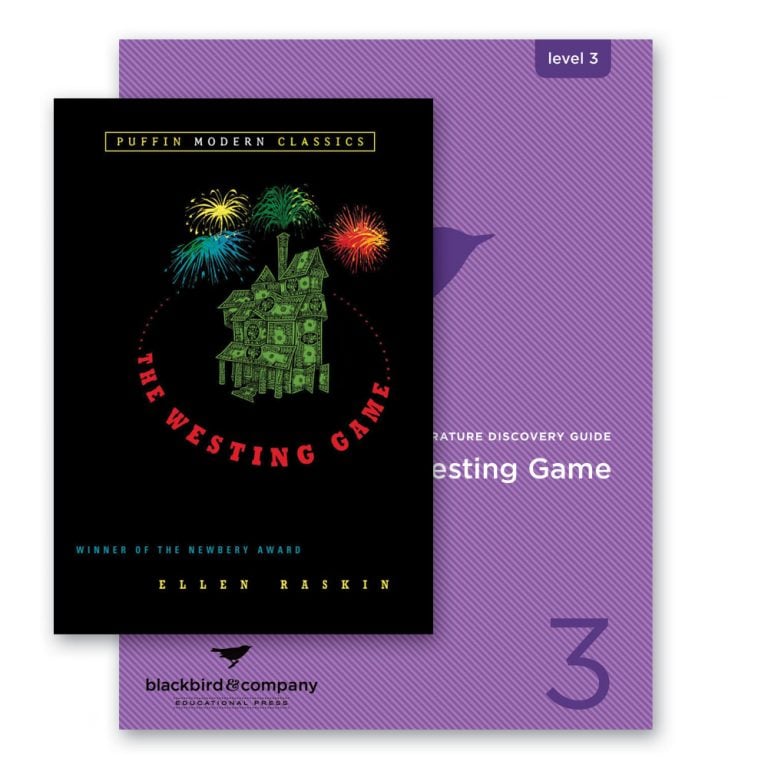
Blackbird & Company Literature Discovery guides are an integrated approach to mastering language arts skills. Each guide is a reading and writing journey. Our titles span a wide range of genres and represent what we believe is the best of classic and contemporary literature on the market today.

The Literature Discovery Guide will do just as the title suggests, guide your student through a close reading of a story. The reading of a single book is divided into four sections to help pace the reader. Each week, as students explore one section of a great story, they will not only discover the components that writers use to tell great stories, but will practice crafting words to bring shape to their own original idea sparked from the weekly reading.

We understand that it is easy for the study of a piece of literature to overshadow the story itself. With this in mind, our goal is to lead the reader through each piece of literature in a way that plumbs its depths while keeping its intrinsic value intact. We further understand that reading has the profound potential to pique the reader’s curiosity and to spark a new idea in the mind’s eye. For this reason we provide weekly occasion for the student to bring shape to a new idea through a directed writing activity. The ultimate goal is to create a routine, but not just any routine, a purposeful routine. We believe that the right kind of practice over time develops a habit of being regardless of the subject being tackled. A habit of being in language arts, once established, will not only create an appetite for great stories but also the skill and tenacity to pin down great original ideas.

Bbco_levelsLevel 1 guides are recommended for a wide range of lower elementary students (grades 2-3) who have acquired the foundational skills necessary to independently read and respond to a simple piece of literature. Because there is a vast age range at this level, books have sophisticated content at an emergent reading level. Each guide is designed to be completed in five weeks, which allows students to work through six to eight units in a typical school year.

View our Level 1 titles here »

Level 2 guides are recommended for middle elementary students (grades 3-5) who are in the process of acquiring the proficiency necessary to confidently read and to respond to a complex piece of literature. Because there is still a range of reading competency at this level, Level 2 books have sophisticated content at an advanced emergent reading level. Each guide is designed to be completed in five weeks, which allows students to work through six to eight units in a typical school year.

View our Level 2 titles here »

Level 3 guides are recommended for confident upper elementary and entry-level middle school students (grades 5-8) who have acquired the proficient skills necessary to read and to respond to a complex piece of literature. Each guide is designed to be completed in five weeks, which allows students to work through six to eight units in a typical school year.

View our Level 3 titles here »

Posted on

Metamorphosis of a Baseball

It‘s true. I’m one of those people who do not get sports analogies. So last week, I was tickled when I noticed Søren unraveling a baseball.

The activity began when he found an old ball in the ivy. He tossed the treasure toward the lolling blue sky a few times then snuck into the work shed and emerged a few minutes later with a pocketknife. He deftly skinned the thing and was delighted to discover that its innards were a tightly wound mass of fine thread.

IMG_4639
He spent an hour or so unwinding without an ounce of boredom. When our backyard had been properly spider-webbed, he came to the end of the fine thread and hit a layer of wound cord. He kept at the business of unwinding and was delighted to discover that at the core of the baseball were two wooden hemispheres, “Mom, look…!”

“I never knew.”

IMG_4638
IMG_4640
I suggested Søren make something out of the baseball components and went back to my gardening, assuming he would shrug off my suggestion. But soon after that he came to me with his summer baseball sculpture, a non-functional tropical smoothie tumbler.

IMG_4642
Now there’s a sports analogy I can chew on.

– Kim

Posted on

Matisse iMadonnari

It’s become quite a tradition to usher in summer with a collective i Madonnari creation. This year’s inspiration started with “The Geranium” by Henri Matisse.

Matisse

From Wikipedia…

The Italian I Madonnari were itinerant artists, many of whom had been brought into the cities to work on the huge cathedrals. When the work was done, they needed to find another way to make a living, and thus would often recreate the paintings from the church onto the pavement. Aware of festival and holy days in each province and town, they traveled to join in the festivities to make a living from observers who would throw coins if they approved of the artist’s work. For centuries I Madonnari were folk artists, reproducing simple images with crude materials such as tiles, coal and chalk.

IMG_2895

IMG_2891

IMG_2927

_MG_3794

Have fun creating your own sidewalk masterpiece! For a step-by-step tutorial, visit this post.

Posted on

Ars Poetica Banner

_MG_3822
Last week we made an Ars Poetica banner to celebrate the year of poetry gone by and to usher in yet another Da Vinci Summer.

We began by crafting a single sentence that described the very essence of a poem. Next, we broke the sentence into poetic phrases, little articles and conjunctions excluded. All the poems were, at last, perfumed with rich images and a splash of device—metaphor smilie, personification.

Poetry is not extracurricular. So as you wade into the slower paces of summer why not begin to develop a habit of being, the habit of poetry?

– Kim

_MG_3711
_MG_3712
_MG_3714
_MG_3710
_MG_3713

Posted on

Mom’s Day Blossom Cards

I have to say, I'm always a little proud of myself when I can scrap together a cute and do-able art project for my 5 year-old with materials I already have on hand. And since I'm not a huge fan of pre-printed drug store cards I decided to make some springtime blossom cards inspired by the Bougainvillea growing in our backyard.

First I gathered some random envelopes and card stock in lovely spring colors. I think I've literally had these envelopes for over ten years. Today their destiny has been fulfilled!

Mom4

Next I prepped the paint. I love craft paint. I'd buy every color if I could! I picked three colors for the blossoms, and for the stems I watered down a few drops of green paint in a small bowl.

Mom1
Mom2

For our "paintbrush" I used a cotton ball and clothespin to help keep little fingers cleaner. I decided to cut the cotton ball down to make it a bit more manageable and discovered a perfect blossom pattern hiding inside. I love happy accidents!

Mom3

Time to make art! I puddled some of the watered down green paint at the bottom of the card and gave my boy a straw that I had cut in half. I encouraged him to blow the puddle around to create the stem and branches. It helped for me to rotate the card as he was doing this to spread the design out a bit. I have seen this techinque many times throughout my blog surfing adventures and I was thrilled to be able to finally try it out.

Mom7
Mom8

Next came the blossoms themselves. I squirted three small blobs onto a plate to mimic the colors of the Bougainvillia blossoms. Very little paint is required, depending on how many cards you want to make.

Mom5
Mom6

Taking the cottonball brush, my boy then added the blossoms. I encouraged him to "plant" them at the end of each stem. I have to say he did a pretty good job with that. Don't worry, should your young artist go on a wild dabbing-spree, the result will be just as perfect and adorable.

Mom9
Mom10

Once the cards dried we added a simple, heart-melting message to the inside.

Mom14

This was such an easy, quick and fun crafting session with awesome results. And we've still got a day to get some of these into the mail for grandmas.

Honestly, even though I know what's coming, I'm so excited to open my own card come Sunday!

Mom13
Mom11
Mom12

HAPPY MOM'S DAY and blessings to all of you amazing mothers out there! What you do is important!

-Tracey

Posted on

Sugar Cube Construction

I have vivid and happy memories from my elementary school years of building my California mission out of sugar cubes. Being that my brother is five years older than me, I was lucky to always have a preview of what was to come for various school projects. Willie was (and is) a master builder, inventor, and maker of all things cool and mechanical and as a faithful little sister, I basically worshipped him, and everything he did and made. His creations were my inspiration and although I never quite matched him in precision and craftsmanship, I am grateful for what he showed me was possible.

Sugar cubes aren't quite as common at the supermarket anymore but if you come across them, snatch up a box or two for a "sweet" construction session. They provide a great exercise in self-control…and hold magical potential for architects of all ages with their sharp edges, sparkly whiteness, and grainy texture. After all the hard work, don't forget to reward your young builder with the thrill of crunching through one perfect cube of 100% pure sugary goodness!

– Tracey

IMG_8335
IMG_8333
IMG_5362
IMG_5359
IMG_8329
IMG_5342
IMG_8327IMG_8324

Posted on 2 Comments

Individuality

Andrewmath

Too bad this photo is blurry, the moment was lucid …

One day at lunch Andrew and Hunter were hanging in the classroom. Andrew kept crafting and solving problems, over and over again (for fun). He would fill the entire whiteboard, erase, then start the process again. Hunter sat by amazed, longing to grab the nearest math book and tear it apart one page at a time for origami, or a possible bonfire.

Some students possess math genius. Some are comedians!

The world needs both.

Posted on

It was a dark and stormy night…

Slide2
And so begins Madeleine L’Engle’s most memorable classic tale, A Wrinkle In Time. A story about the life-changing journey of three children, their epic battle against darkness and the cosmic power of love.

2012 marks the 50th anniversary of Wrinkle. Interestingly, we might have never heard of Meg Murray or Charles Wallace as L’Engle’s manuscript was initially rejected by 26 publishers before editors at Farrar, Straus & Giroux read it and enthusiastically accepted it. It went on to win the John Newbery Medal as the best children’s book of 1963 and has so far sold eight million copies. It is now in its 69th printing. Now that's a lesson in perseverance!

As the author of over sixty books, Madeleine L’Engle’s rich legacy includes poetry, plays, writings on faith and four additional stories about the Murray’s adventures. “Why does anybody tell a story?” she once asked, even though she knew the answer. “It does indeed have something to do with faith,” she said, “faith that the universe has meaning, that our little human lives are not irrelevant, that what we choose or say or do matters, matters cosmically.”

The thing about fantasy literature is that it has the ability to inspire our imaginations and our souls to believe in that which seems impossible. We all want to know that there is a bigger purpose to our lives. We want to see that those who are “regular” can overcome their ordinariness and achieve greatness, make a difference—even save the universe!

To explore more, visit: www.madeleinelengle.com

In addition to A Wrinkle In Time, the following fantasy guides are available from Blackbird & Company:
Level 1 – The Iron Giant & My Father's Dragon
Level 2 – City of Ember, Half Magic, The Magician's Nephew, The Wonderful Flight to the Mushroom Planet
Level 3 – The White Mountains & The Thief Lord