Posted on

Kalidescope of Butterflies

Blue

Claude Monet's birthday was a November celebration. Imagine the Impressionist in his garden, over 100 years ago, painting something wonderful.

Monet

 After reading A Blue Butterfly by Bijou Le Tord, I set my students free to watercolor butterflies in all shades of blue. Of course I had pre-cut the shapes so that all the focus would be on the blue anticipating poem-making.

Prompting students to write a singular butterfly statement and then to treat that sentence apart we soon created a wonderful kaleidoscope of butterfly line-break poems.

IMG_2130
IMG_2130
IMG_2130

You can too. 


-Kim

Posted on

After a Book Journey: Create


Reading a book is a journey. From Los Angeles to New York you’ll travel through the city and the countryside meeting wonderful people and seeing new and exciting places. Let the journey begin! (Hat tip to Reading Rainbow.) Take your 2nd grader on an Earlybird Destinations journey. They will not be disappointed.

Places you will go:
Miss Rumphius by Barbara Cooney
Abuela by Arthur Dorros
The Wonderful Towers of Watts by Patrica Zelver
Fly High, Fly Low by Don Freeman
Letting Swift River Go by Jane Yolen

And by the time they get to the end, they will not only have a deep appreciation for the places they’ve explored, but a heart full of fodder for their creativity to unfold.

Here’s a simple a simple lesson to help your students enact and elevate their creative responses to stories.

  1. To begin, if you are going to use a box (and boxes are a great way to begin, always paint the box). Give yourself a blank canvas upon which you can build your idea. A coat or two of gesso or acrylic paint will do just fine.
  2. Use more than 1 art medium. Here for example, using paint and air dry clay, use both folded and crumpled paper, live foliage, found objects, and so on.
  3. Be sure to anchor to the book where the idea originated by creating a meaningful Title or by posting quotes around the project.

You don’t have to be an artist to make your idea beautiful. And, think about it, ideas are meant to be appreciated. So, go on, beautify.

~Kimberly

Posted on

Take a Line for a Walk

IMG_0789

Here we are again, First-Days-of-School upon us. All of us teachers are certainly prepared with a hefty handful of academic goals, each comprised of an even heftier handful of learning objectivStill I can't help but smile, as Fall sneaks in from the wings stage right, and Summer exits the wings stage left. I'm in the audience applauding joyfully, overcome with Fall-feelings. And all this smiling reminds this teacher that education is more than the academic goals I have set for the coming year.

Education is looking up in delighted silence marveling that the leaves have, once again, begun to turn gold, rust, and chartreuse.

Education is learning to enjoy process, the process of entering into a great story, the process of engaging with a mathematical problem.

Education is the ongoing engagement with the process of success and the process of failure  

Education is embarking on a journey.

Truth be told, education is a kindred relative of art-making.

So this year let's begin by inviting Paul Klee to teach our students to slow down into their important work.

As students are taught to engage in complicated activities slowly over time, they will begin to recognize that becoming educated is something far more weighty that getting the right answers. Slowing into their important work, students will enter the art of learning.

IMG_0788

Introduce your students to Paul Klee, the Swiss/German artist of the 20th century whose whimsical paintings still take the world by storm, putting smiles on the faces of viewers of all ages.

Paul Klee reminds us that "A drawing is simply a line going for a walk." So let's go for a walk with Paul Klee lines.

Begin this exercise by providing a variety of finely sharpened colored pencils or a variety of colored, fine-tipped Sharpee pens. Have your student first choose one of the line/dot compositions to copy. Begin by showing the student how to trace from one line to one dot with a finger. Tracing enables the student to experience subtle angles on the page and to map out a plan for the copywork. Once a finger tracing is complete, start in one corner of a blank sheet of good quality drawing paper and draw the first "anchor" line with one color. When it is time for a dot, choose another color. For the new line that connects to that dot, choose yet another color. Continue this process until the Paul Klee black and white line/dot drawing has been transformed to a unique colorful masterpiece all your student's own.  Please note, this exercise will take time and is best accomplished over two or three hour-long sittings. It can be accomplished by students young and old, by anyone, in fact who can manage a pencil with a willingness to try.

Finally, keep in mind, this exercise, while led by a famous artist, is not primarily an art lesson. Art is a secondary outcome. This is a lesson in slow attentive observation. It is an activity that will strengthen strategies that will be useful in all academic pursuit. Most importantly, taking a line for a work demonstrates that learning is and should be a joyful pursuit.

Happy fall to all.


-Kim

PS … and if you want to try a fun Paul Klee painting exercise, click through  

Posted on

Ugly Vegetables

Use Blackbird & Company’s Earlybird Spring Literature and Writing Discovery Guide to plant a Chinese vegetable garden! The Ugly Vegetables by Grace Lin tells the tale of a little girl who helps her mother grow some very unusual vegetables while the neighbors are all growing flowers. Read how those ugly vegetables brought the neighbors together over a bowl of soup.

A little research will yield many inexpensive ways to use containers to grow vegetables.Check out our Pinterest page.

We’d love to hear your garden ideas too!

Leave a comment…


-Sara

Posted on

April Showers

IMG_0759

For this project, begin with a sheet of watercolor paper or heavy cardstock. Next practice drawing some iconic clouds on scratch paper. When you are happy with your design, draw three or four or five clouds in pencil lightly on the watercolor paper. Be sure to overlap the clouds a bit. Trace the clouds with a black Sharpee. Once your clouds are established in the sky, use your Sharpee to make textural designs by echoing the curves with repetitive lines. Then it will be time for you to use your Sharpee to make little raindrops fall. This is a terrific opportunity to practice patience, one tiny raindrop at a time. 

IMG_0760

At last it is time to add some color to your clouds. Choose three watercolor blues and washright over the Sharpee cloud.

Sit back, enjoy your art, and stay tuned. You know that they say, "April Showers bring May Flowers!"


-Kim

Posted on

Rechenka’s Eggs

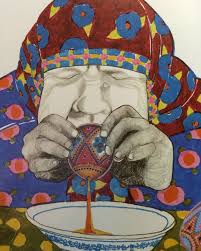
The fifth book in our Earlybird thematic Spring Discovery Guide is a Blackbird & Company favorite, Rechenka’s Eggs by Patricia Polacco is in our top ten favorite children’s books of all times! Beautifully illustrated this wonderfully told tale will introduce your student to the amazing art of Ukrainian Pysanky egg decorating.

This has been a yearly tradition at our house during Springtime. All the supplies you need can be found online. And if you can find a copy, be sure to watch Reading Rainbow (season 10 ,episode 4) to see Patricia herself creating a beautiful painted goose egg. …Magical!

“Behold the egg,” said Lavar Burton.

~Sara

Posted on

Earlybird for the Month of Poetry


April is just around the corner. It’s time to think poetry.

When is a flounder like a dish?

Who reads the Newt News?

How many lumps on the Bactrian’s back?

How many words rhyme with weevil?

What does the hawk remind the reader to be thankful for?

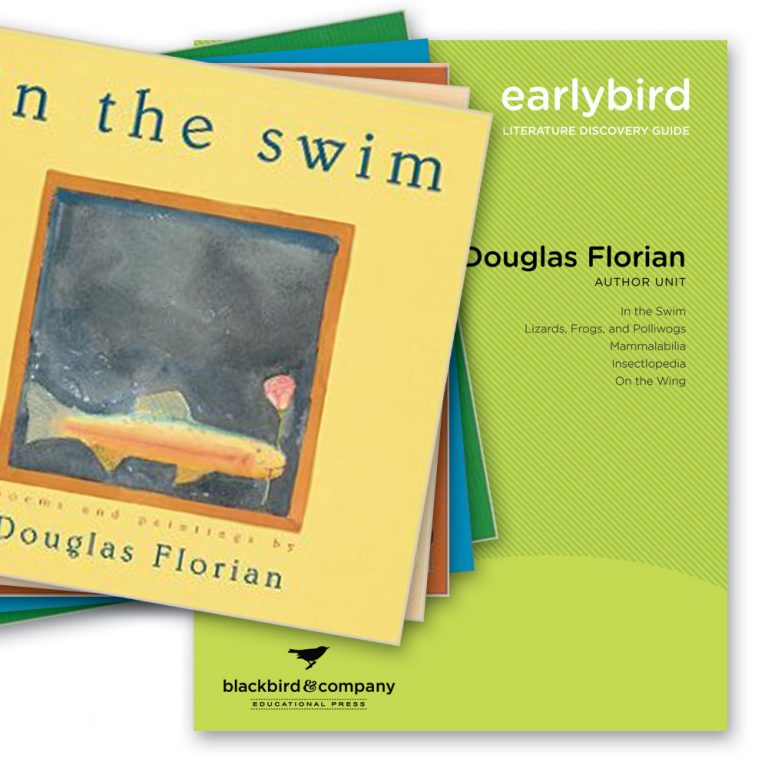
In our Earlybird Douglas Florian Discovery unit, students will explore beautifully illustrated collections of 21 poems. Each poem is pure silly fun blending science and whimsy to teach the reader about life in the sea, scaly slimy creatures, mammals, spiders, insects, and our fine-feathered friends.

Winner of the Lee Bennett Hopkins Poetry Award and recipient of an ALA Notable Children’s Book Award, Douglas Florian is the author and illustrator of many children’s books. He believes there is only one rule when it comes to poetry: There are no rules. Douglas Florian gives credit to his father as his first art teacher, who taught him to love nature. He begins his poems with research of the real thing and then uses that information to create an imaginary poem. Douglas Florian lives in New York City with his wife and five children.

Your 1st and 2nd grade students will not only write and illustrate poems inspired by the Florian poems, they will explore the traits of characters, acquire new words, and practice making sentences. More importantly, they will enjoy exploring the art of poetry.


~Kimberly

Posted on

Shark Shape Poems

To begin this project, go the the library and gather a collection of shark-picture-books. Read and enjoy at a safe distance. Sharks have sharp teeth.

Next, write a sentence or two about a shark incorporating some true facts and some not-so-true facts (after all, this is poetry). Be sure to include a simile (use the word "like" or "as" to compare the shark to something).

Sketch a few simple shark shapes, no details, just the outer contour. Choose a favorite to enlarge. Using light pencil draw the shark on a sheet of watercolor paper. Trace the light pencil drawing with black Sharpee.

Now write the shark sentences around the shark shape in, once again, very light pencil. When the sentence is spaced and spelled well, trace the words in black Sharpee.

Finally, the fun part… Mix up some deep-sea-watercolor blue and wash it right over the whole thing. Swish, swash, that's right! 

Shark

And when your shark poem is dry, beware of the blur that is caused when it swims right off the page as all good poems should.
Whale


-Kim

Posted on

Metamorphosis for April

IMG_2127

Butterflies are blossoming for the month of poetry!

These lovely creatures began with a lesson on the life cycle of this intricate insect and the book, A Blue Butterfly: A Claude Monet Story by Bijou Le Tord.

From there, with a bit of imagining, we were able to construct a singular sentence: Imagine you are a butterfly... What do you see? What do you sense? What do you wonder? What are you glad about?

Each sentence was thoughtfully considered. Each word matters in a tiny poem! I find that offering little phrases such as, "Butterfly, you…" or "My wings flutter…" or "I am flitting…" (and I'm sure you will come up with a few of your own…), help students overcome the "I Can't" road block. Thing is, they CAN! Most often the sentence starters disappear, over taken by the unique creativity of each writer's unique voice.

IMG_2127

Next, we traced a simple butterfly shape and set it free from sheets of watercolor paper. We used only shades of blue—blue watercolor, blue colored pencil, blue pipe cleaners.
IMG_2127

And the result is poetic. 
IMG_2127


-Kim

Posted on

It’s Spring in Monet’s Garden

Monet6

Claude Monet, leader of the Impressionist movement, was a masterful gardener. Yes, that's right, gardener. I've been to Monet's garden in France. This artist's garden bursts to life in spring. Spectacular is a small word to describe the grounds. You can read about it in the delightful book, Linnea in Monet's Garden. But you can also experience it through his paintings. 

So, on this first day of spring, why not plan a visit to Monet's garden via a "close reading and rendering" of one of his garden paintings? You can learn so much about the art of painting by copying the work of a master. Here is how we did it:

Here's how to paint this painting in two three-hour-sessions:

Session 1

To begin, cover your canvas with a light hue from the painting. While the paint is still very wet, use a clean brush to draw the shapes you see. Let this stage dry completely before proceeding.

Monet5

Next, mix up a a limited palette of colors in jars that can be sealed so the acrylic paint will not dry out. When mixing colors to match this painting, you will not only mix primary pigments to find the secondary and tertiary colors (red and blue make purple, yellow and blue make green, orange with a hint of red is red-orange and so on), but you will need to experiment with adding a dash of compliments to discover the subtle complexities of Monet's palette. When you add a touch of orange to its opposite, blue, you will discover a lovely iteration of blue. For Monet colors, once you have the hue, you will add white to each color to achieve the lovely pales familiar to this artist. When you have your palette, seal it up for Session 2.

Monet 7

Session 2

Start with laying down the dark blue-green in the negative spaces. Then, while the background is drying, begin to add detail to the lily pads and blossoms with the medium values, loading your brush with different hues and unloading them onto the canvas. Rinse your brush in between color changes. When the background dries (and acrylic dries fairly fast), give it a second coat, allowing the subject of the painting to dry a bit. Continue painting in this manner, paining the light values last. You may need to step back from the paintings to discover missing details. Be careful not to mix colors on canvas while paint is wet or the lovely colors will turn to mud.  

Monet2

It's spring. Take a moment to smell the flowers blooming and be inspired by the fragrance. You never know what you might learn. "I perhaps owe having become a painter to flowers," said Claude Monet.

-Kim