Posted on 1 Comment

The Spider That Did Not Skip a Beat

Web copy

At the end of back-to-school week #3 I was exhausted and, frankly, a bit discouraged.

The tower of blocks was skewed and teetering: Three sons and a daughter on top of Laundry with a capital L on top of an empty refrigerator on top of a rat in my garden on top of dusting on top lesson plans on top of a sore throat and a stuffy nose.

So early Saturday morning, I made a cup of tea and called my friend Shirean who has three grown children, only one left in the nest. I was sure she would have an offering of remedy words.

You know the call…”I’m so tired… I can’t…!”

Shirean patiently nodded across the miles,” I have been there,” while gently prompting me to scoop myself out of wallowville.

All the while, sipping tea, breathing in a healthy dose of fall fresh air, I pondered a spider on her intricately woven web basking in ray of morning sunshine. Just as my telephone conversation was nearing the end, the tiniest breath of breeze destroyed the web. I still marvel at the spider’s response. Instantly she dropped on a long silky thread and began the climb to weft and warp anew.

What’s a spider to do?

Perspective.

– Kim

Posted on

Our City Garden

Greentomatoes
Tomatoes I’ve been watching our garden grow. The boys have learned so much about attention as they tend this living and growing thing. When little green tomatoes appeared they beamed with satisfaction. And when it was time for the first harvest (which was sizable for these city dwellers) I could not get them to stand still for the photo!

Since the garden was also abloom with basil and zucchini, we decided to make our first meal, Italian-esque. We can dream Tuscany, right?

We set a pot on the stove and waited for the water to boil for the pasta. Meanwhile, we chopped tomatoes and basil and sauteed them in olive oil and a pinch or two of salt. We let the harvest settle into flame just long enough to wilt the vegetables. Then we put the chunky goodness into our food mill and cranked until the base for our sauce emerged.

Shopped
Spinn We poured the tomato basil puree into a sauce pan, reduced it slightly, and added some cream. We served this over our pasta with grilled slices of homegrown zucchini on the side.

Trust me, this was a first for our family.

Seed. Earth. Water. Sun.

Galvanized trash containers and a front yard planter converted to a vegetable garden.

My boys are still amazed.

– Kim

Meal

Posted on

Da Vinci Summer II: Spontaneity

Sir Ken Robinson has all sorts of ideas about creativity:

“You can be imaginative all day long and never do anything.”

“To be creative you have to do something.”

He defines imagination as, “…the process of having original ideas that have value.”

Creativity is is the work of bringing an imagination to shape.

Perfectionism and procrastination have the power to silence an idea by simply stopping imagination in its tracks. I’ve seen it happen over and over and over again. So has Sir Ken:

“If you’re not prepared to be wrong, you’ll never come up with anything original.”

As a mom and educator, I design opportunities for creativity to occur on a daily basis. Other times—and I am thankful for these moments—spontaneity does the work for me.

Last week my two youngest sons, Liam and Søren, spent the day at the office with Uncle Brian who gave them a challenge: Make something.

He provided:
• Gaffer’s Tape
• Bubble Wrap
• Zip Ties

And they spent the next couple hours creating.

They marched into the house that evening beaming with pride in their accomplishment.

Thanks Uncle Brian.

Photo-4
Photo-2
Photo-5
PS I couldn’t help but notice some whispering of you-know-who in their creations!

Posted on 3 Comments

When the Schoolroom is a Mentor

Inside schoolroom spaces,

children

see

hear

touch

move freely

experience

discover

and respond!

As children engage with schoolroom spaces, learning becomes an active pursuit rather than a passive process.

Basket

Schoolroom spaces provide opportunities for the child to practice deep concentration.

Blocks

Schoolroom spaces offer activities that are self-correcting for our little ones so that they may work on developing confidence through competency.  Schoolroom spaces are organized to encompass an age span. It is wonderful when the younger child experiences the daily stimulation of older role models, and wonderful when the older child beams in the responsibilities of leadership. Students not only learn with each other but also from each other.

Bigkid

Schoolroom spaces offer opportunities for observation. The process of investigation and discovery motivates the child.

Garden

Schoolroom spaces provide opportunities for the older child to make choices for independent research that will spark curiosity, stir up the imagination and avoid the doldrums.
Quilt

Schoolroom spaces elevate the child’s work.

Salon

Inside schoolroom spaces learning blooms.

Boys

Posted on

Wonder & Delight – Language Arts

Not Back to School Blog Hop

I am so excited for fall! It’s true, I am actually excited for the first day of school! While I love teaching all subjects. Language arts is near and dear to my heart.

When our children are young, we teach them to decode (read) and to encode (write) language. This work, in fact, is a complicated task that spans at least three years of our child’s education.

We teach the child that letters—abstract strokes on a page—represent sounds. String those sounds together and you get words. Place words in just the right order on that same page and, well, now you’re talking.

From here the child learns to define, punctuate, to structurally order words on the page according to the rules of grammar. The child might not be able to define exactly why, but soon will discover that words strung together just right are delightful!

Remember Mother Goose?

Blow, wind, blow! And go, mill, go!
That the miller may grind his corn;
That the baker may take it,
And into rolls make it,
And send us some hot in the morn.

And Robert Loius Stevenson’s A Child’s Garden of Verses?

When I was down beside the sea
A wooden spade they gave to me
To dig the sandy shore. 

My holes were empty like a cup.
In every hole the sea came up, 
Till it could come no more.

Remember when syntax was a wonder before it was a chore? We crush wonder when we belabor rules at the expense of discovery. Reading and writing is so much more than decoding and encoding.

BBCO_mosaic_sm
How do we encourage our children to care about the work of reading?

How do we encourage our children to care about the work writing?

We encourage them to be curious. We encourage them to care about their ideas.

Many years ago, curiouser and curiouser, I had an idea.

How could I teach my children the valuable “HOW TOs” of reading while simultaneously encouraging their curiosity? How could I teach them the valuable “HOW TOs” of writing while simultaneously allowing them to shape their big ideas?

This quest has developed into an extended family passion—Blackbird & Company Educational Press!

IronGiant_bundle fpo

I have found that books are terrific mentors, but I have a support team too. Following are some of them:
Etc-workbooks

For phonics I use Explode the Code and a fun new online version.

009980

With my older children I use, Vocabulary from the Classical Roots.

037834

I love Easy Grammar (have used it for dozens of years).

When we teach our children that reading and writing is not a chore but an opportunity, we empower our children to delight.

Posted on

Home Ec: Eggs

Summer is a great time to acquire some habits that have been deemed extracurricular, habits that I believe are not supplementary at all, but a vital part of learning.

Making recipes with your children provides them the opportunity to learn basic cooking skills that will serve them the rest of their life and is a perfect time to show them some science.

Home Economics is my passion, so here goes…

To begin, choose a recipe that is simple and delicious. Next, decide what specific science topic the recipe will allow you will explore.

Soooo, let’s make some Sparkling Sugar Kisses! These yummy meringue cookies are easy and fat free. This recipe below is from the King Arthur Flour Cookie Companion.

Making meringues is the perfect gateway for a little lesson about eggs.

Eggs are composed of the shell, which holds the egg inside. Shells are produced in a range of amazing colors because they come from different breeds. While it is terrific fun to explore shell color, any color will do when it comes to making meringue.

Just inside the shell is the membrane.

DSC_0394

When you crack open the egg you will see the yellow yolk sitting inside the albumen.

Out of the shell, fresh eggs stand up taller and firmer on the plate. The white should be thick and stand up around the yolk. The yolk should be firm and high. A less fresh egg will be runny and flat.

The chalaza, it’s the white cord that holds the egg in place inside the shell. There is an air cell between the shell and the membrane that grows larger with age.

J2240x1488-141

Eggs are evaluated by passing them over bright lights where the interior quality can be seen. Grade AA eggs have a firm white and a thick round yolk and perfect shells. Grade A has “reasonably” firm whites and perfect shells. Grade B has thinner whites and some stains on the shells.

Now to the subject of sizing eggs. The size does not refer to the dimensions of an egg or how big it looks. Size tells you the minimum required net weight per dozen eggs. So Jumbo eggs have 30 oz. per dozen, ranging all the way down to Peewee eggs which have 15 oz. per dozen. Most standard recipes call for AA large.

The best thing about eggs is that they are high in protein, vitamins, and minerals.

Now on to the making….

To make a proper meringue you have to do a few things to ensure success.

Always begin with room temperature eggs because when you whip them more air can be incorporated so the volume will be bigger. To warm them fast just place the eggs in a bowl of warm water for a few minutes.

Make sure the mixing bowl and whisk you will use to whip the whites are clean. Wash them in warm soapy water to degrease. Fat will coat the ends of the egg white’s protein, which greatly diminishes the whites ability to hold air.

J2240x1488-84

Now you are ready to separate the whites from the yolks. Strain them through clean fingers! Most recipes for meringue call for a little salt and cream of tarter to help the molecules of whites hold onto water and air molecules—chemistry in action!

To beat the whites, use an electric mixer or whisk them by hand. Either way the whites go through several stages.

J2240x1488-455

The first stage is a puddle of clear liquid. As you begin to beat, a puddle with foamy air bubbles will emerge. Eventually the whisk begins to leave tracks in the bowl. To test which stage your whites are in simply lift up the beater out of the foam. If a point forms and falls over immediately, you’re looking at soft peak. From here 15 to 20 more strokes will bring you to medium peak, and another 15 to 20 strokes to stiff peaks. Be careful, don’t over beat the meringue because liquid will begin to separate out from the foam and you’ll end up with grainy, lumpy looking whites.

J2240x1488-457

Meringue calls for super fine sugar because it makes a less grainy meringue. To make your own super fine sugar simply give it a good spin in the food processor and the crystals will get super finer!

Make sure not to add the sugar too soon in the beating process. Start adding gradually somewhere between soft and medium peaks.

By the way, this recipe calls for vanilla, but I flavored mine with peppermint extract. You can even crush peppermints to add to the batter. Be creative!

– Sara

DSC_0168 (2)

Line
Sparkling Sugar Kisses

Yield 2 dozen // Baking temp 250F

• 2 large egg whites

• 1/8 teaspoon salt

• ¼ teaspoon cream of tarter

• ½ cup (31/2oz) sugar, superfine preferred

• 1 teaspoon vanilla extract, or the extract of your choice

• Coarse sugar

Preheat the oven to 250F. Line 2 baking sheets with parchment.

In a large, very clean, nonplastic bowl. Beat the egg whites until they’re foamy, then add the salt and cream of tarter. Add the sugar gradually, continuing to beat until the meringue is thick and glossy, and forms stiff peaks. Beat in the vanilla at the end.

Drop meringue by the tablespoon onto the prepared baking sheet. Sprinkle each with coarse (or colored) sugar. Bake for 1 hour, then turn off the oven and let the kisses cool in the unopened oven (don’t peek!) for 11/2 to 2 hours, or until they’re dry and crisp all the way through. Remove them from the oven and store in an airtight container.

It you use a tablespoon cookie scoop, don’t heap it; level it off; to obtain the correct size and number of cookies. For fancy meringues, pipe them onto a sheet using a pastry bag and the tip of your choice.

Variations: Stir in ½ to ¾ cup mini-morsel chocolate chips after the vanilla.

DSC_0004

Posted on

Carpe Diem

Testbubbles

It's that time of year again: Standardized Test Season.

I've had students want to crumple, rip, burn, chew, even fold and fly their standardized testing bubble answer sheets. But this year Taylor takes the prize, "I am going to turn this into a piece of music."

And so he did. Yep, it's true. So far he's translated his vocabulary bubbles to a little Schoenberg-esque ditty.

Testmusic

Vocabulary

Can't wait to hear Reading Comprehension! This is what I call new heights!

Posted on

Grabbing at Weeds

IMG_2476

There simply is not enough time. I panic and move faster through another day, tackling the stacks set before me.

This time every year I get the itch to plant a garden, but, “…there are children to care for, grades to issue, dishes to wash and clothes to fold, dinner, emails, phone calls…”

This past weekend Sara taught me to dig for sunshine, to be warmed by dirt.

Just as my dear country mouse (I am admittedly jealous) was about to get into her little car and escape this city, she looked at me with that gleam in her eye and said, “Let’s do it…”

The next thing I knew I was in the garden furiously dumping ancient dirt from garden containers. Topsy turvey.

We moved on to tackle weeds that sprung up around the edges of the fence where we would be moving the containers so that afternoon sun will tempt vines to crawl up twine and drip with snap peas. But the problem was, fun as this moment was, as much as I wanted to be in the garden, especially with my friend, checklists were flashing in my mind.

I was grabbing at weeds hand over fist when I came to a plant that was flowering—yellow blossom—I paused, “Pretty.” I was mesmerized until I remembered it was a weed that would that would turn to thistle and stick to my socks. I yanked it out and noticed that the checklists haunting me disappeared.

So what’s up with that?

– Kim

Posted on

Perloo the Bold

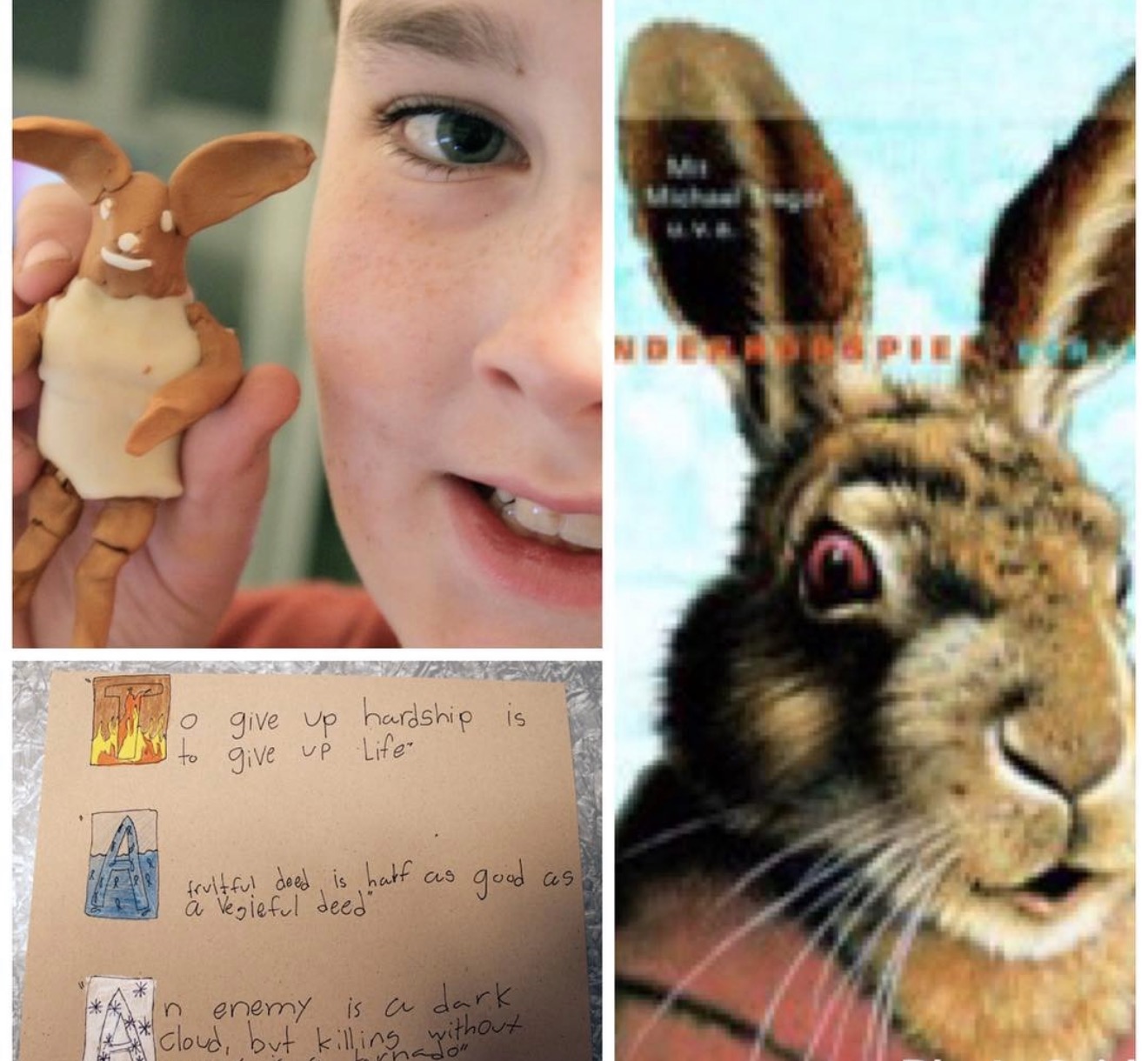
When my youngest son, Søren, and his literature circle buddies began reading Perloo the Bold, by AVI his imagination was captured. Perloo, the protagonist, is a peaceful, fairly introverted scholar much like my son. I think they hit it off from the get go.

So in this story, Perloo has been chosen to succeed Jolaine as leader of the furry underground creatures called Montmers. When Jolaine dies and her evil son seizes control of the burrow, Perloo must step up to the plate.

During the second week of thinking deeply about the story, my quiet, unassuming son slipped under the loft where we keep our overflow art supplies and came into the study arms loaded with a box of assorted Fimo clay. He got to work conquering his idea.

IMG_7565

When I asked him about the project he told me he was making a claymation film of Perloo the Bold. Søren spent many hours cleverly crafting characters and posing them in one position, then another using his camera to capture the motion.

IMG_7563

Midway in his movie making he set the project aside, went back to the art cabinet, this time for paper and colored pencils and began work on a set of original proverbs complete with ornately illuminated letters.

IMG_7732

With this task complete, Søren resumed progress on his little film. When the filming was complete, he enlisted his older brother, Taylor to compose original music for his piece. He was so proud when Taylor was done and his movie was complete. When I made one last suggestion, that Søren make a title slide, he knew just what to do, “I will make the title fade in, Perloo… the Bold. Yes, that’s it.” In a matter of seconds the slide was complete. Most fascinating of all, at least to me, was the strategic placement of the slide that was seemingly intuitive. He did not put the slide up front, but a couple frames into the movie to line up with a significant change in the rhythm of the music. Fantastic!


Søren’s creative response to this book not only demonstrates his deep understanding, but that his critical creative thinking skills are alive and well.

Sometimes it is the quiet, unassuming creatures that save the kingdom. Pondering this possibility, no doubt, inspired my son.

– Kim