Posted on

Writing is NOT Calculus!

When we teach a student calculus, we are teaching them to attend to small parts of a larger form. The word calculus comes from the Latin, meaning small pebble.

When teaching our students to write, we should begin by teaching them writing is an art form!

So why have we turned the art of writing into a calculus?

Great writing never begins with capitalization, punctuation, or grammar!

Great writing begins with an IDEA!

This is the rule of art: Form Follows Function

Writers must focus first on the function or purpose of writing—the idea. Once the idea is drafted in rough form, the writer digs back in and applies mechanics—corrects misspelling, capitalization, punctuation, embellishes word choice, improves syntax, and so on. Writing is a process.

So, let me clarify, I’m NOT saying don’t teach capitalization, punctuation, or grammar.  I’m simply saying that primarily focusing on mechanics over and above actually constructing ideas will never produce exceptional writing.

The best way to learn to write is to WRITE.

Who, when asked to write a sentence about an apple, will begin like this: “I will need an interesting adjective, an adverbial phrase, plus a dependent and independent clause,” with a deep dive into grammar and mechanics and rhetoric? NO! You will pick up your pencil and you will write your idea! Once you get an idea on paper, you will, as time permits, reread and polish that idea—improving word choice here and there, possibly rearranging phrases, correcting spelling and capitalization and so on. Writing, like all art forms, requires that the writer engage in a process.

For the past 30 years, in addition to educating my own children (who are now thriving adult readers and writers), I’ve guided countless students through our CORE Literature and Writing Discovery Guides. And what I’ve learned is this:

The key to success over time?

Choose your battles.

Each week in the CORE Literature and Writing Discovery Guides, students will encounter a writing prompt inspired by the week’s reading. These prompts will require different types of responses utilizing different types or domains of writing—narrative, observational, imaginary, persuasive, and so on.

The weekly writing prompt will:

1) Allow students to write their ideas in a vast array of writing domains.

2) Move students through the process of constructing ideas, from draft to polished form.

3) Motivate students to engage in the work of idea making.

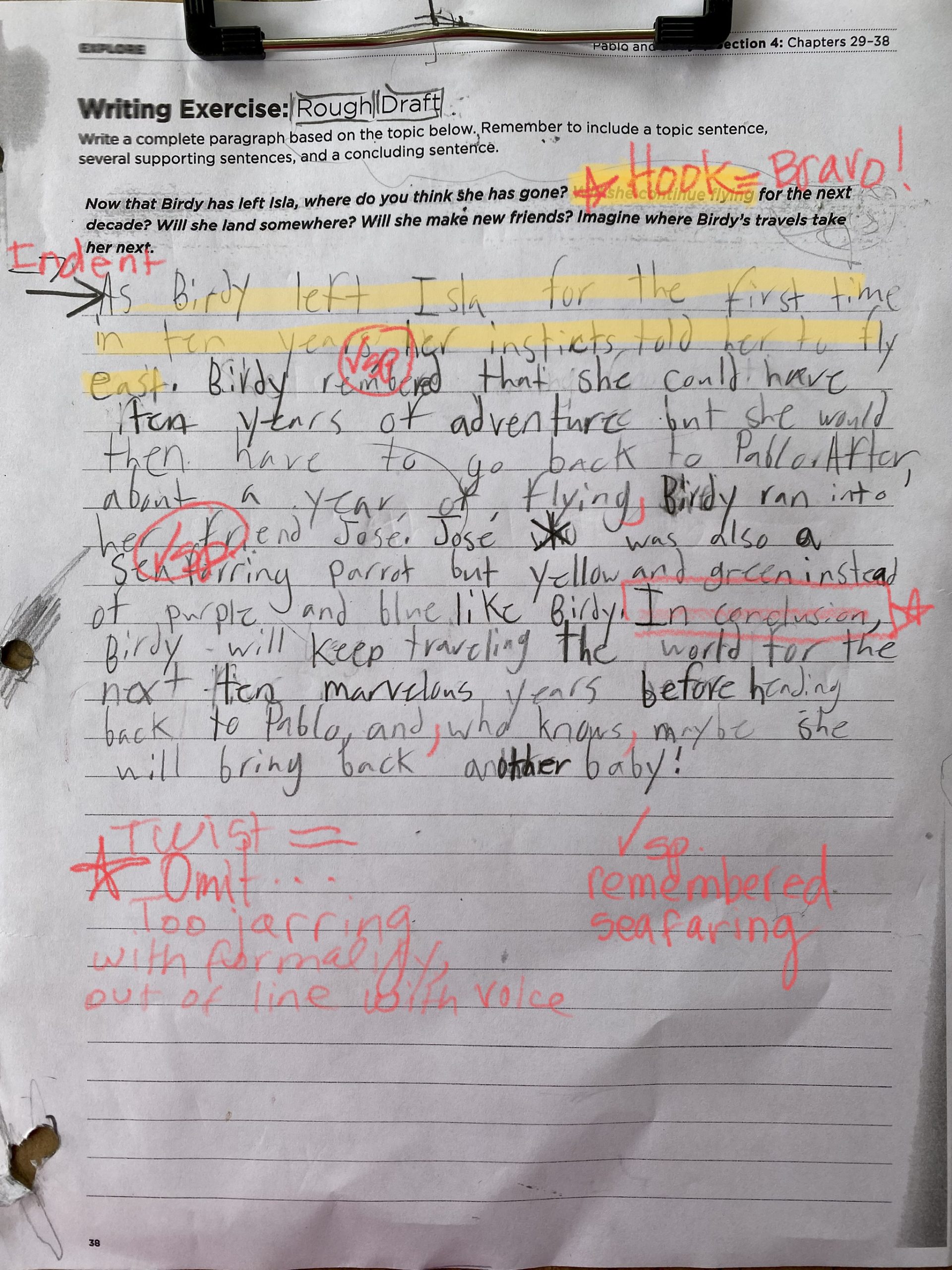
The best writing teacher is a mentor who encourages the student’s idea. This 4th grade student is responding to the Section 4 prompt in the Pablo and Birdy student guide. You can see by simply reading, that this young writer cares about the idea being constructed. You can see by examining the effort  made to communicate the idea coherently. Like any construction zone, this is messy, there are sections scratched out, there is scribble in the margin, there is darkened in pencil where spelling is being considered by the student writer. This is all GOOD!

How to Conference One-on-One:

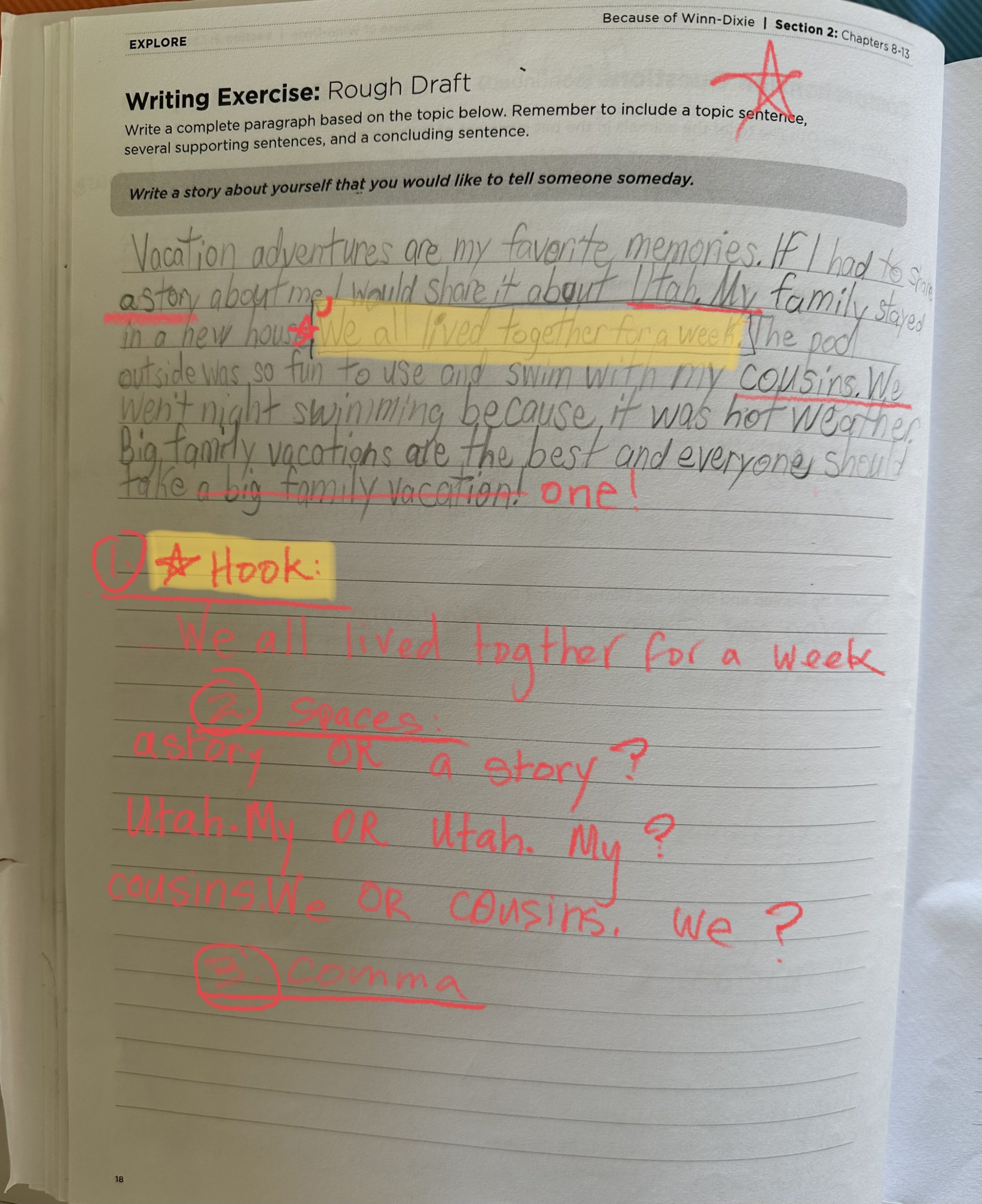
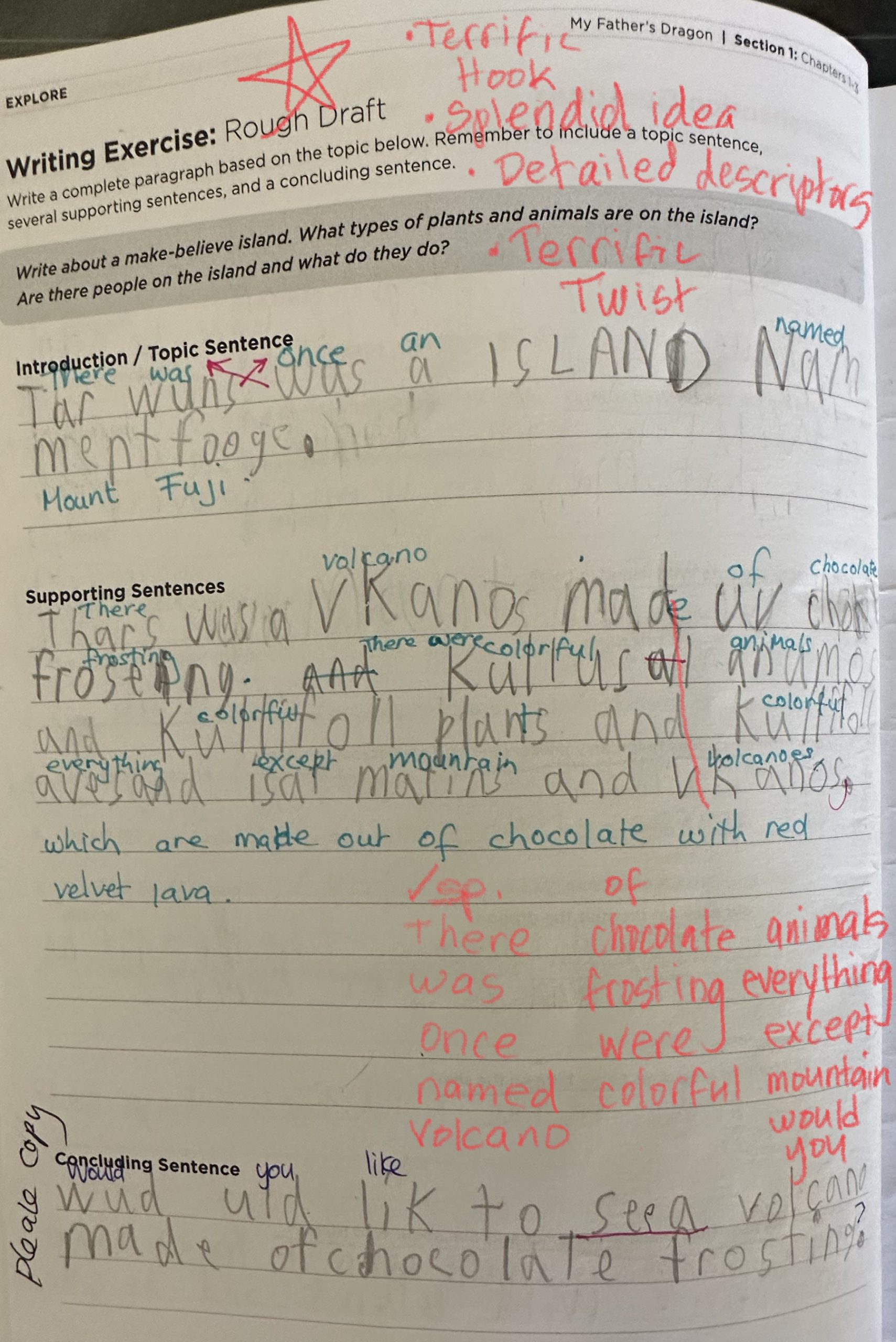
During the 5-minute conference (keep it pithy), have the student read aloud what is written on the page. Use your red pen to make edits and suggestions as the work is being read aloud. For this paragraph, I focused on the following 4 topics:

The HOOK

This is something that is a focus each week, teaching students to open their idea with a sentence that moves beyond a “topic opener” toward a sentence that actually HOOKS the reader into the idea. This writer, who had been working in our CORE for over a year, opened this with a really well constructed, informative sentence—a terrific hook! What’s so great about this sentence? Consider that less experienced writers might write something like this:

Birdy left Isla to fly away.

This sentence is a very flat statement, lacking the detail that engages readers to read on. But this type of simple sentence is often where young writers begin. The goal of the teacher is never to re-write the hook, but rather to encourage the student to add details. Why did Birdy fly away? Where did Birdy fly? In the sentence written by this student, there is also a bit of intrigue in the phrase “for the first time in ten years” that makes the reader sense a bit of courage in the act of flying away!

As Birdy left Isla for the first time in ten years, her instincts told her to fly east.

Indentation

The indentation is a small, but constant reminder.

Spelling

I typically don’t make writers look up misspellings in a dictionary, but rather create a checklist in one of the white spaces on the rough draft. As the student reads I am checking misspelled words, then, as I discuss what I’ve discovered after the read, I make the corrected spelling list. There are two misspellings in this paragraph.

Twist at the End

The TWIST at the end has a bigger purpose than concluding. The last sentence of an idea should keep the idea in the reader’s mind to ruminate and ponder. With the phrase “in conclusion” at the beginning of this student’s Twist, the reader is jarred from the flow of the lovely narrative. Something about this phrase is out of sync with the rest of the voice. The phrase is formulaic. Simply omitting it transforms the last sentence:

(In conclusion,) Birdy will keep traveling the world for the next ten marvelous years before heading back to Pablo, and, who knows, maybe she will bring back another baby!

This statement is actually a rhetorical question, so the exclamation mark at the end is acceptable.

Imagine now this sentence with different syntax:

For the next ten marvelous years before heading back to Pablo, Birdy will keep traveling the world, and, who knows, maybe she will bring back another baby!

This rearranging was not offered because I felt the student’s sentence (minus “in conclusion”) was lovely as is. However, it’s always good to imagine possibility and to have many tricks up your sleeve!

Ultimately, if you can read, if you can enjoy an idea, and if you can be delighted in the potential of language, then roll up your sleeves and get into the garden!


~Kimberly
Posted on

Person, Place, Thing: Writing Beyond the Noun

WE ARE HAPPY TO WELCOME OUR BRAND NEW UNIT:

Advanced Composition: Person, Place Thing as Long Form Research

Our unique scaffolding guides 11th and 12th grade students over the course of 30 weeks, each step of the way, in the process of researching and writing a long-research paper. This creative non-fiction project is an opportunity for high school students to participate in literary writing before heading to college.

While students will use the scaffolding twice (in both 11th and 12th grade), each paper will be unique depending on the topics chosen. Each year students will choose a theme that they will explore through a person, a place, and a thing. For example, our student sample explores the theme of tragedy via Abraham Lincoln, Terezin, and escalators. Another student might want to explore joy via Henri Matisse, Disneyland, and the yo-yo. Still another might tie hope to Emily Dickinson, the library, and feathers. The possibilities are endless! And because the topic is the student’s choice, and the work is scaffolded incrementally, the 30-week project is not overwhelming. Quite the contrary, students will rise into this work!


So click through to pick up your brand new copy just in time for the coming school year.

Posted on 1 Comment

Campfire for High School: Coalesce

Coalesce is a beautiful word. It means: to grow together; to unite into a whole. This word combines the prefix “co” (which means “together”) with the Latin verb alescere (meaning “to grow”).

There you have it.

Grow together. Combine. Unite. Fuse.

When students reach high school, it’s time to put all they have learned about reading and writing and thinking to task. It is time to coalesce.

That’s what high school language arts is all about.


Tip #10

Use a pencil!

First things first. We recommend all journaling and rough drafts be composed by hand with a pencil.  Yes, even in high school. Especially in high school! The pencil is s technology that is much better suited to the art of writing because it is less passive than keyboarding and therefore creates a stronger connection to the processes we use when creating an idea. At this level, students should, of course, be typing final, polished drafts of their essay, but the pencil is primary!


Tip #11

Publish ideas.

Writing is not meant to be brought into shape simply as an exercise on paper, given a mark, then crumpled and tossed to a trash bin! Writing is an idea whose purpose is to be shared. When a high school student composes an essay and moves it to a polished state, its purpose is to be read. Think of publishing, at the individual level, as a beautiful final draft of an original idea. Share this idea with friends, with family. Share the idea via snail mail or electronically. Look for opportunity to get your idea in print! The goal is to find readers.

Tip #12

Jump into your idea!

YOU are ready! High school is the time to  take the plunge. So confidently dive into a novel and come out the other side with an original idea to share with the world…


~Kimberly

Posted on

Around the Campfire: Essays and Tigers and Poetry, Oh My!


Let’s talk middle school.

In our CORE materials for middle school—Level 3 Reading & Writing Discovery Guides—students will continue the good work of writing ideas  they began in the Level 1 & 2 units.  With Blackbird & Company, your middle school students will develop the skills and confidence that will prepare them for high school reading and writing.

Tip #6

LOVE the red pen.

All writing comes into being through a process:
1. First comes the IDEA. Without an idea, the writer will simply stare at the blank page.
2. Once there is an idea in the mind of the writer, the pencil steps in to translate thoughts to words on the page.
3. When the pencil’s work is complete, the job of the writer is to become a reader. Encourage your students to RE-READ everything they write.
4. Empower students to use the RED pen as they re-read. Teach them to use strong words, to fearlessly re-arrange, and not be afraid to strike through.
5. Polish the draft, preferably in cursive…

Tip #7

Write in cursive!

Writing with a pencil by hand is a foundational skill. But it’s also a beautiful endeavor. I have fond memories of learning to form the ABCs in cursive. This work was quiet, slow, and mysterious. Yes, mysterious. My grandmother, who raised me, wrote little notes by hand and left them in various places around the house to my great delight. Her cursive was one of a kind, a lovely extension of her loving self.  It was not like any other by-hand note I’ve ever encountered in life. That’s the thing about penmanship. Penmanship is personal.

Tip #8

Essays are ideas!

An essay by definition is an attempt or endeavor. An essay is an exploration of an idea, a meandering journey like following a river. An essay is an opportunity to simultaneously explore an idea and to navigate your reader through its wonder. Great essays have the power to encourage, empower, and enlighten. For this reason essay writing should never be treated as a mechanical endeavor, but rather,  a pathway for the writer to communicate the depths of the heart and mind.

BIG ideas can be communicated through a range of forms. The essay is a specific form. But often students hear the word and suddenly experience writer’s block! Some become frozen by fear. This should not be the case! Remind students, an essay is simply an opportunity to explore an idea in more depth.

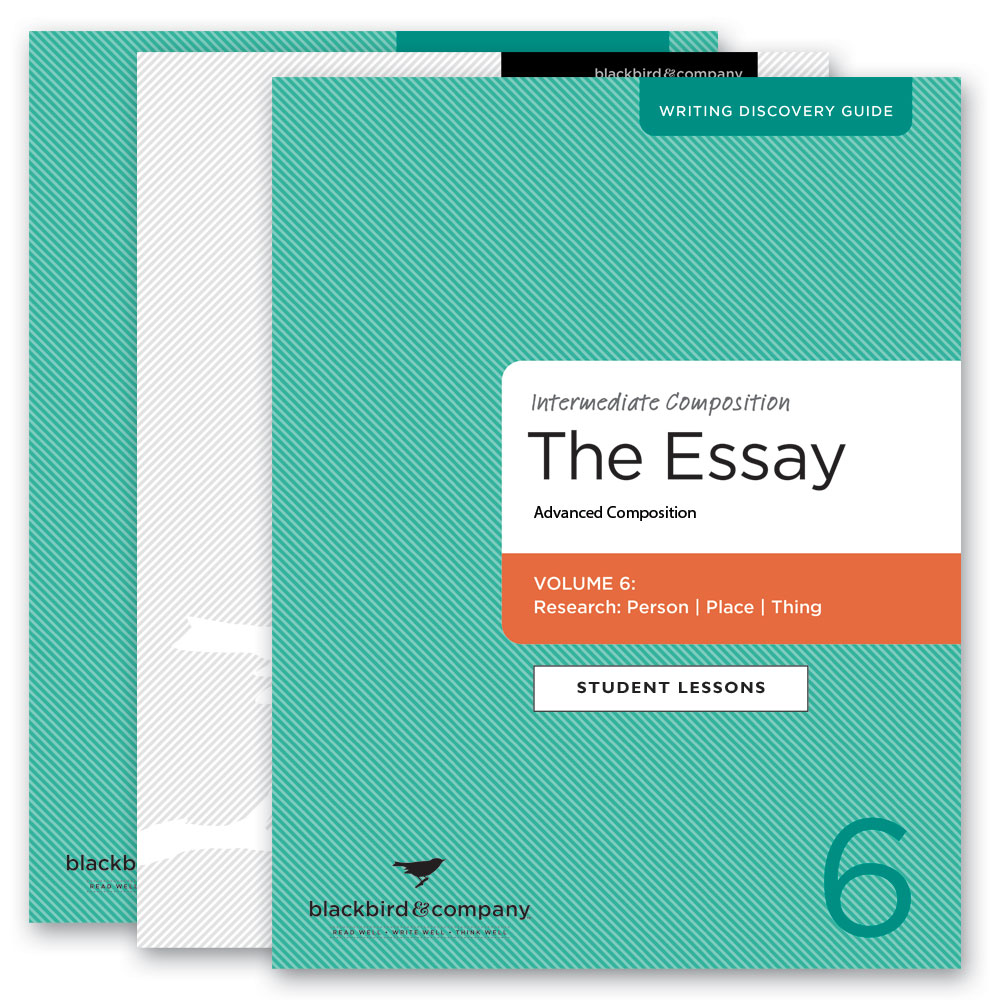
Introduction to Composition: The Essay, for  middle school students, provides the scaffolding that will enable students to shape meaningful essays.

Tip #9

Read poems // Write poems

T.S. Eliot said: “Genuine poetry can communicate before it is understood.”

Poetry is a close cousin to visual art. Poetry is an opportunity to paint—to paint with words. Writing poetry helps students not only learn that words have specificity, but that sometimes less is more. Writing poems help students discover, when it comes to words, possibility is vast. But the best lesson learned is this: it is always better to SHOW versus tell.

The snow is white.

Or

Winter wind gently lifts sparkling flakes, little rainbows floating and drifting around my head.

Your middle school students will discover the delight of reading poetry and the craft of writing poems as they are guided through Exploring Poetry.


~Kimberly

Posted on

Around the Campfire: Writing is a GIFT

Tip #5

Writing is a gift.

I’ve been teaching the art of writing for over 30 years. I DO NOT insist my students wrangle a lasso to subdue their grammar. Remember, Form follows Function. I DO insist they value their ideas, and engage in the art of communicating authentically. I tell them:

Wrap your idea like a gift you would like to receive.

Would a beautiful gift be wrapped in sloppy handwriting? Would it contain run-on sentences with no end marks e-v-e-r?  Would it be tedious to read with holes in the flow that confused the reader?

I don’t think so!

I tell my students: Your writing is a gift!

When it comes to learning language arts much of the exceptional work that your students will accomplish is subjective in nature tied to their ideas. As we moms and teachers value these ideas and challenge them to catalog and craft these ideas over time, literacy skills soar.

Ideas spring from a wealth of knowledge tied to curiosity. During the elementary years students from grade 3 through grade 8 will read 36 (yes, THIRTY SIX!) novels!  Their discoveries from reading tied to their observations and inspired by imagination and curiosity will enable them to engage in the weekly writing exercise—a simple paragraph communicating an idea unique to the writer. Students will compose 144 paragraphs. What is unique about our approach is that the paragraphs being composed will be meaningful to the writer. Unique. Authentic.

Each of our Literature & Writing Discovery Guides is designed to guide students into the art of reading and writing and thinking.  But there is an added bonus, Section 5. Please don’t skip Section 5!

Section 5 sets aside a week to think about, absorb, and apply the story as a whole. The goal of Section 5 of is to create a project to remind readers that stories are gifts that  keep giving.

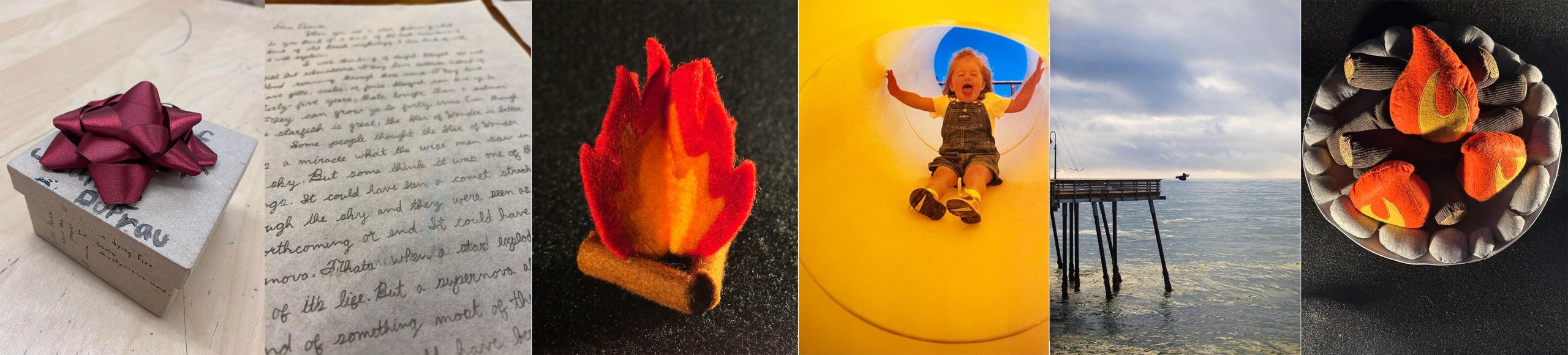
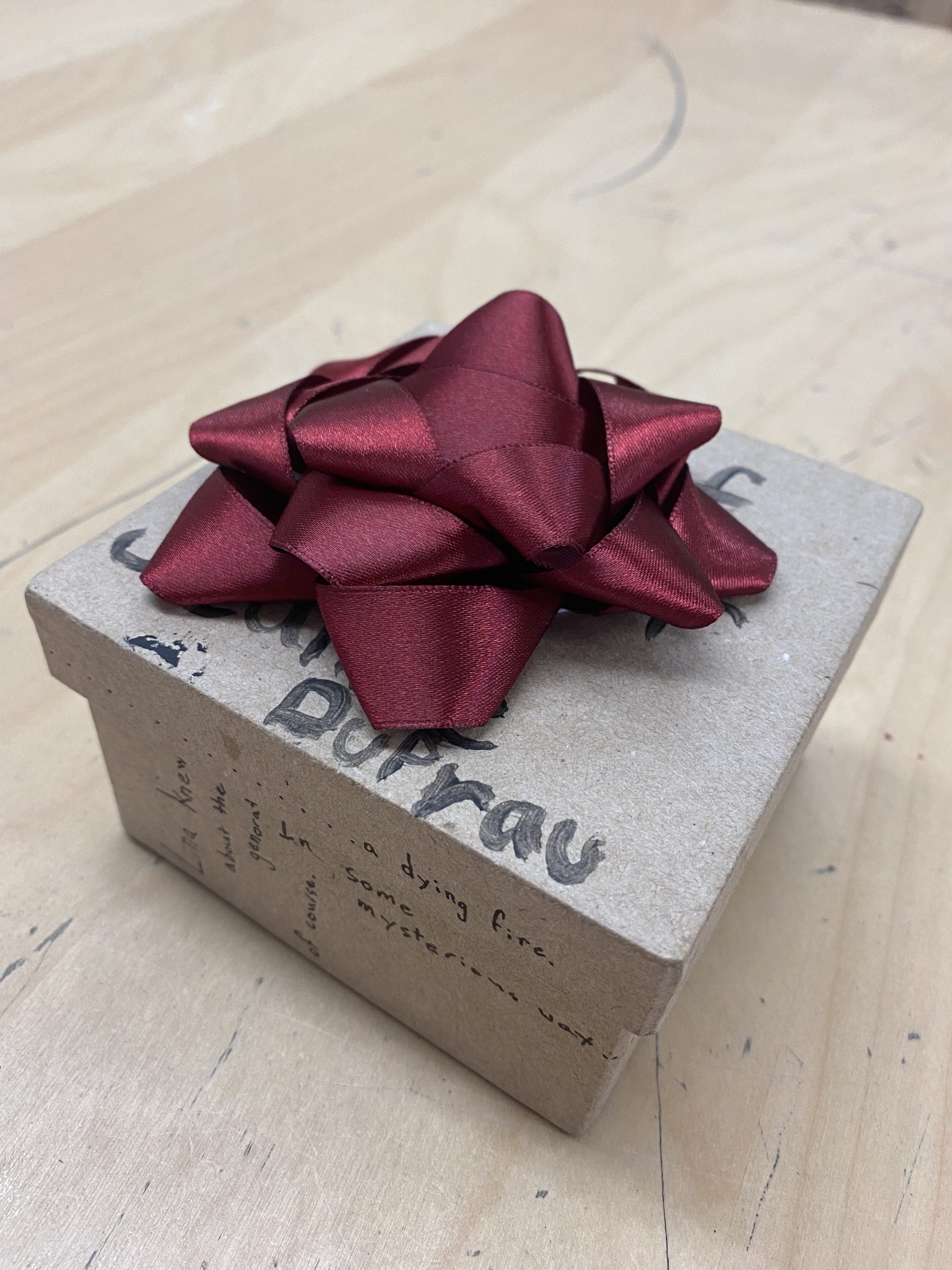
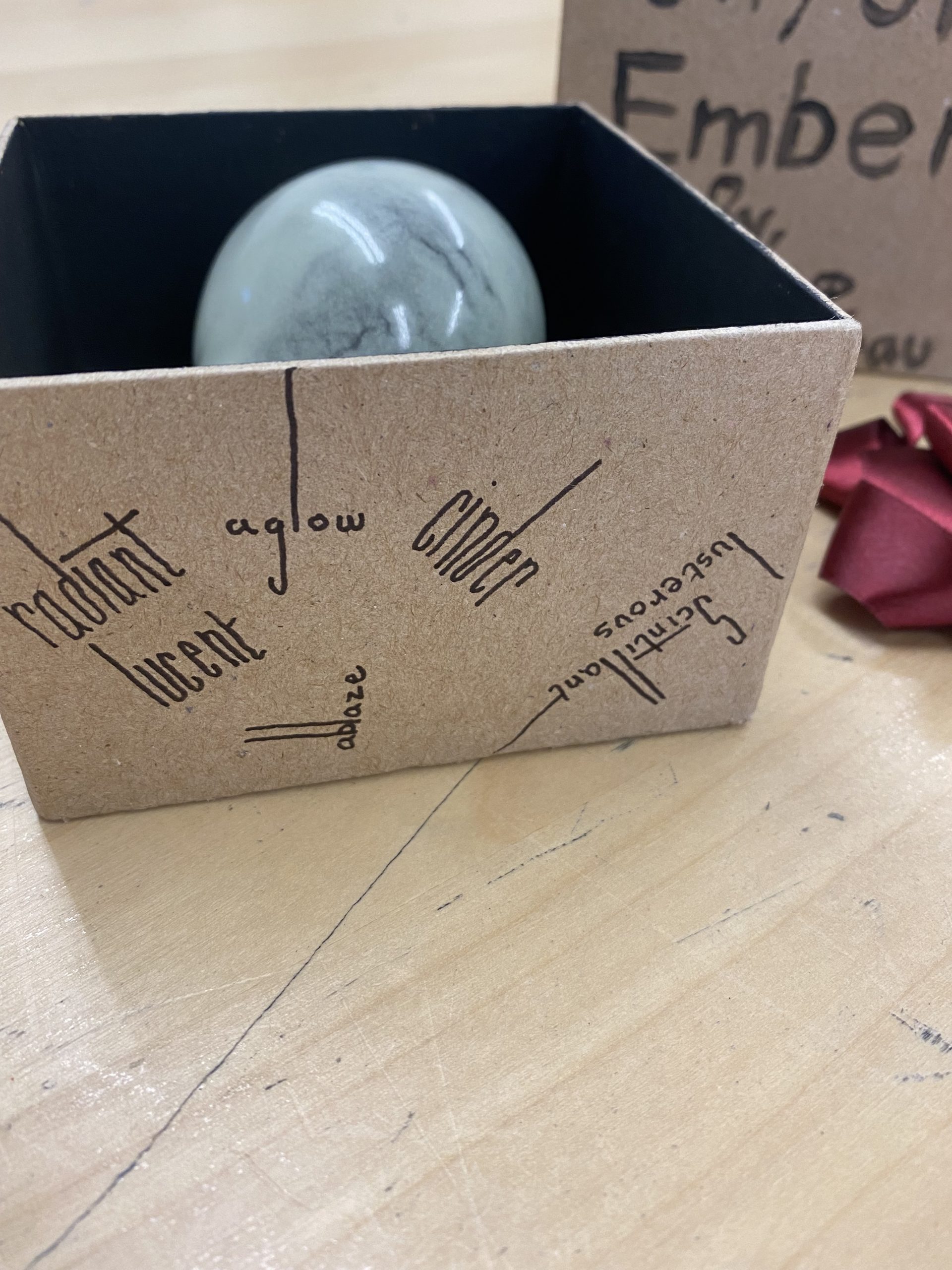
This project is tied to the story City of Ember by Jeanne DuPrau. This student used singular words related to the story, themes, and quotes to decorate the outside of a little box. Inside they found an object—a lightbulb vase—and filled it with glow-in-the-dark paint to visually represent the conflict of the story:

What will happen when the generator finally fails?

I love this little project. I love the story City of Ember. The takeaway for this teacher: If we were to reduce writing to mere mechanics, darkness would fall on ideas and we would be sorry readers!

Let them write ideas!


~Kimberly

Posted on 1 Comment

Campfire Season: Writing an IDEA is genius!

For those of you who are new to Blackbird & Company, and those who are seasoned users, pull up a log, and gather round the campfire!

During the month of January we’ll share stories and offer ideas to ignite curiosity and motivate enthusiasm as you and your students move into the long stretch of this coming school year.

Tip Number 2.

Begin 2023 by making the most important question the centerpiece of your approach to language arts:

“What’s your big idea?”

Valuing ideas is key to authentic writing . If your  student does not care, then the pencil will reflect this fact. The act of writing will be boring. The simple truth is that, once a student develops the confidence to write an idea, the work of writing becomes an intrinsically valuable exercise.  Our CORE Literature and Writing Discovery Guides challenge students to journal their ideas week after week.

Learning to Write Well! is simply-one-step-in-front-of the-other, I promise! If you partner with us and encourage your students to journal their way through six stories per year, you’ll be amazed by robust growth in your child’s ability to take an idea from a tiny seedling of imagination to a carefully crafted sentence, paragraph, poem, essay, and more.

There is NO substitute for consistently encouraging your children to write their ideas. No matter the level, kindergarten through high school, the long stretch of the school year is looming. We urge you to courageously press into coaching your child in the daily art of writing! Don’t give up! Come June, your students will have brought shape to significant original ideas as they moved through the CORE of our program!!! And, more importantly, they will have gained confidence in their ability to communicate. Writing an idea is genius.

GIVEAWAY(S)

Enter to win an easy light up fire pit built for the backyard and beyond from our friends at Solo Stove – plus, a Blackbird & Company Yeti Thermos (2 total)!

ENTER TO WIN NOW


Each student’s work is important work!

Read well! Write Well! Think well!


~Kimberly

Posted on 1 Comment

Welcome 2023! It’s campfire time…!

We want our students to read and write well. We want them to think creatively and to value their ideas.

Learning, no matter the subject, can be an awesome journey. The path can be filled with wondrous sights to delight the intellect and warm the heart .

But the opposite can also be true.

The opposite of an awesome journey would be an arduous one. The opposite of a path with wondrous sights to delight the intellect and warm the heart is one filled with brambles and thorns that discourage and weaken. On this journey, this path, learning is thwarted, the heart is discouraged, and some form of illiteracy is a common outcome.

Here are some literacy facts to ponder, some fact’s that we desire to change:

21% of adults in the US are illiterate in 2022

54% of adults have a literacy below 6th grade level

The state with the lowest adult literacy rate is California

In autumn 2020, research carried out by the Department for Education (DfE), the Education Policy Institute and Renaissance Learning found a learning loss of up to 2 months in reading in both primary and secondary pupils, based on STAR assessments of more than 400,000 pupils (DfE, 2021).

In October of 2020, an assessment of 112,000 children’s writing skills by No More Marking suggested that year-7 students were 22 months behind where they should be. (Christodolou, 2020).

Together we can do better! Right?

Learning to read and write and think is a lifelong journey.

We are creatures with an enormous capacity to enjoy and enact language.

Tip Number 1.

Enjoy the journey!


Join us ’round the campfire this month as we share tips to inspire happy learning and literacy.

As we look back on 2022, we Blackbirds are considering what is happening at large in the realm of literacy with a heart to help—one student at a time. Looking forward to 2023, the happiest news will be hearing stories of your students—your dear children—pressing happily into their important work, the work of becoming literate.

Read well! Write well! Think well!  =   Happy New Year!*


GIVEAWAY(S)

Enter to win an easy light up fire pit built for the backyard and beyond from our friends at Solo Stove – plus, a Blackbird & Company Yeti Thermos (2 total)!

ENTER TO WIN NOW


Posted on

The Art of Crafting a Letter

Thanksletter
The potential of the letter is expansive. Its form is deftly suited for all occasions.

Letters bridge.

Letters are common ground.

Letters are a gift.

But our slapdash digitalized pace has fashioned handcrafted letters out of style.

Let’s face it. Letters are a gift we scarcely know how to handle.

As a writing mentor I’m at odds with the pervasive mechanistic approach to writing that cultivates dread and squelches the writer’s voice.

The work of writing is first and foremost an art form. I want my apprentices to marvel at the potential of language to transcend communication.

Words, crafted well, echo in the heart.

I am always seeking new ways to engage young writers with the finer of art of crafting words, making every effort to inspire through writing meaningful exercises. My goal is to cultivate curiosity and motivate young writers to engage in the complex process of writing that will produce something that echoes their heart. When young writers are empowered that their ideas are meaningful, they raise an authentic voice. Grammar and mechanics are secondary to voice.

I’ve come to discover in my own process as a writer and, after twenty years of mentoring, that writers who value their voice will not only focus on the difficult work of unpacking the rules of writing—grammar and mechanics—but will also integrate and apply that work. 

Might the art of letter writing be revived?

This said and the Thanksgiving season upon us, I’m giving my writing apprentices a gift that I want to share with you, a gift in the form of a challenge:

This week, craft a letter of Thanksgiving. This week give words.

Here are some tips that will help your writing apprentices get started: 

1. Riff on another writer’s work.

To begin the Thanksgiving letter, encourage writers to begin by listing some facts about Thanksgiving. Next, read Abe Lincoln’s 1863 Thanksgiving Proclamation. Think about these words being written in the midst of Civil War. How are these words relevant in 21st Century America? Now have them read Lincoln’s first sentence closely. Instruct writers to use Lincoln’s quote at the start of the letter and to do the work of translating the sentence, “I think Abe Lincoln meant ___________.”  Finally, challenge the writers to use the phrases “blessings of the fruitful fields” and “healthful skies” to create a personal metaphor of thanksgiving. What might they represent in the apprentice’s world? Riffing on the work of a master mentor such as Abe Lincoln promotes specificity of language, here, the fruit will take the form of gratitude. 

“The year that is drawing towards its close has been filled with the blessings of fruitful fields and healthful skies.” – Abe Lincoln

2. Utilize parallel writing.

Begin with an interesting quote:

“I would rather sit on a pumpkin, and have it all to myself, than be crowded on a velvet cushion.” – Henry David Thoreau

Find a pattern and craft a sentence of your own your own:

I would rather _________________________ than _________________.

I would rather consider the diversity in a pile of freshly raked fall leaves than wander aimlessly in a grumble of boredom.

3. Make your letter beautiful.

Writing is a process that begins with an idea.

Ideas must be forged to words on a page.

Never skip steps.

Rough drafts matter!

But once your drafting is done, once every word is as it should be, then (and only then) dive into the work of making your words shine on the page. Writing is gift and a gift is never wrapped until it is complete.

Once upon a time writers were apprenticed in the art of handwriting, were compelled to practice the basic shapes and orientation of letterforms. Once, writers were required to master a script, establish a hand—slant and flourish—one that was both legible and lovely. Now, there is not much value placed on this work.

Must the art of handwriting become yet another artisanal extracurricular? Engaging in the process of beautifying forces the young writer slow down to focus on words and phrases in a way that typing can’t, promotes the self-edit to a whole new level. I ask my apprentices often, “Isn’t a handwritten document more precious than a computer generated one?”

– Kim

Posted on

Connect the Dots: Craft a Letter


What do the circulatory system, WW1, the life-cycle of a star, Samuel Adams, great characters from exceptional stories, and a single spring from the workings of an ink pen have in common?

Why human potential, of course.

Interdisciplinary endeavors provide the grand opportunity to perch students high above the realm of facts and mechanics, inspiring them to weave connections across disciplinary boundaries as they reflect on common themes, symbols, and purpose.

What better way to fortify learning?

An interdisciplinary endeavor challenges students to weave new knowledge to what is previously known. Challenges students to assemble and construct as they learn ignite curiosity.

And so letter writing is a tradition in my writing workshops. Letters crafted by hand. From the pencil markings scratched on paper to polished draft. The kind that take nearly an hour to read, to seep in and savor. Letter writing empowers student writers to share the connections they are making. Interdisciplinary connections. Connections at the intersection of acuity, creativity, and and ingenuity. But most important, engaging in the art of letter writing demands authenticity. Letter writing requires writers to raise their voice.

This year, letter writing at the Guild coincided with a wonderful Miss Lori (our Historian in Residence) lesson. When introducing students to The Committees of Correspondence, she first asked for a definition of the word correspondence and was met with the chirp of crickets. Not one could conjure a working definition.

“What does it mean to correspond?”

Crickets.

I imagine she stopped for a bit of word study before proceeding: “To correspond is to communicate by exchange of letters. Correspondence is a letter or letters that passes between correspondents (the letter writers).”

“Ohhhhhhhhhh!”

This set the stage for Miss Lori to continue, “The American Revolution would have never succeeded if it weren’t for letter writing.”

Think Samuel Adams. Back in 1772, he organized a network of letter writing—The Committees of Correspondence—to keep colonists informed of British actions against the colonies, and to plan a concerted response. Letter writing united the 13 colonies and girded their loins for revolution.

Letter writing is a terrific domain to teach a writing truism: one idea leads to another. And when it does the reader is engaged, intrigued, mesmerized.

At the Guild, letter writing exercises are a grand opportunity to inspire young writers to connect the dots, dots that they might not have imagined could be connected. And as the correspondents weave this disparate knowledge to one, they bring permanence, relevance, and significance to what is learned.

Trust me, it requires courage to weave the circulatory system, WW1, the life-cycle of a star, Samuel Adams, great characters from exceptional stories, and a single spring from the workings of an ink pen to a cohesive letter of consequence. But the task is worth the effort. So pull out some paper, think about this past year’s learning, connect the dots.

Letter writing is kindly, generous, revolutionary.


-Kim