
In the case of collective nouns, we might more aptly title this post Wonderment in Numbers!
Believe it or not, collective nouns are rooted in medieval sport! It all began with the hunt, the animals encountered, and a woman named Juliana Berners.
A scurry of squirrels.
A bouquet of pheasants.
A rangale of deer.
Back in 1486, she was the first woman in the English language to publish a book, The Book of Saint Albans. This particular book confesses her thoughts on medieval hunting, hawking, and heraldry—hobbies of noble men. Included in the book is an appendix of over 150 collective nouns for animals encountered during the hunt. These nouns tickled the ears of her readers and, over time the list grew.
The thing about a name is that it reveals something of the very nature of what is being named. Some are named for a behavior characteristic, like a “watch of nightingales,” birds singing long into the night. Some collective nouns are determined by the nature of the work performed, think “a yoke of oxen” and “a burden of mules” and you will see what I mean. Still others are named according to a personality trait, “an unkindness of ravens” and “a murder of crows” are infamously applicable.
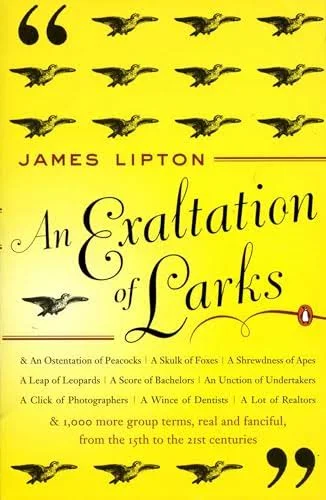
Collective nouns caught on in the Middle Ages, but it didn’t stop there. James Lipton, published, An Exaltation of Larks back in the 90s, at the tail end of the 20th century. He reminded us to look back at the origin of this special type of naming, but to also carry the activity of naming forward. The very nature of the English language is like clay in the potter’s hands. Twenty-six letters enable us to transcribe the 44 sounds that make up all the words in the English language we can possibly imagine. Put those words together to form phrases and sentences and paragraphs and poems and essays and novels and songs! But also, consider inspiring your students to use words in new ways to carry on the sport of naming.
I’m thinking right now of Great-grandma Garnet’s boxes of unorganized photographs—the “whisper of photographs”—and just like that, voilà, a collective noun.
~Kimberly