Posted on

Be Adventurous: Read a Book

Stowaway Bundle


So here’s what Karen Hesse knew to be true:

Once upon a time, in the summer of 1768, Captain James Cook sailed from England on H.M.S Endeavour, beginning a three-year voyage around the world on a secret mission to discover an unknown continent at the bottom of the globe. What is less known is that a boy by the name of Nicholas Young was a real live stowaway on that ship. Yep, eleven year old Nicholas Young really did stow away on Captain Cook’s voyage around the world! And what did Captain Cook do when he discovered the stowaway? Well, he commissioned Nick into the Royal Navy, made him assistant to the ship’s surgeon aboard the Endeavour. And, as if this is not enough, Nick was the first person on Captain Cook’s ship to spot New Zealand and later explored Antarctica.

Karen Hesse took this little bundle of history and spun a fictional journal filled with hurricanes, warring natives, and disease, as Nick discovers new lands, incredible creatures, and lifelong friends.

Be adventurous: read Stowaway!


~Kimberly
Posted on

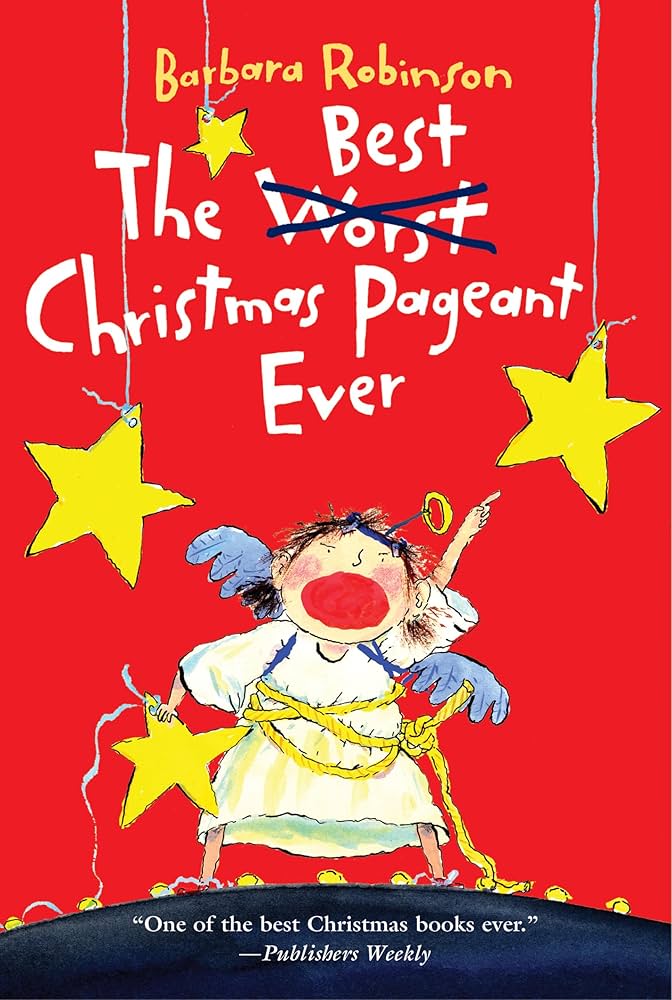
The Best Christmas Read-Aloud EVER!

What happens when the worst kids take over the Christmas pageant?

The Herdman kids lie, steal, smoke cigars, swear, and hit little kids. So no one is prepared when this outlaw family invades church one Sunday and decides to take over the annual Christmas pageant. Thanks to the Herdmans, the pageant is transformed into the most unusual anyone has seen and, just possibly, the best one ever.

After reading the book, whip up some kettle corn and watch the film!

~Kimberly

Posted on

Think Persona Poem

Star

What do Man with a hoe, by Jean-François Millet and Starbucks have in common?

Being an avid follower of Van Gogh (who created a drawing inspired by Millet's Man with a Hoe), I recognized at once Starbuck's nod to these great artists. Brilliant.

Millet was a thoughtful artist who cared deeply about the dignity of the commoner. As I stood in line waiting for my pumpkin-spiced latte, I whipped out my phone to consider Millet's wisdom via Google and consider why in the world Starbucks would echo his painting (a painting that I've stood before on many a trip to the Getty). This is what I discovered:


This: "Sometimes, in places where the land is sterile, you see figures hoeing and digging." "From time to time one raises himself and straightens his back, …wiping his forehead with the back of his hand." 'Thou shalt eat thy bread in the sweat of thy brow.'"

And this: "Is this the jovial work some people would have us believe in?" "But nevertheless, to me it is true humanity and great poetry."

And this: "To tell the truth, the peasant subjects suit my temperament best; for I must confess, that the human side of art is what touches me most."

And then Van Gogh's voice chimed in: "I feel that there is nothing more truly artistic than to love people."

And I thought: Persona Poem, yes, yes, yes!

Personae, in Latin, this form of poetry is a terrific opportunity for pretending on the page. Several years ago, when I was teaching the feudal system and medieval art, I had children pretend to be stationed in various social roles and to create persona poems to help them explore daily life in medieval times. The persona poems were brought to life in a collection of short films.      

So, what do Man with a hoe, by Jean-François Millet and Starbucks have in common?

For me, two words come to mind: Important Work.

This year at the Guild our persona poems will be inspired by Millet, Van Gogh, and yes, by Starbucks.

Stay tuned.


-Kim 

Posted on

Stowaway with Nick

Stowaway Bundle

During the summer of 1768, Captain James Cook sailed from England on H.M.S Endeavor’s first voyage to explore the little known southern hemisphere. Eleven-year-old Nicholas Young was a stowaway on this voyage. True story.

Karen Hesse invites us to delve into this pocket of history alongside the stowaway and experience the astonishing adventure alongside Nick.

After reading, encourage your students to recreate the adventure in a meaningful and lasting way. Section 5 in our Literature and Writing Discovery Guide will present opportunities to move beyond mapping out the story details to identify the impact the story had on the heart.

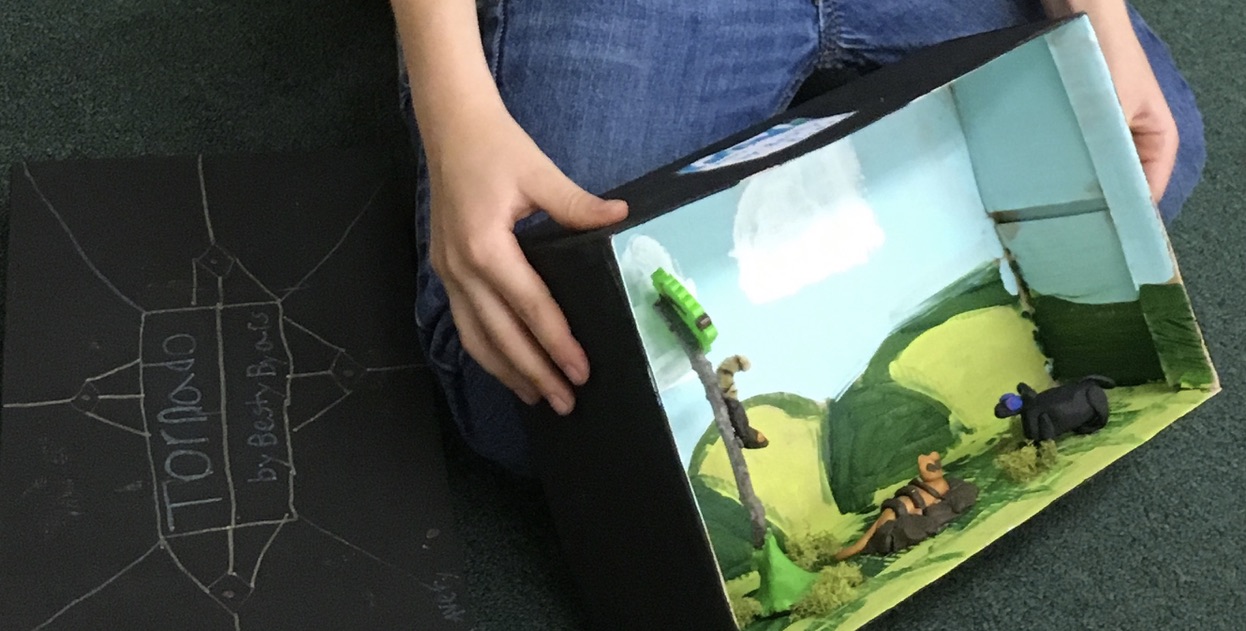
My youngest son, Søren, spent significant time and effort researching the ship itself and committing his personal reflections to marks burned on wood. Creativity tied to a great story helps the reader retain and apply in ways where the essay falls short.

Captain Cook reminds us sky’s the limit, “Do just once what others say you can’t do, and you will never pay attention to their limitations again.”

~Kimberly

Posted on

After Books, Tinker.

Every time you finish reading a book, think tinker.

The word “tinker” comes from the middle English referring to people who engaged in the work of patching worn tin kettles. When I was young, tinkering was a crude, quick fix of any object regardless of the medium, be it tin, wood, brick, or fabric. My great-grandpa Ted was a tinker. I loved exploring the bits and bobble in his shop, creating assemblages of junk while he merrily tinkered. Back then tinkering was not considered an art form, it was something more akin to the household junk drawer. When I was young, tinkering was pretty much DIY before the acronym came to be.

Fast forward, I LOVE how the growing maker movement has brought a deeper meaning to this wonderful word. Nowadays, “to tinker” is recognized (rightfully so) as a significant step in the process of making, in the process of bringing shape to ideas.

What better way to deeply integrate and apply knowledge gleaned from great stories than to thinker an idea to shape?

So how to begin?

Think shoebox. Think wire. Buttons. Tags. Cork. Think ric rac and ribbon. Paint Glue. Hooks and chain. Clothespins and pompoms.

Think junk drawer and you are moving in the right direction for a tinker project.

So the next time your child reads a book, when it’s time for Section 5, download a planning sheet and think tinker time!


-Kim

Posted on

Look See: Poem of Spongy Bone

Sponge

Write a poem incorporating an interesting fact you’ve recently heard or read. It doesn’t necessarily have to be concerned with the physical sciences, although that is a great place to start. Andrea Gibson uses this device in her spoken-word poem, , using lines such as “‘Cause it is a fact that our hearts stop for a millisecond every time we sneeze / And some people’s houses have too much dust” and “It is a fact that bumblebees have hair on their eyes / And humans, also, should comb through everything they see.”


Example:

This Isn’t Happiness

They say that the average person laughs 15 times per day… each time I hear that, I wonder whether that includes the people whose cats have just died or who just spilled coffee on their blouse… I wonder whether if it includes those people who don’t really laugh, but exhale through their noses in unusually quick succession with laughter in their eyes… and I wonder whether those good laughs, the kind that rips your stomach raw and warms your eyes with saltwater, count as two (or maybe fifteen) of the kind of laugh you measure out during irritatingly semi-casual events.


Now, visit our . Can you spring from here to your poem?


-Constance

Posted on

The ABCs of Art and the Lively Lines of Picasso

Owl

Picasso was a master of line. Check out his . Try to make an owl of your own.

Now, think poetry. One of the significant ABCs of poetry is sound. Try to write a poem using only this one element. Try to repeat one sound throughout your poem, write a poem based on a singlular sound.

Example:


hoo of an owl

frosted stars twinkle

and the hoo of an owl whittles

 a tune on shadowy branches

-Kim & Constance

Posted on

The ABCs of Art and the Oeuvre de Léger

When I teach children to read and write, I begin with the ABCs—phonics to words to phrases to sentences and beyond. The possibilities are limitless.

When I teach children to appreciate and make art, I again begin with ABCs—line, texture, value, shape, and color.  Again, the possibilities are limitless.

When it comes to introducing the potential of shape in visual art, French artist, Fernand Léger (1881-1955) is always invited to the Guild. 

In art, we begin by looking. And for this Léger lesson we looked at one of his wonderful "studies" titled, Étude Pour L' Anniversaire, 1950 (pen and ink on paper):

Leger3

And after a thorough session of looking and discussing all the wonderful integrated shapes, the drawing began:


Leger1

The strokes were sketchy at first, until the apprentices were satisfied that their shapes echoed the original work.

Next, we inked in the drawing, erasing pencil lines as we went. 

Leger2

When the observing, sketching, and inking was completed, we stood back from our studies and discussed what happens next by exploring Léger works related to his study:

Leger4


L’ Anniversaire, 1950 (gouache on paper)

Leger5

Birthday, Two Women, 1950 (oil on canvas) 

Leger6

Birthday, Two Women, 1950 (oil on canvas) 


-Kim

Posted on

The Storyteller

Fade_Rose

Write a small story that describes the parts of an object or characteristics and memories of a person, in order to tell a story or reach a conclusion about a certain character, just as the fading parts of this rose imply a history of aging and weather without words—by showing, not telling. The House on Mango Street, Esperanza vicariously describes her family by describing her house.

Example:


Red Tennis Shoes


Every month, my mother tells me to throw out my red tennis shoes. 

They’re about two sizes too small (left over from tenth grade, because tenth grade was the best year, this liminal space where you weren’t the school baby and you didn’t have to worry about WHAT YOU’RE GOING TO DO FOR THE NEXT FOUR YEARS because God knows that’s too much responsibility, and all you need to worry about is whether you’ll get an A or a B, or whether you look better with a red or pink lip.)

One shoe’s lacings have been torn into frayed ribbons (because of my brother’s dog who mistook my shoes for his red ball, and I would say that it was stupid except for the fact that he often couldn’t recognize one thing from another, like my handwriting from my mom’s or fun from fulfilling, and yet you know she still loved both of them for their eyes)

They’re still covered in dirt stains (from the time we went camping in the Appalachians and I saw trees burst into photosynthetic flame for the first time, and the image of a ring of massive trees blossoming into red around a stagnant lake is still so sharp)

Every night I go to the trash to throw them out, I turning back to the house in the distance with its laughing yellow light, dangling their relieved weight from my hands.


-Constance

Posted on

Moths of Summer

Moth2


In the scheme of biological classification, butterflies and moths fall into the Order we call Lepidoptera. Typically speaking, butterflies are brightly colored diurnal creatures. Moths are nocturnal and lackluster. But there are some exceptions. Leave it to Van Gogh to lend his artistic curiosity to the Great Peacock Moth that began with a sketch, and ended in a painting.

We began with a close observation of the artists palate, imitating each color with acrylic paint. We stored the colors in pint-sized mason jars knowing that the paintings could not be accomplished in one sitting.

The apprentice painters began by lightly sketching the composition in pencil on canvas, all the while marveling at Van Gogh’s marvelous composition.

Next came the brushes, the paint. The artists began with the lighter colors, blocking in the delightfully organic shapes, until layer upon layer, the moth began to emerge in its surroundings. The last colors to be painted were the deep blue-green outlines and the popping crimson accents.

I’d like to imagine Van Gogh smiling.

Metamorphosis is transformation.


Moth

-Kim