Posted on 2 Comments

Sneak Peak: Welcome Hatchlings!

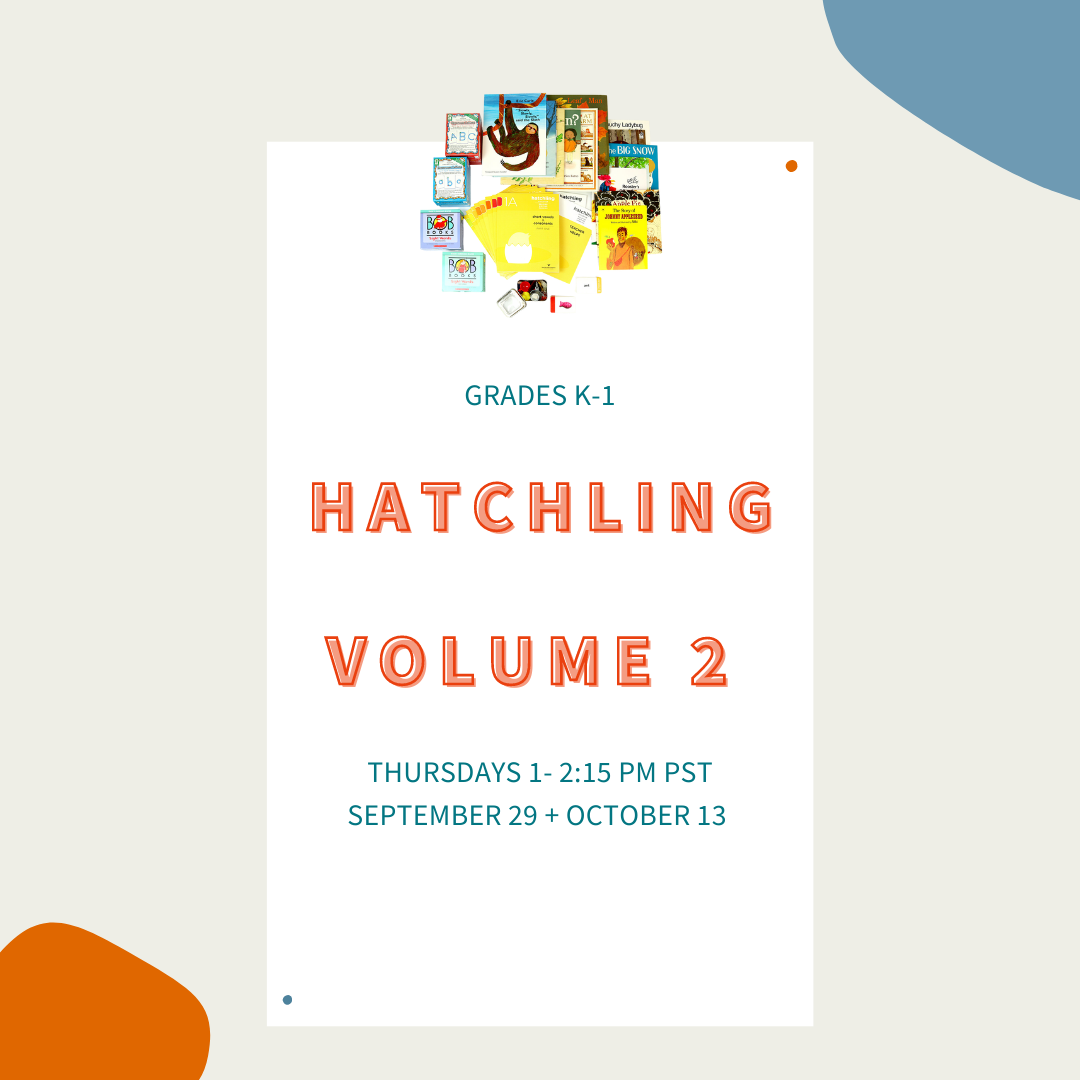
We are so pleased to announce the arrival of our Hatchling Discovery Guides! This integrated, multi-sensory approach encourages Kindergarten through 2nd Grade learners to discover the complex connections between reading and writing the fun way.

 Our Hatchling unit is designed to be paced over the course of two years as a comprehensive language arts program that introduces all the skills necessary to read fluently and write fluidly. Over the course of 52 weeks (2 school years), your little ones will discover the joys of reading and writing, delighting in the process.

Each year the phonics of reading and writing is introduced in a logical progression from initial sounds to more complex patterns in three concise student journals. Our teacher guide is designed to help you mentor and inspire your students through their individual important work. There are no lessons to prepare, but rather time to come alongside.

Each week students will:

  • Learn and practice phonics using miniature objects and colorful didactic flashcards 
  • Utilize a moveable alphabet and the sand tray to reinforce learning
  • Read, write, and acquire sight vocabulary
  • Read exceptional literature
  • Create meaningful journal entries
  • Engage in line-work activities that strengthen developing fine motor skills

complete first grade language arts

For second year students in 1st or 2nd grade, we’ve added an element that teaches the four types of sentences and offers an opportunity to practice the art of sentence crafting using the miniature objects. Mazes, too, are a fun addition at this level, further developing fine motor skills and logic.

And, in line with all our offerings, we’ve tied writing to great stories. What better to spark the child’s imagination than an endearing tale?

All this, plus “just right” readers along the way, enables your students to practice phonics as it is being introduced.

We believe the best kind of learning is happy learning . Hatchlings will open the door to the wonder and potential of language, inspiring curiosity and independence along the way. Both Volume 1 and Volume 2 will be available for pre-order at blackbirdandcompany.com April 1st. Hatchlings will begin shipping early June to those who place early orders. Stay tuned for more details.

Posted on

Think Fall

earlybird fall bundle


I love fall. I love the sights. I love the scents. I love the texture of leaves crunching beneath my feet. I love the snap of ripe apples being twisted from branches.

And I love the stories of fall. With my youngest, Søren, I worked through our Earlybird Fall Literature and Discovery Guide three times (once at the beginning of kindergarten, once at the beginning of first grade, and once at the beginning of second grade)! Count them, three.I’m totally serious.

Three is an important number.

There is so much happening intellectually in the primary years—Kindergarten, First, and Second Grade. These first three years of school are when children are learning the basics of reading (decoding) and writing (encoding).

My son the kindergartener loved stories and he loved to draw. Copying words became an extension of this fun. We would read the stories together and chat our way through character descriptions. I used a hand-held whiteboard to capture his ideas so he could happily copy them as art into his journal. We enjoyed a fall craft each week, that was a given. When we read, How to see an Apple Pie and See the World, we made miniature apple pies. When we read the Scarecrow, we made a scarecrow doll. When we read Apple Picking Time, we drove for two hours to pick apples, taste apples, and after that, we made apple prints.

The second year, and the third after that, when I brought out the books, my son did not groan. My son was delighted to see his seasonal friends! The only thing that changed during these second and third passes was that my son was able to utilize his knowledge of language so far to encode his own ideas with me by his side. When we talked about the characters in Apple Picking Time, he was able to write a single words like “brv” for brave, and “frind” for friend to describe Anna. He was able to complete sentences from the word bank on his own. His journal time became an independent exercise too. We expanded our crafts to include a full-sized scarecrow, but we still made our traditional mini-apple pie.

During our third, and final pass at the unit at the beginning of 2nd Grade, Soren came loaded with ideas, “Mom, when we read Barn Dance, can I make the characters out of Legos? And when it came time for apple pie, he peeled and cut the apples on his own (with me hovering close by), measured the flour (dusting the kitchen with twice as much required for the recipe), and rolled the dough “all by himself” (for the most part). That year character descriptions included a deeper ingrained knowledge of phonics—friend was at last “friend” and “brave” was at last brave”—and a peaceful sense of independence. I knew that this would be the last fall we would work through the guide. Third grade would bring a new adventure with our Level 1 guides.

Soren did not work through any other Earlybird selection more than once. But he did work through them ALL during the primary years (kindergarten and 2nd grade). And I’m so glad he did. He worked through Level 1, Level 2, Level 3, and Level 4 too!

My son is now seventeen, and, looking back, I can say with certainty that it took all those years for him to develop and percolate his reading and writing skills. Literacy is an immensely complex, nuanced art. This year Søren is a high school junior interested in philosophy reading the likes of Kierkegaard (his namesake), Hobbs and Locke and Whitman. Who would have known back when we were picking apples? But I have no doubt in my mind that he is able to wake through the work of these wordsmiths because of the traditions we began back in kindergarten.

I am convinced that the longitude of utilizing our approach—the Blackbird & Co. approach—gave him the stamina and the skills to think deeply about great books and to formulate original, well-versed culminating ideas.

It’s still fall. Why not begin today? Snap an apple off the tree. The harvest season is small and precious.


~Kimberly

Posted on

after Robert McCloskey

McCloskey

During the fifth week of Discovery, Section 5 encourages each reader to develop a creative culminating project with options that provide a variety of ways to demonstrate deep understanding of the book. Your students will not only have a chance to demonstrate their originality, organization, clarity of purpose, and critical thinking skills, more importantly this culminating endeavor will allow them to show off what they have learned in their own, uniquely creative way.

Students really love sharing their culminating thoughts about great stories. Encouraging readers to create Section 5 projects with a high level of execution teaches them that their ideas are valuable and builds integrity into their work.

This sweet and yummy final project was sparked by our Robert McCloskey Earlybird literature discovery guide. After reading Blueberries for Sal, this student was inspired to do a little research on blueberries and bake muffins for his friends! Learning over great books is so rich!

Take a look at our Flickr page for some great examples of culminating activities. We’d love for you to share your ideas.

-Tracey