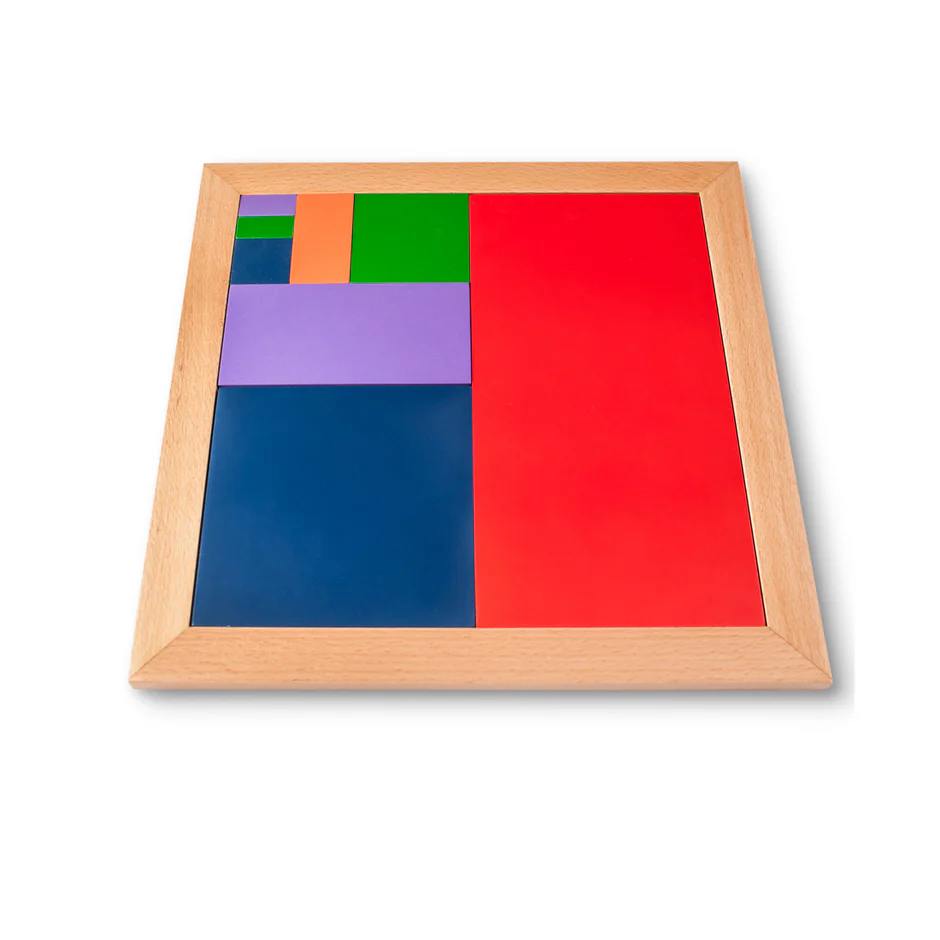
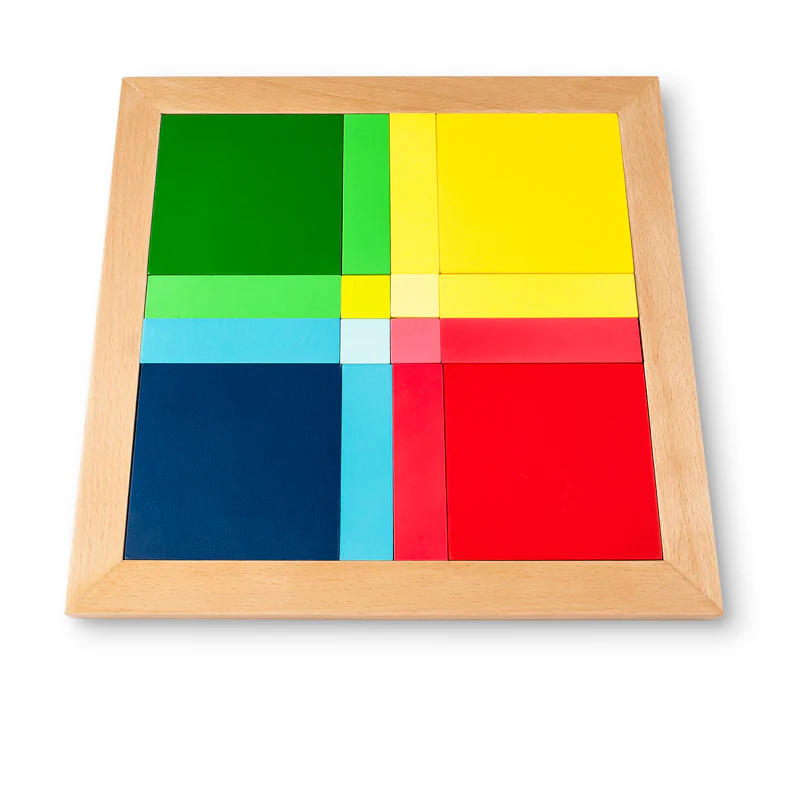
Once again, hop on over to Red Hen Toys and pick up the Binomial Square puzzle. Of course, this Montessori / Froebel inspired material is designed to prepare students for more complex math instruction down the line—proportional reasoning, base 4 numeration, polynomials and more.
But for this summer activity, the goal is to integrate the activity into the art of writing. Begin by presenting your student with a blank journal, a pencil and some colored pencils. Here is a little nugget to spark curiosity:
Did you know all multiplication problems can be represented by a rectangle?
Copy this sentence and move on to create original questions in the journal.
Encourage students to freely explore, beginning with questions, questions they will write in a journal:
How many blue pieces are needed to make a square? or How colors does it take to make a square?
Keep exploring and composing questions along the way. From here move on to statements like:
There are sixteen pieces in the Binomial Square puzzle.
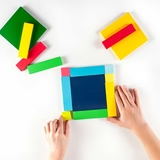
Finally, begin to build shapes and craft instructions—imperative sentences. From the image above, a first sentence might read:
Pick up the bright yellow rectangle and place it vertically on the right on the table in front of you.
Next, place the light green rectangle horizontally flush right at the bottom of the bright yellow rectangle, creating a 90 degree angle.
Keep going from here! This activity engages your students in active learning—reflection and problem solving instead of passive direct instruction. Students who enter into the activity of journalling and puzzling, will be setting the stage for more advanced math learning, but more importantly for advanced writing. Slowing down and observing relationships between the puzzle pieces, will strengthen observational skills. The process of communicating observations with words on paper will develop skills and strategies that will help your writers write well.
DON’T FORGET TO PLAY BINGO!
Download your Summer Bingo for free on Printshop HERE and submit a picture of your completed bingo sheet below to enter the raffles. Bingo will run June 1st through August 31st—so print out your bingo sheet and get to crossing off squares!
~Kimberly