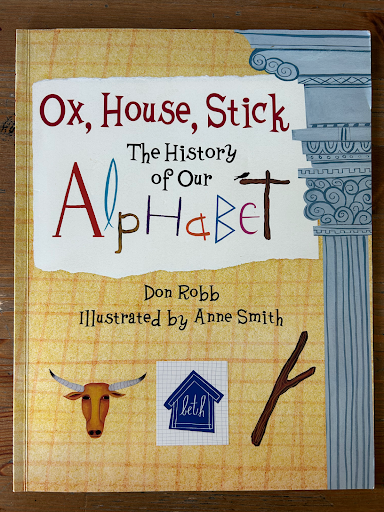
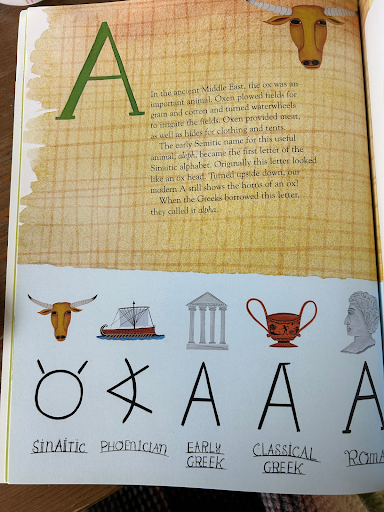
Coming this APRIL: The Wonderful World of Phonics


Observation begins with a question: What am I seeing? In a world filled to the brim with stimulation, it is easy to take our senses for granted. Though we are usually quick to have thoughts on things that we taste and smell, sight (of all things) can often be overlooked. We see so many things on a daily basis that it’s easy to forget to stop and really look.
You might assume that this is true for things we only see once, but oftentimes this overlooking occurs with things we see on a daily basis. Think about the patience of your front door. It’s waiting every single day for a passerby. Surely you walk by it and through it several times a day. But when was the last time you truly observed your front door? Are there new cracks? Has the paint faded? Has the metal of the hinges or doorknob tarnished? Most of us probably couldn’t answer these questions without going to have another look.
Observation is not just for the artist making masterpieces or the scientist performing meticulous experiments. It is for us to better understand and know the world we live in. It is for us to learn to move past assumptions and fill our minds with sighted knowledge. Our world with is briming with sights to see, so let’s dive into the art of observation.
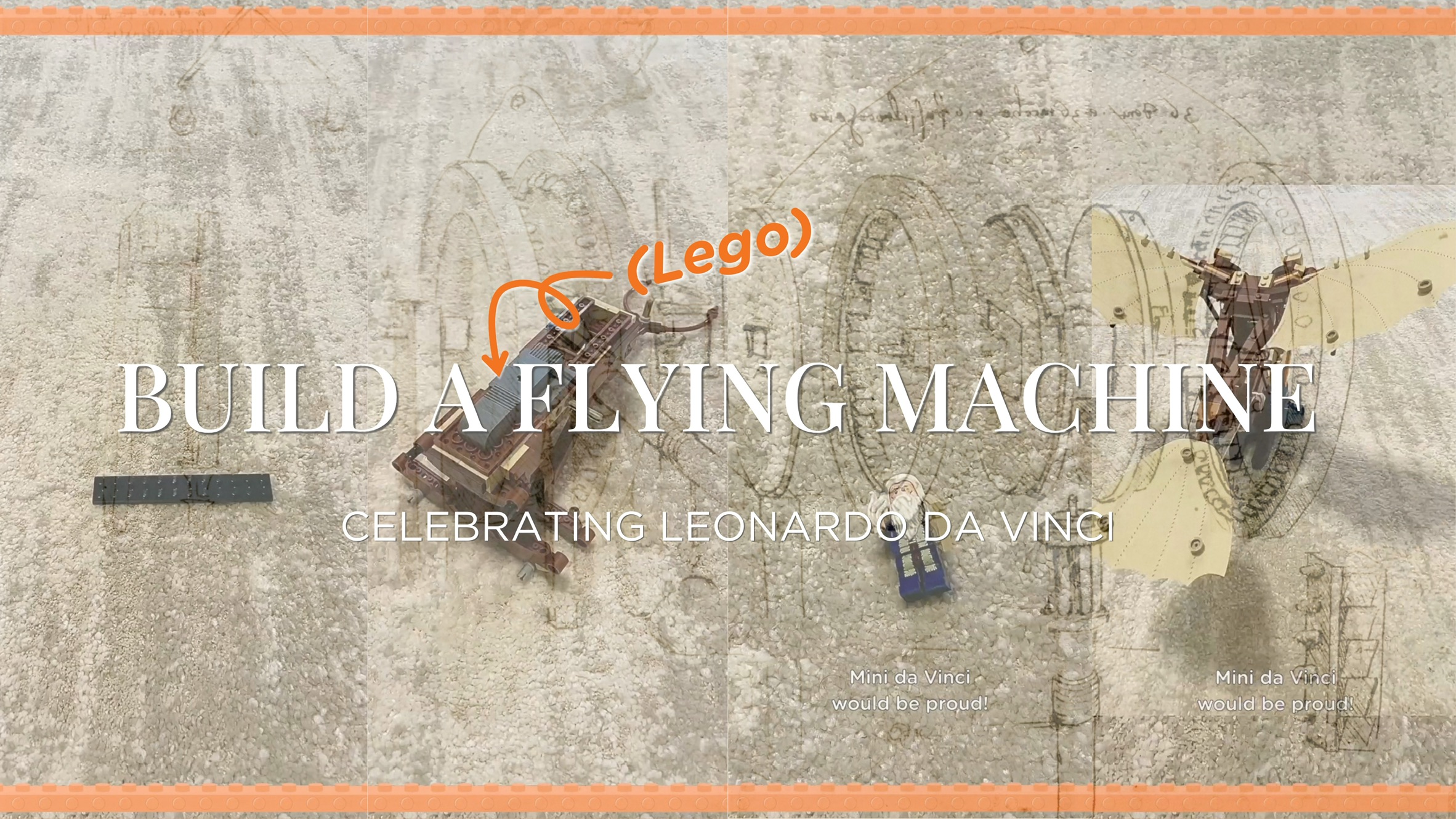
There is nothing like art-making to engage students in active learning. Leonardo da Vinci, the quintessential Renaissance Man, made over 13,000 journal observations during the course of his lifetime, and as he did, he not only gained an enormous body of knowledge, but also created masterworks and made significant discoveries that he generously shared with the world. His influence is far reaching.

I’d follow this with some smaller, yet still amazing facts:
Snow is made up mostly of air:
Fresh snow contains a bunch of trapped air, which is why it feels light and fluffy.
Snow is frozen water:
Snow is simply water vapor that has frozen into tiny ice crystals in the clouds.
Snow can fall even when it’s not very cold:
As long as there is enough moisture in the air, snow can fall even at temperatures slightly above freezing.
Snowflakes are six-sided and unique:
Depending on the temperature and humidity, and because each falls through the air differently, they have unique patterns and six-sided shapes—needles, columns, and plates.
Close the lesson with another BIG fact:
The biggest snowflake, recorded in the Guinness Book of World Records back in 1987, was found in Montana. The snowflake was 15 inches in diameter and 5 inches thick! That’s one BIG snowflake! I’d likely mock up a way to help them see this fact:

The woodland animals were all getting ready for the winter. Geese flew south, rabbits and deer grew thick warm coats, and the raccoons and chipmunks lay down for a long winter nap. Come Christmastime, the wise owls were the first to see the rainbow around the moon. It was a sure sign that the big snow was on its way.

No one thinks one or two snowflakes will amount to anything. Not the man with the hat or the lady with the umbrella. Not even the television or the radio forecasters. But one boy and his dog have faith that the snow will amount to something spectacular, and when flakes start to swirl down on the city, they are also the only ones who know how to truly enjoy it.
These sentences have one word in common: gray.

We will read several poems together, learn about specific birds, then we will focus in on the blue jay. We will read about the blue jay in the appendix at the back of the book before focusing in on the poem. We will learn that these birds store up to 100 seeds and nuts per day in preparation for winter. We will learn about its tricky ability to hide the store and locate it easily when needed. We will learn about courtship and nest building and the raising of baby jays. This and more. And then we will read the poem.

~Kimberly

This last weekend we went and saw my son in a performance of Mary Poppins. He had been rehearsing for months and it was finally his time to “wow” the audience from the big stage. Everyone came armed with their role and their costumes and their props and their accents. The stage was transformed and we were transported to London in 1910. The main stars of Mary Poppins are of course, Mary Poppins and her magical chimney-sweep friend, Bert. But the story itself really centers around the father, Mr. Banks, who sees his role as a father as strictly providing and not in nurturing. As the musical performance played out, the audience experienced the magic, the struggle and the transformation in the family and especially in the father. Mr. Banks was no longer a 14-year-old boy, but a man struggling in his role of provider, husband, and father.

In Pages online, we read a terrific story during this last session with my middle school Level 3 students called Banner in the Sky. This book was about a boy climbing the highest mountain, the Citadel, in the Swiss Alps. It is a fictional book but based on real research and experience climbing. As we read, we were transported to these mountains, holding on for our lives, experiencing the harsh weather conditions and the strength of the climbers both physically and mentally. Before this book I had never pondered what climbers experience.
Through books we get a glimpse of the past we never experienced. We learn about things we have never done. We ponder what things might be like in the future. In my Level 4 Pages class, we read The Giver—a book that talks of a newly created community where everyone lives in sameness, under a set of rules where the weak and rule breakers are sent to Elsewhere. Memories are too painful for people, so they are taken away and placed with one single person, a person separate from society, called the Giver. The book is set in an unspecified future with no exact date. This young adult dystopian novel was written in 1993 and has sparked questions about conformity, individuality, unexamined security, freedom and the importance of our past and experiencing pain.
Blackbird and Company has created curriculum to accompany the journey and adventure of books; comprehension, setting, plot, vocabulary, themes, motifs and symbols are covered. But we really dive deep when we ask the student or should I say the writer to write, their ideas, feelings, opinions, beliefs. Our prompts ask, what tricky or fearful experience have you encountered? How did you get through? What would you do if faced in the same situation as the character? What do you want to do when you get older? Who influenced you?
To write, we need only to start with a word, a phase, then one true sentence. It sounds so simple, but the words we choose to use are important, meaningful. We can paint pictures with our words, create dramatic scenes, show painful, tragic moments, create laughter, and love. In the performance of Mary Poppins, one of my favorite scenes is when they sing the song, Supercalifragilisticexpialidocious! Mary Poppins, inventor of this word, gets the whole stage singing her brand new magical word! Simply said, it is something to say, when you have nothing to say!
What a challenge that word would be to put in an essay, but much more powerful, might I say magical, than simply saying something is good.
By the age of 5 years old children recognize at least 10,000 words. By 10-years-old, children can speak and write an average of 20,000 words and learn on average 20 new words a day. They can also understand the fact that words have multiple meanings. A High school student may know anywhere from 25,000-50,000 words. When I looked up the average vocabulary for adults, it ranged from 20,000-35,000 words. Children double their vocabulary between 5 and 10-years-old, learning an average of 20 new words a day! But over 10-years-old, learning new vocabulary slows or even stops. An average teen or adult might just have a vocabulary of 25,000 words. That’s only 5,000 more than a 10-year-old, maybe staying this way for their lifetime.
We have moved away from books you hold in your hand and dictionaries you flip through. We’ve have moved to media. As a whole we have moved away from writing with a pencil and instead typing on the computer.
We can create possibility. We can create words and meaning. The possible starts with YOU. And the way I see it, with a good book and some time.
“In this world of words, sometimes they just can’t say everything.”
Or can they? I would like to find out!
~Clare


~Kimberly

I have such fond memories of alphabetizing words, dictionary in hand. I loved the way the dictionary was organized, unlocking the system on each page, the guide words at the top—the left word directing me to the word at the top of the left column; the right word directing me to the last word in the right column. I loved how the dictionary taught me that each word possessed a very specific pronunciation, history, and meaning. But most of all, I loved how the dictionary taught me to alphabetize.

~Kimberly

Back when I was in elementary school, the eraser was at once a tool for writing and a tool for printmaking—yes, printmaking! Essential tools were paperclips, stamp pads, and blank 3 x 5 cards in the back of my, now vintage, tin card file box, and a black-inky stamp pad. Somehow, there was always quiet time during my school day to imagine and create, especially in 6th grade when my teacher would put on Cat Stevens and let the whole LP play, both sides. I would carve little designs into my pink erasers with a paperclip untwisted to become an artist stylist. Once happy with the design, I would simply coat the eraser with inky black and stamp it on an unlined 3 x 5 card.

I have absolutely zero unhappy memories with erasers, quite the contrary! The color, smell, shape, feel of the pink eraser sparks all kinds of happy memories. Most important, I was not afraid to make mistakes as I learned to become a writer. The little pink eraser was by my side to help me alter mistakes. Mistakes in spelling. Mistakes in punctuation, capitalization. And more crucial mistakes too—mistakes in content.
Writing is a process that will always involve mistakes whether the writer is a student writer or a proficient adult writer. Each stage of the process is looking forward to the polished, final draft. Along the way, many changes will be made easily, thanks to the eraser.
The little pink eraser is the perfect partner of the pencil and has been for hundreds of years. We will always recommend student writers use the pencil as it is the best technology available to support learning this art form.

Increasingly in our world, we all know electronics have played a bigger and bigger role in our lives. With the advantage, comes a great deal of disadvantage we all are trying to mitigate, especially when it comes to our children. Blackbird and Company offers some terrific books that can take your students into the wonderful world of nature and adventure. While we, of course, strive to be outside in the great outdoors as much as possible—hands in dirt, feet on trails or wiggling into ocean sand—we can also inspire a love of nature and animals and a life of adventure through good books.


[Inside Cover, Flyleaf, Sara’s childhood edition]
Follow along as Sterling and his beloved dog Wowzer find a raccoon kit in the woods and bring him home. You will have quite a vicarious adventure and meet many enchanting animals in this true story set in the back woods wilderness of Wisconsin. Hear what life was like for a very clever eleven year old boy at the end of WW1 who grew a victory garden and was building a canoe in his living room!


Rudi Matt, son of the famed mountain climber Josef Matt, lives under the shadow of the very formidable mountain his father perished on while trying to be the first to summit it. This is a gripping coming of age story, where Rudi defies his relatives and sets about to conquer the mountain even though no one believes the mountain can be climbed. It is high adventure and set during a different time in a different culture. There are heart pounding moments in this book where you will feel your own fingernails biting the rock face trying to gain purchase!

Learning, no matter the subject, can be an awesome journey. The path can be filled with wondrous sights to delight the intellect and warm the heart .
But the opposite can also be true.
The opposite of an awesome journey would be an arduous one. The opposite of a path with wondrous sights to delight the intellect and warm the heart is one filled with brambles and thorns that discourage and weaken. On this journey, this path, learning is thwarted, the heart is discouraged, and some form of illiteracy is a common outcome.

As a native Angeleno, born and raised in Los Angeles, California, with rampant fires raging so close to home, I hesitated launching into our virtual campfire tradition. My great-grandparent’s home—one of the homes in which I whiled away many years of childhood—though no longer part of our family, was lost. And the loss tugs at my heart.
In this home, my imagination thrived. Great-grandma Garnet Jewel had an old desk that belonged to her father, Great-great-grandpa Carlisle, who, lore has it, was an avid letter writer. This desk, chock-full of luxurious vintage stationary, fountain pens, and cancelled stamps, became a happy place for me since GG Garnet gave me free range of its contents. Behind the desk, built-in bookshelves were practically splitting with the weight of classics, including a complete red-linen collection of Dickens.
I’m so thankful for the freedom I was given to bring shape to my little girl ideas. I’m certain that this rich environment of great books and old-school technology—pencils and pens and all sorts of paper—inspired me to engage happily in the art of writing. I’m thankful for that childhood home that contained great-great-grandpa’s books and desk and utensils to write. Writing, bringing shape to an idea is no easy task. I’m thankful too for Charles Dickens who continues to remind writers of all ages that nothing is impossible when it comes to creating an idea:
~Kimberly


~Kimberly