Posted on

It’s November, let’s be thankful!

Fall is a cozy season. It’s the season of turning leaves 🍂🍁 and curiosity inspired by the natural world, of bundling up with mugs simmering cider for long meandering walks. Can you feel the crisp air? Hear the crunch of leaves? Look up! The blues of fall are amazing! Fall is when we collect pinecones and spy animals readying for the long winter nap. Most of all, fall is the season of gratitude!

There are so many ways to demonstrate gratitude.

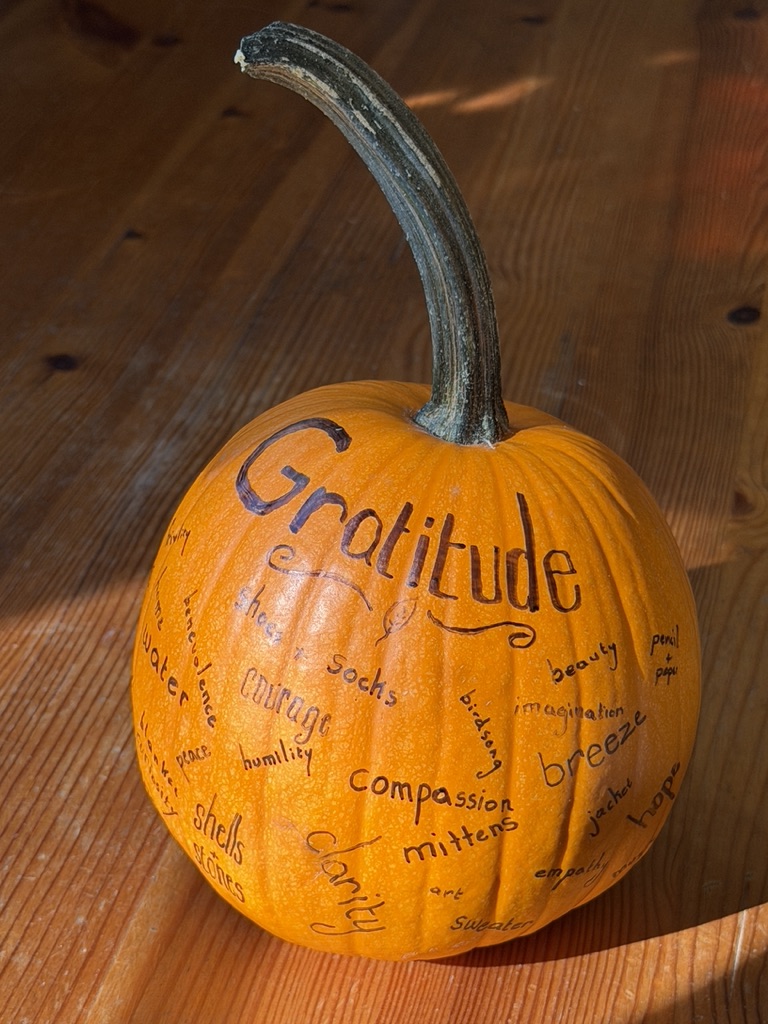
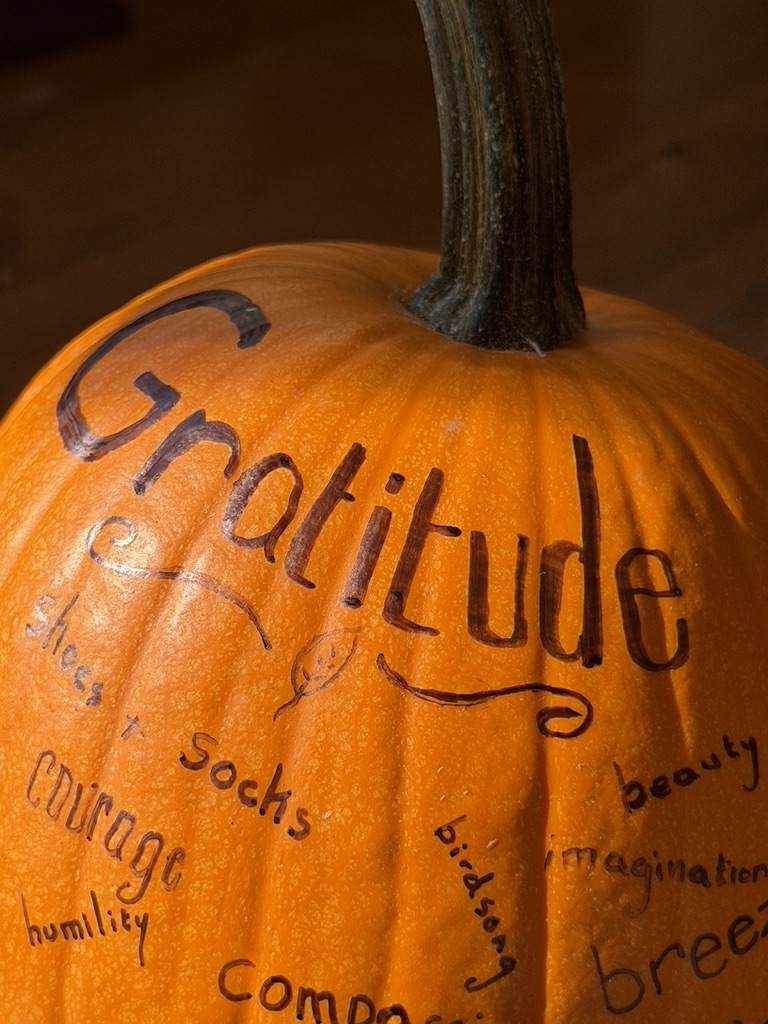
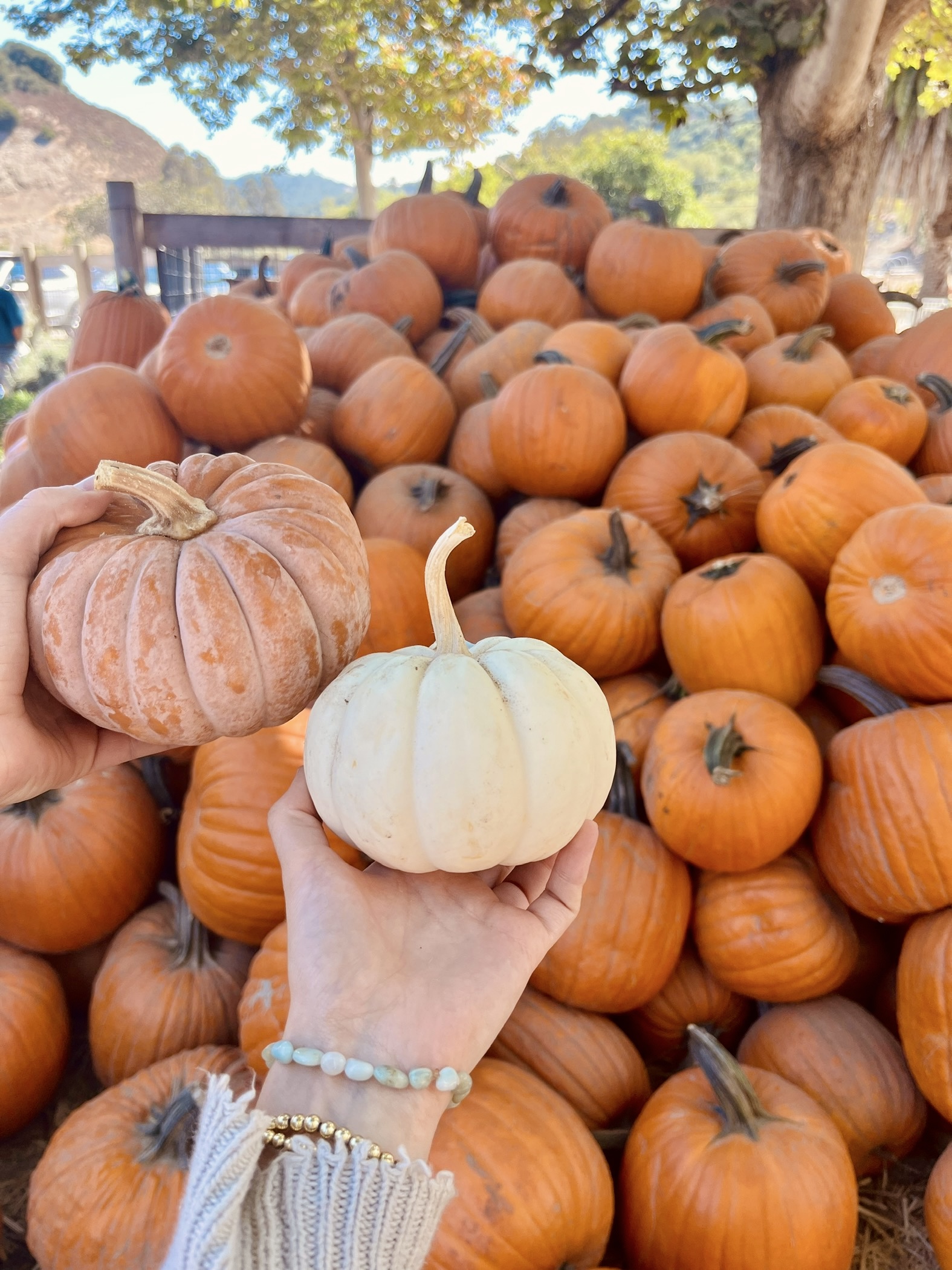
Pick up a pumpkin, a Sharpie, and set thankfulness into motion. You have all of November to scribble your messages. Maybe try a white pumpkin and fall-colored markers.

Be creative, but mostly: Be thankful!


~Kimberly

Posted on

First, Read a Book!

I’ve been asked more than once: Do I have to read the book?

My response? No—you GET to read the book!

Having homeschooled my four children alongside countless other children in my hybrid micro-school, I know “reading a book” sounds like an impossibility. It’s not.

First, read a book!

Ultimately,  to be the exceptional teacher I believed my children and my students deserved, I read some books! MANY books! And you know what? I was WOWed! Great stories are simply amazing!

I’m proud to report, I read alongside my children kindergarten through 12th grade.

I read on the beach in summer while my children made sand castles. I read at the park while they climbed up and down the slide. I read during swim lessons. I listened to a child read aloud here and there while I did dishes. And I enlisted Audible! You can do this!

What I decided, early on, was to become the teacher who is delighted to learn.

Blackbird & Company curriculum is designed to inspire children to read and to write and to think well. During the process of engaging with books, journalling their way through stories, and working through the process of writing original ideas, your students will gain skills and confidence.

So back to “Do I have to read the book? (Yes), ” and on to the the next step: Prepare to be a guide.

Next, pack a knapsack of tools!

The following “support materials” are NOT simply “extras” but, rather, tools designed to help YOU, the teacher, make the most of our ELA curriculum. You don’t need to be an expert or have all the answers tied up in a pretty bow. You need to be willing to teach, mentor, guide. Our support materials are not scripted. When it comes to the art of teaching, we left plenty of room for YOU—the teacher, to teach, to mentor, to guide. We have built into each student guide: pacing, a rhythm of routine, and simplicity that will allow YOU to actually teach.

Always begin at the beginning.

Get to know the student guides—begin with out CORE Literature and Writing units. Once you understand how these work, the APPLICATION materials will be a breaze to navigate. There is valuable information for YOU, the teacher, to implement alongside a mentor built into the scaffolding that will guide your students through the journaling, research, and writing.

Our TEACHING TOOLS are designed to give you space to confidently set learning into motion. Every element of our student materials is designed with purpose, our teaching tools are no exception. The following materials will help you create opportunities for your students to be curious, imaginative, and to develop the tenacity to bring shape to their ideas.

Teacher Helps: For our Kindergarten and 1st grade teachers we’ve created a Hatchling Teacher Helps that will support you through these crucial years. We’ve also created a slim handbook filled with strategies to support you, the teacher, with students utilizing CORE Levels 1, 2, & 3 (3rd grade through 8th grade).  This said, every single student guide contains its own pacing, information, and strategies to support your students well.

Answer Keys: English Language Arts is just that, an art form. As such, the majority of what your student journals and writes about is subjective in nature. Our blog contains many articles to help you edit student writing. We have created answer keys for the small portion of each guide that is answerable, or objective in nature. These can be downloaded and printed for FREE! Or, you can save paper / printer ink and simply access online!

Reader’s Guides and Seven Tips:  Leading young minds through literature can be intimidating—teachers are forced to ask the big questions, like, “What are the themes of this story?” and “How can we learn from these characters?” And that’s not even mentioning the pivoting we have to be prepared for when our students pull questions seemingly out of nowhere! Consider our Reader’s Guides are the helping hand we extend to, your, the teacher and parent-teacher as you read along your students.

Lesson Plans: Because each and every classroom is unique, be it a traditional seated classroom, a  hybrid micro-classroom, or a homeschool setting, our lesson plans are a great place to get started. We have created lesson plans for curated Grade  Level Collections and also for every single individual type of product for those who curate unique ELA collections.

Downloadable Materials: Print Shop is the place to discover some wonderful downloadable resources. From primary ABCeDarian projects to Writer’s Checklists to Cgaracter Trait cards to Reader’s Guides for teachers—the resources are rich.

Videos: We are constantly adding videos to support. From our Hatchling videos for Kindergarten and 1st Grade, to the Leonardo da Vinci instructional videos, to our most recent “How to Edit Student Writing” and more. Explore and check back often.

You don’t have to have all the answers. You simply have to be willing to be a guide, wandering with your students in the realm of wonder.


~Kimberly

Posted on

The October Teaching Slump

In the land of teaching, October has quite the reputation. The October Teaching Slump. The October Blues. The month of disillusionment. 

In October, the excitement of beginning the school year has passed. The jaunt from summer to Thanksgiving seems more like a forced march than anything else, lacking breaks to catch a breath. And the once-theoretical workload of lesson planning, grading, and managing behavior is at an all-time high. Our best laid, well intentioned plans have a way of going awry. It’s no wonder educators hit a wall!

If you’re feeling discouraged, burned out, tired, know that you’re not alone. Even the most seasoned teachers—in both the classroom and homeschool space—experience disillusionment this time of year. The October slump is just part of the teaching cycle; it doesn’t mean you’re not cut out to be a teacher!

Here are a few tips to mitigate the October blues. You got this!

  1. Put your energy where it matters. All of our teaching tools, routines, and curriculum plans are there for a reason—but we also have to think about the actual needs of our classroom and students. Take a moment to analyze which teaching techniques most resonate with your students and which ones seem to glance off. Put your energy towards what works. Leave behind what doesn’t.
  2. Take care of yourself. Teaching can be all consuming. There’s always more work to do! That’s why it’s important to spend some time taking care of yourself, be it through exercising and walking, eating nourishing foods instead of relying on caffeine, and prioritizing sleep. Everyone, both students and teachers, seem to get sick in October. Do your immune system a favor and carve out moments for yourself!
  3. Notice the little wins. October isn’t usually when we see the fruit of educating our students (which contributes to that feeling of endlessly pushing a boulder up a hill). This is the time for planting seeds and watering sprouts—the harvest will come. In the meantime, celebrate the baby steps your students take in becoming readers, writers, and thinkers. Little wins are there when you look for them!

Stay strong. Educating the next generation isn’t easy—but nothing worthwhile ever is!

~ Claire S.

Posted on

Announcing: Reveal 2026 is LIVE

“To create art is to have courage.

“If art is a window to the soul, then artists take a great risk every time they pick up their pencil, throw clay on the wheel, or brush a white canvas with that first stroke. Because to be fully known is to be vulnerable—both to love and rejection. 

“Yet somehow, despite this risk of hurt, you can’t find a time when humans haven’t created art. This suggests that for centuries and millennia, people have found that the risk inherent in creating art is worth taking. Because maybe, just maybe, baring your soul to the world is the only way to become who you are meant to be, the only way to become radically vulnerable and authentic and brave. The only way to become radically human.”

So begins Reveal 2026. 

For those of you who are new to Blackbird & Company, Reveal is our annual student writing and arts journal. We believe writing is an artform that is meant to be read by a reader. Therefore, we aim to get our students’ writing into readers’ hands!

This year’s theme is ideas. In Reveal 2026, you’ll see a collection of writers and artists who dared to share their ideas with the world. Expressing one’s inner, most vulnerable self isn’t easy. It’s a tenacious affair, an affair that sometimes involves dragging ideas onto the page kicking and screaming. I couldn’t be more proud of all of our students who found the courage to share their world with an audience. 


And good news—Reveal 2026 just went to press. You can order your copy of Reveal HERE to share your student’s work with family and friends, or to catch a glimpse of what our Blackbirds are up to. 

Lastly, a big thanks to everyone who helped these students take flight, from our teachers to parents, to our supporters and cheerleaders. You’re making a difference!

~ Claire S.

Posted on

Shakespeare’s Yellow Leaves

Sonnet 73 by William Shakespeare begins like this:

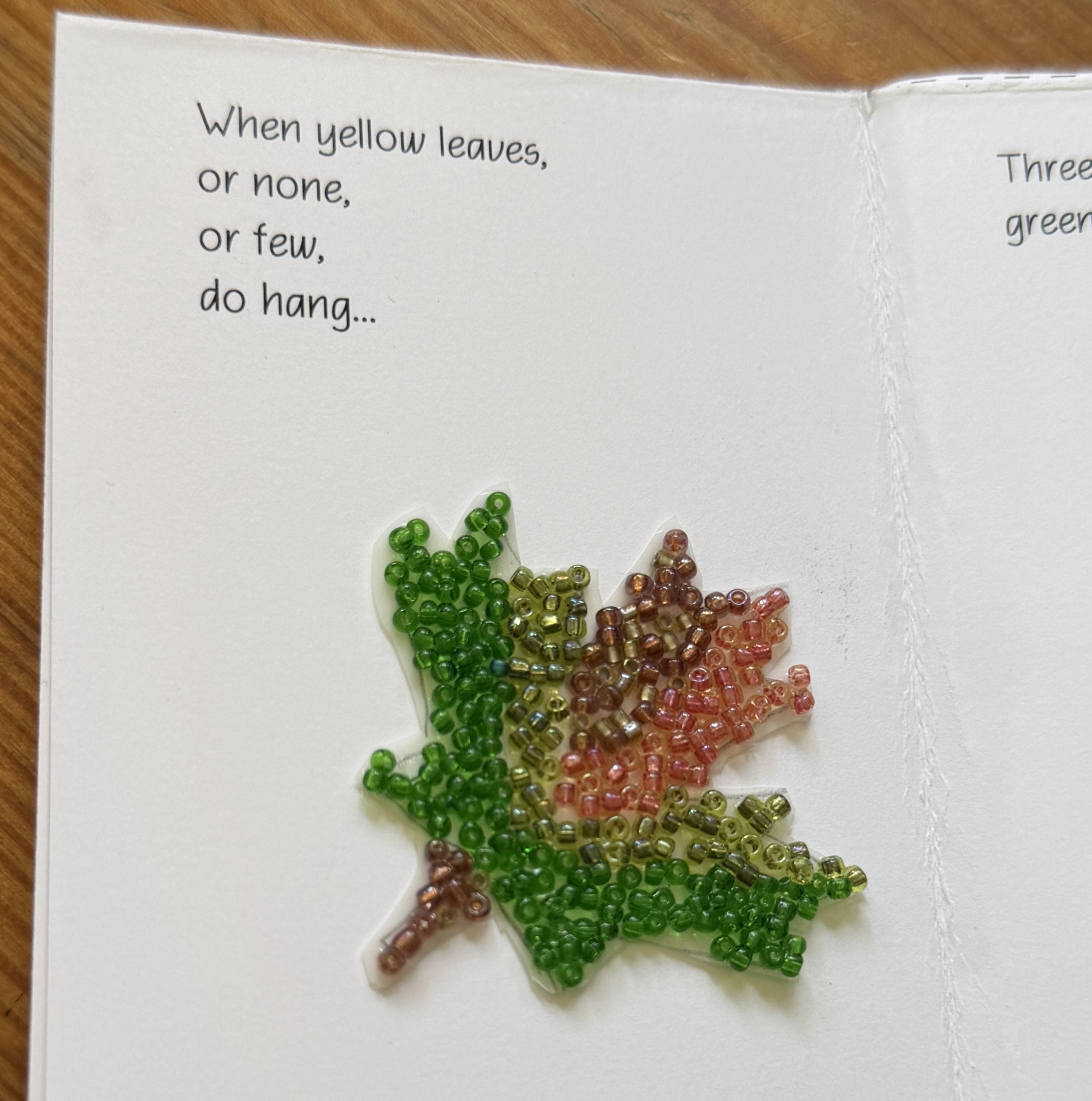
When yellow leaves, or none, or few, do hang
Upon those boughs which shake against the cold

Sara’s beaded leaf is inspired by Shakespeare’s falling leaves. This is a wonderful time of year to help our students add to their fund of knowledge.

Why are leaves different shapes and sizes?

Why do leaves change color?

What exactly is photosynthesis?

All great questions to ponder in fall.  Step outside to observe fall in your neck of the woods. What do you discover about the leaves of October?

Download Six Breaths of Fall on printshop to create your own response to Shakespeare’s yellow leaves. Be sure to send us a photo of your work.

Click through to explore some more ways to leaves, here and here and here.


~Kimberly

Posted on

Combating: “I can’t!”

Fall for me is a time to reminisce on back-to-school. What motivates a student to engage in the work of learning? Long ago I wrote an observation of my youngest son engaging in one of our Level 2 Integrated Literature and Writing units.

What stood out to me as a mom and an educator is the fact that, after writing his way through the book, Søren created a culminating project that was conjured up in his very own imagination. Creativity is NOT extracurricular. Creativity combats the “I can’t” grumbles.

With our approach, each book is read and explored over the course of four weeks. During the fifth week, students develop a creative culminating project with options that provide a variety of ways for them to demonstrate deep understanding of the book. Students not only get a chance to demonstrate their originality, organization, clarity of purpose, and critical thinking skills, more importantly this culminating endeavor will allow them to show off what they have learned in their own, uniquely creative way.


~Kimberly

Posted on

By Hand is Beautiful

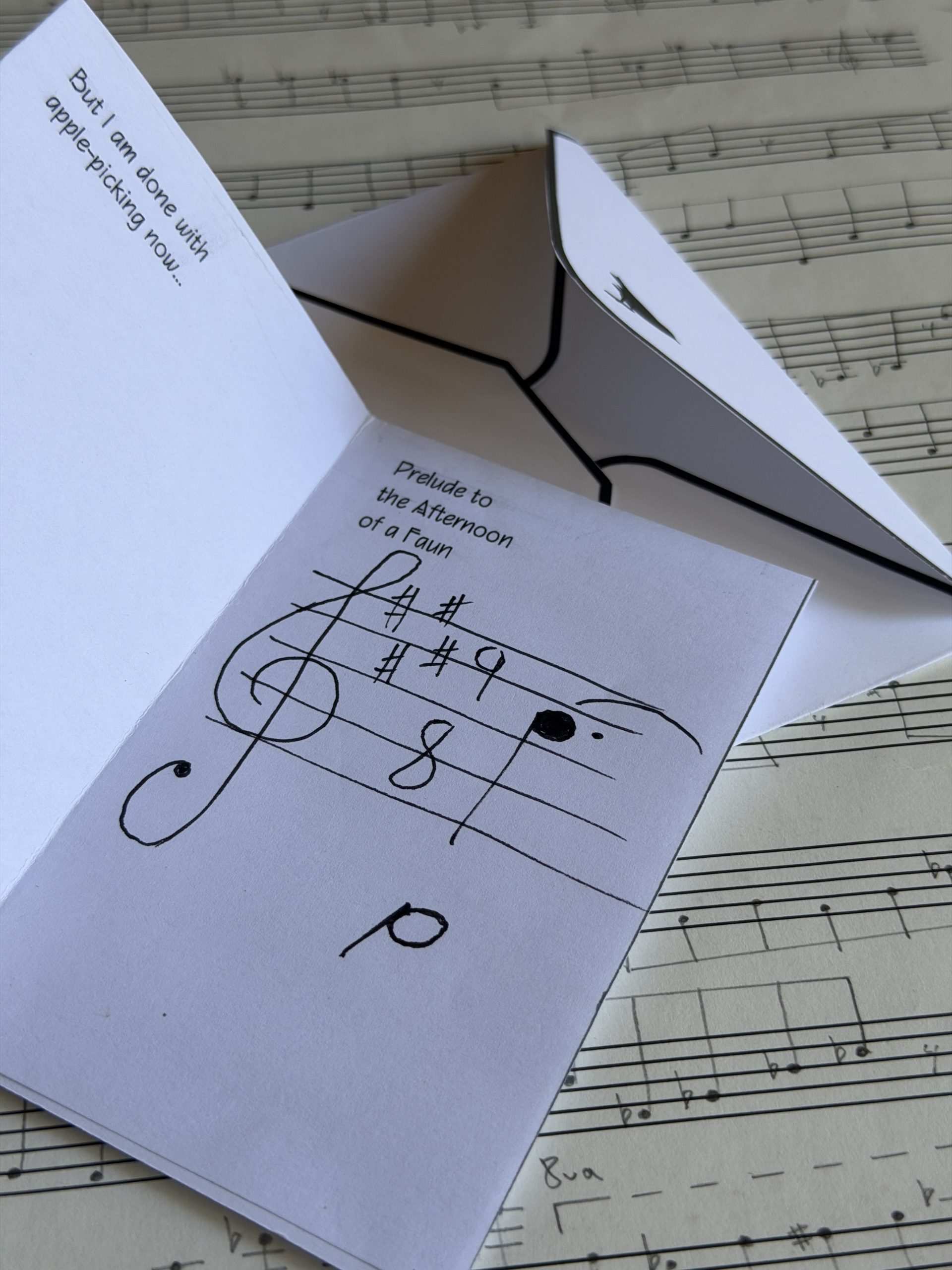
“Prelude to the Afternoon of a Faun” is a tone poem by Claude Debussy that he later re-worked into a performance for two pianos. The work, as most of Debussy’s compositions, is impressionistic in nature. Think Claude Monet.

This week, for our fourth breath of fall, our resident art and music teacher, Master Taylor, offered this piece of copy to inspire BIG ideas. “Prelude to the afternoon of a faun,” when I explained the project to him, was the first thing that came to mind. It came to him lightening fast.

“My goal is to give my students the tools to assist in bringing their ideas to life through their art.” ~Master Taylor

There is a mechanics to art—a way to hold the pencil and how much pressure to apply. We are taught small finger movements to handwrite. In art we are taught to use the arm to assist in drawing a line as opposed to fingers. Wrist and arm movements can assist in making bigger lines. Learning the mechanics of art is skill learning. Music too involves kinesthetics. So does writing a word, a phrase, a sentence, even a poem. Taylor believes in slowing down or in his words, “settling down” into the process of art-making. As a teacher, his goal is to inspire students to make beautiful, important work that is authentic.

Notice the connection between writing and the arts?

According to Taylor, “S l o w i n g  down, doing less, doing it well. This all takes time. It’s all important. It’s your work.  It’s your idea.  It matters.”

Taylor here, for Six Breaths of Fall, did what Taylor does best, was inspired by music. Once upon a time Taylor wrote all of his compositions by hand. His idea here was to copy the first note of Claude Debussy’s composition, the jumping off place this week, and to photograph it on a pice of music he composed by hand with a pencil. Beautiful, right?

Six Breaths of Fall is an opportunity for students of all ages to be inspired by snippets of poems and music and visual art to craft and compose their own tiny ideas.  We want your work to be yours. We just want to support you in building your toolkit to get your idea where you want it to be. The possibilities are endless. Click through to get started!


~Kimberly

Posted on

But I am done with apple-picking now.

Robert Frost writes this line in his poem, “After Apple-Picking.” The speaker in the poem narrates their weariness after a long day of apple-picking, drifting in that in-between state of being not fully awake or asleep. Even the rhyme scheme reflects the speaker’s disorientation; the end rhymes are all over the place! This poem is like a pool of crystal clear water: you can gaze deeper and deeper into its depths, and you might even catch a glimpse of yourself staring back.

Take a few minutes to read “After Apple-Picking” at the end of this post. I promise it won’t disappoint.

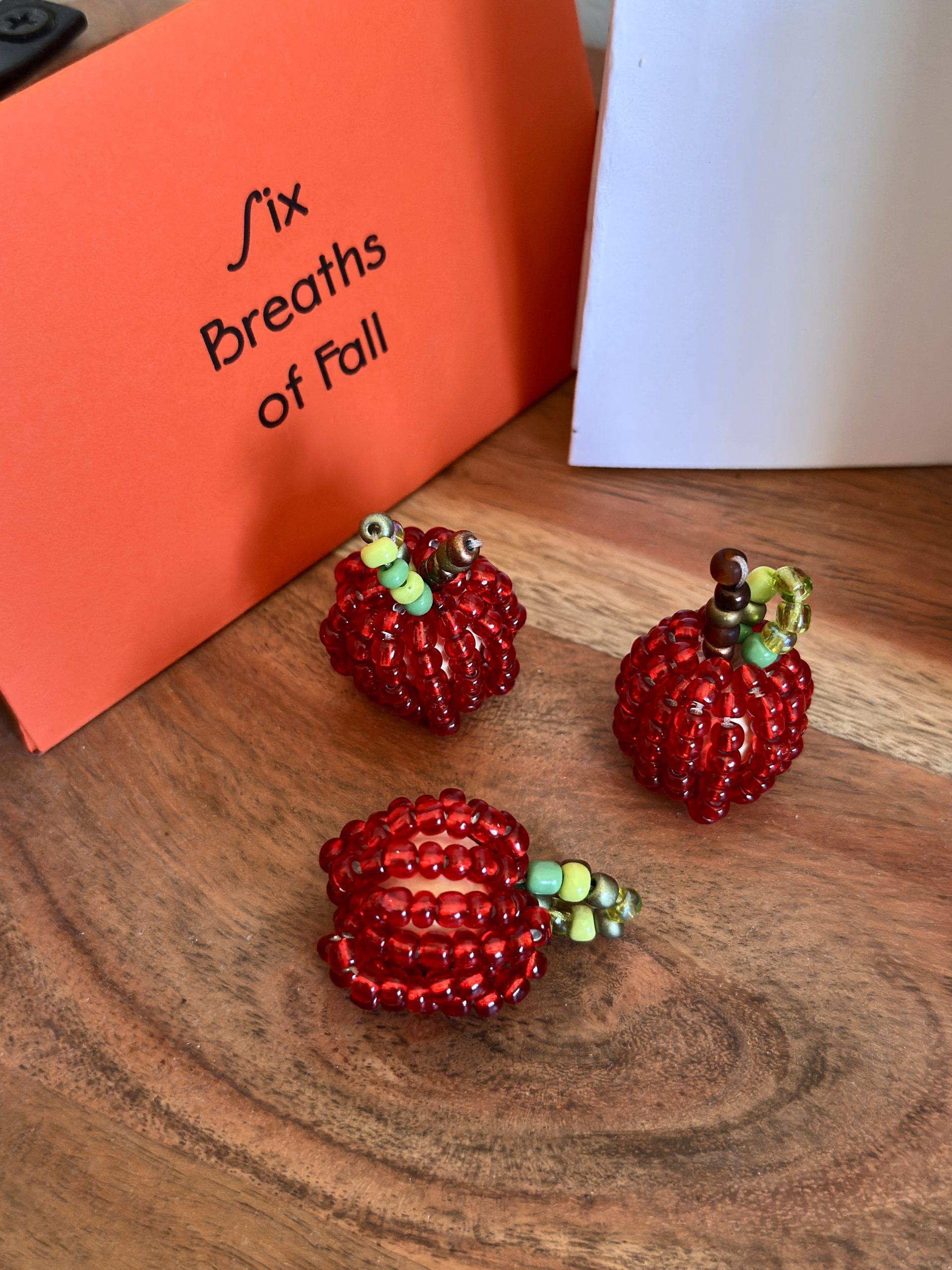
Frost’s line, I am done with apple-picking now, serves as inspiration for this week’s Autumn Artfest prompt. One of our wonderful Blackbird & Company artists, Kelly, found her imagination sparking at this line. She took the apple-picking idea and ran with it to create miniature beaded red apples—so cute!
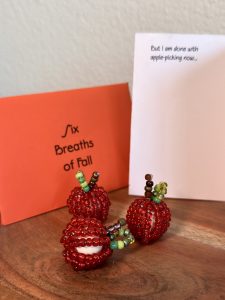
Need a refresher on what exactly Autumn Artfest is all about?

Each Monday morning, we will post on the blog a prompt for you to ponder and respond to, along with one of our artist’s renditions as an example. Every prompt is a quote or homage to a published poem, painting, or musical piece about Fall. Collect your creations in our downloadable chapbook, Six Breaths of Fall. Embrace the Autumn spirit!

Feel free to vary artistic mediums each week. Here are some art forms to consider:

  • Poetry
  • Painting – watercolor, acrylic, etc.
  • Drawing
  • Microstories
  • Embroidery
  • Beadwork
  • Music composition

Send in photos of your creations to our social media or email. We would love to highlight YOUR breaths of fall on the blog!

~ Claire S. 


After Apple-Picking


My long two-pointed ladder’s sticking through a tree

Toward heaven still,

And there’s a barrel that I didn’t fill

Beside it, and there may be two or three

Apples I didn’t pick upon some bough.

But I am done with apple-picking now.

Essence of winter sleep is on the night,

The scent of apples: I am drowsing off.

I cannot rub the strangeness from my sight

I got from looking through a pane of glass

I skimmed this morning from the drinking trough

And held against the world of hoary grass.

It melted, and I let it fall and break.

But I was well

Upon my way to sleep before it fell,

And I could tell

What form my dreaming was about to take.

Magnified apples appear and disappear,

Stem end and blossom end,

And every fleck of russet showing clear.

My instep arch not only keeps the ache,

It keeps the pressure of a ladder-round.

I feel the ladder sway as the boughs bend.

And I keep hearing from the cellar bin

The rumbling sound

Of load on load of apples coming in.

For I have had too much

Of apple-picking: I am overtired

Of the great harvest I myself desired.

There were ten thousand thousand fruit to touch,

Cherish in hand, lift down, and not let fall.

For all

That struck the earth,

No matter if not bruised or spiked with stubble,

Went surely to the cider-apple heap

As of no worth.

One can see what will trouble

This sleep of mine, whatever sleep it is.

Were he not gone,

The woodchuck could say whether it’s like his

Long sleep, as I describe its coming on,

Or just some human sleep.

Posted on

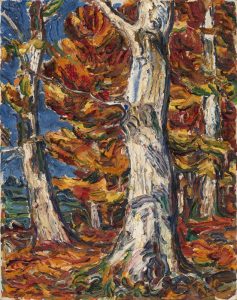
Why do the white beeches in fall sigh?

Great question…this sounds like a query that can only be answered in the form of art! Week two of Autumn Artfest finds us ready to paint, draw, sew, compose, bead—in other words, ready to create. 

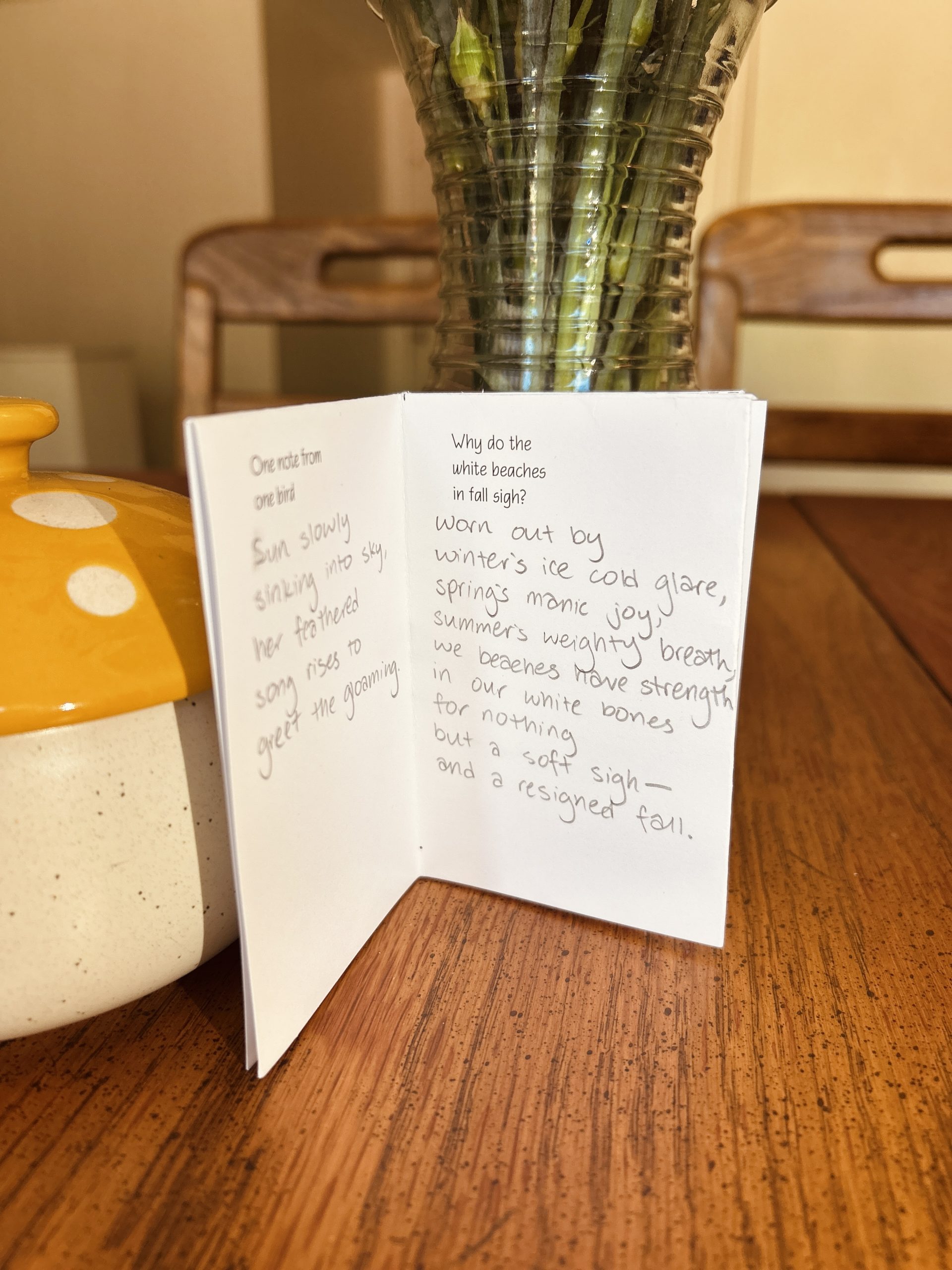
This week’s prompt is inspired by German painter Christian Rohlf’s White Beeches in Fall. He completed this expressionist oil painting in 1910. Yet over 100 years later, we still find the painting’s warm, vivid hues and remarkably colorful white trunks to capture the same Autumn of today. 

Here’s the poem this prompt sparked in me:

Why do the white beeches in fall sigh?


Worn out by

winter’s ice cold glare,

spring’s manic joy,

summer’s weighty breath,

we beeches have strength

in our white bones

for nothing

but a soft sigh—

and a resigned fall.


Need a refresher on what exactly Autumn Artfest is all about?

Each Monday morning, we will post on the blog a prompt for you to ponder and respond to, along with one of our artist’s renditions as an example. Every prompt is a quote or homage to a published poem, painting, or musical piece about Fall. Collect your creations in our downloadable chapbook, Six Breaths of Fall. Embrace the Autumn spirit!

Feel free to vary artistic mediums each week. Here are some art forms to consider:

  • Poetry
  • Painting – watercolor, acrylic, etc.
  • Drawing
  • Microstories
  • Embroidery
  • Beadwork
  • Music composition

Send in photos of your creations to our social media or email. We would love to highlight YOUR breaths of fall on the blog!

~ Claire S. 

Posted on

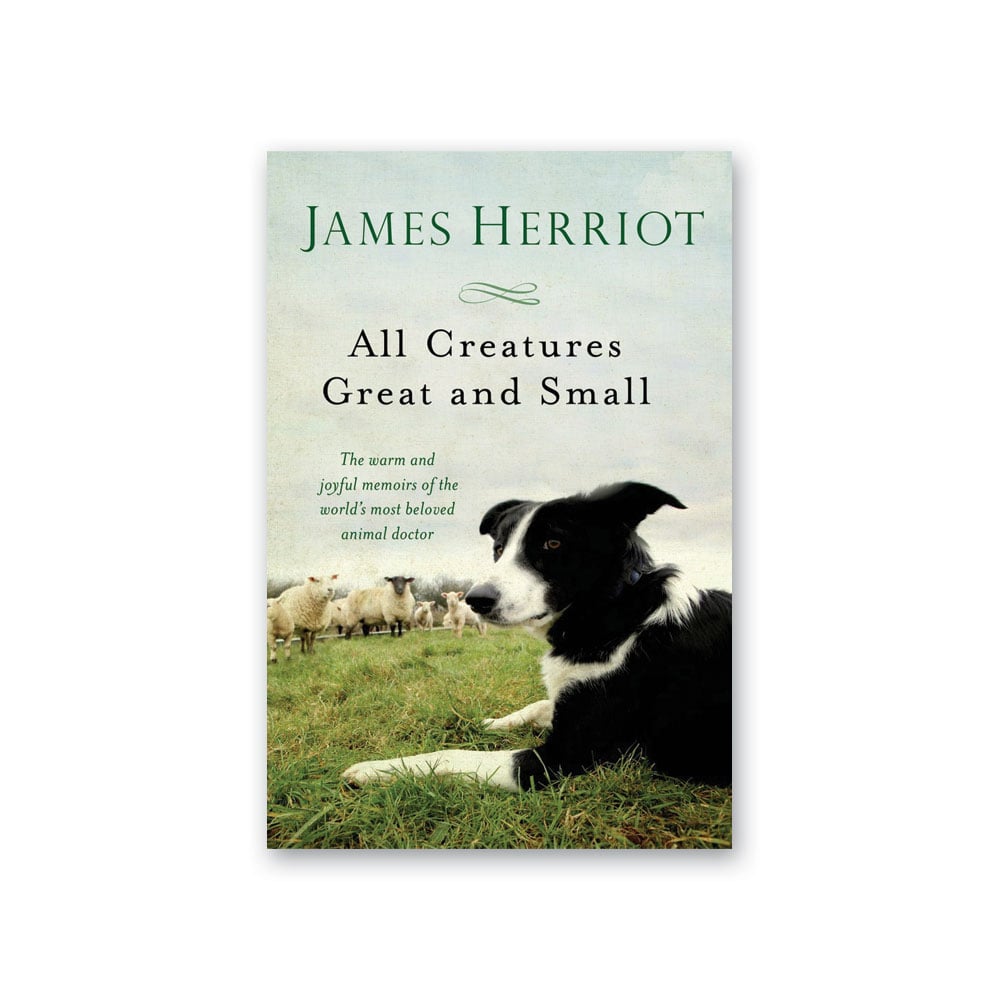
Happy birthday, James Harriot!

All Creatures Great and Small

James Alfred Wight (who used “James Harriot” as a pen name) lived a life worth remembering. You might know James Harriot as the author of All Creatures Great and Small, which happens to be one of my all time favorite books—it’s hilarious, poignant, insightful, and beautifully written. Harriot finds significance and value in the smallest of moments, showing us that we don’t need to travel far and wide to experience the good life. Living deeply starts in the mundane, in the now. All that to say, All Creatures Great and Small is a must-read.

Back to the man behind the book, James Alfred Wight, called “Alf” for short. While All Creatures Great and Small is labeled a memoir, only about half of its content are from Wight’s life. The other half is fiction. 

On his birthday, here’s a glimpse of Wight’s life you might not have caught from reading his books:

  • After German air raids targeted his home cities, Wight enlisted in the RAF (Royal Air Force) in 1942 to serve as a pilot during World War II. He was a skilled pilot but was discharged a year later for health reasons. Going from the RAF to the Yorkshire countryside is quite the change!
  • Wight started writing in earnest after twenty-five years of working as a veterinarian, in his fifties. For the first three years of his writing journey, Wight struggled with rejections. After a publisher advised him to write in the first person and take a more autobiographical route, he struck a tone that resonated with his readership and the rest is history.
  • Wight’s books have sold over 100 million copies! His first six books have all sold over a million copies. 
  • In the book, Siegfried Farnon brought James into his veterinary practice as a partner. Siegfried is portrayed as cantankerous, eccentric, and loveable. Siegfried is based on Wight’s business partner, Donald Sinclair, who fits the bill for this characterization—which might even be a toned down version of what he was like! Wight’s son recalls that the reason Sinclair was “such an eccentric character was that he didn’t think he was.” At first, Sinclair took offense at his characterization in All Creatures Great and Small, saying to Wight, “This book is a test of our friendship.”

If you haven’t had the chance yet, crack open All Creatures Great and Small, a high-school, Level 4 read (Check out the book and guide bundle HERE). I promise you won’t be disappointed!