Posted on

The Character of Characters

When readers open the cover of a book and enter the pages of a story, they begin a journey.

Each of our Literature and Writing Discovery Guides, Earlybird through Level 4, is a personal journal of that journey. Each section of the journal begins with the observations the reader makes about the characters. Over time, students will encounter diverse characters who introduce them to themes common to real people. At first, at the Earlybird level, the way students describe the characters they encounter will be very simple, single words—kind, happy, silly. As they progress , readers will discover that the character of the characters is complex and will want words at their disposal to accurately communicate what they observe.

How does this happen?

Beginning in the 2nd grade, we inspire our students to begin collecting words. What better way than to follow characters in beautifully illustrated books as they collect words? Operation Lexicon provides 10 years of word collecting for students in grades two through twelve!

In the 3rd grade, with Operation Lexicon: Character Traits, word collecting is specifically related to the characters we read about and the people we encounter in the real world!

Additionally, we have created FREE downloadable character trait flashcards tied to our Levels 1, 2, and 3 for students to have a collection nearby as they construct observations.

*****

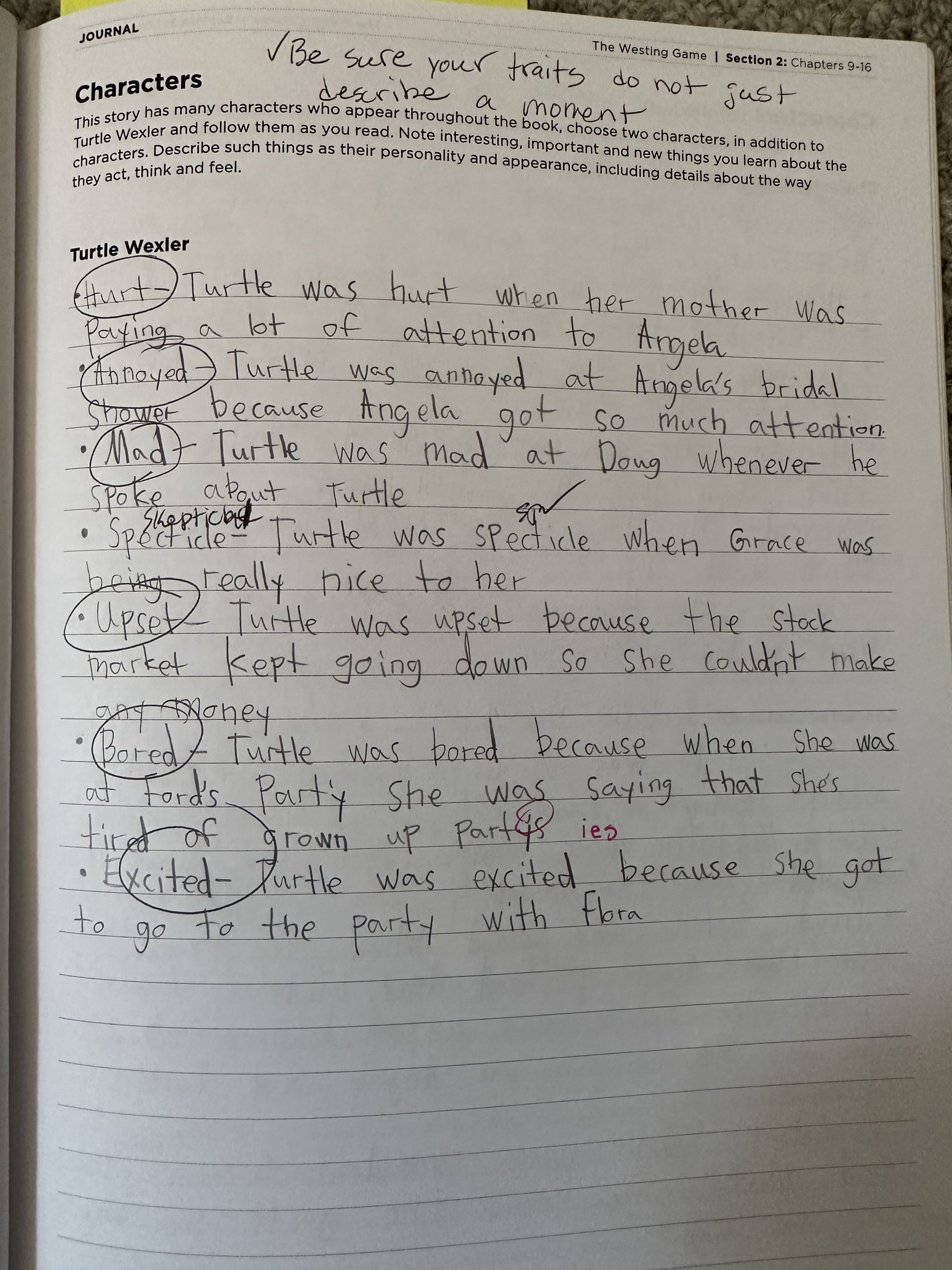
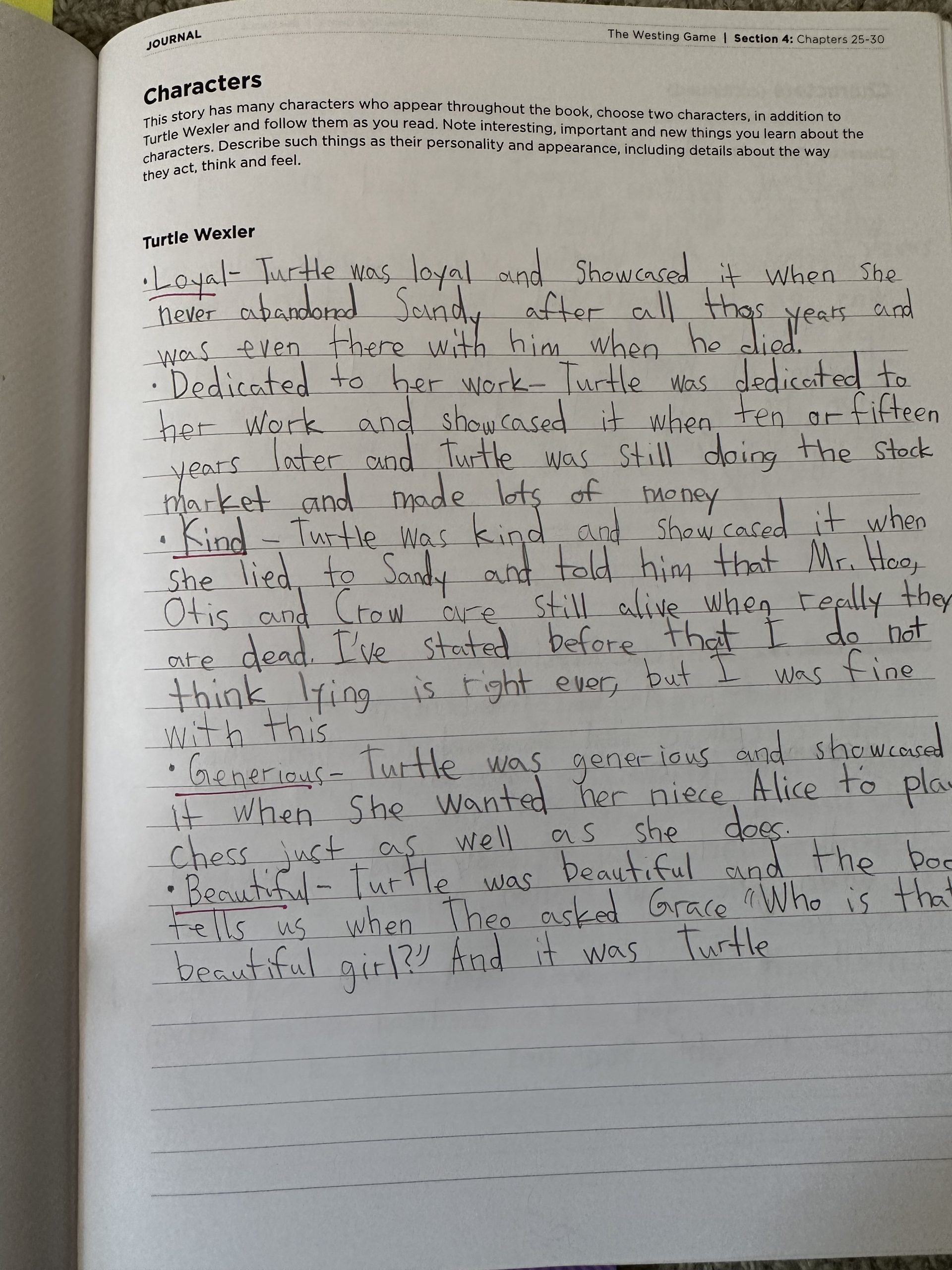
As students progress in their journalling skills, they will learn to defend their observations with examples from the story. Overtime, it is important to teach students to discover a wide variety of traits—both permanent and transient. Sometimes situations that characters encounter determine character in the moment, other times we observe characters growing and changing.

During the first two sections of The Westing Game, this student was attending to momentary reactions which is not wrong, but narrow:
When encouraged to step back and observe Turtle Wexler’s overarching traits, the task was easy because of a treasure trove of specifically descriptive words:
It’s difficult to describe the power of integrating reading + writing through journalling, but it is easy to SEE, and wonderful to be a teacher whose sole purpose is to stand beside and truly mentor students in the important work of becoming literate.


~Kimberly
Posted on

Comprehension is Comprehensive

Students working in our CORE Literature and Writing Discovery Guides will, each week, respond to “comprehension” questions that chronologically review the plot points from the week’s reading. But here, “comprehension” is an exercise that both draws students deeper into the heart of the story and the art of writing. Comprehension is a comprehensive exercise!

Comprehension is the act of making meaning from something heard or read.

Comprehensive includes all or nearly all elements or aspects of something.

There are many skills embedded into this complex activity beyond demonstrating that a passage has been well read. The act of responding to questions with a complete, detailed statement, is an opportunity for students to slow into the story details, but perhaps more importantly, to press into the work of constructing sentences.

*****

Following are two examples of the vast comprehensive nature of this weekly comprehension activity.

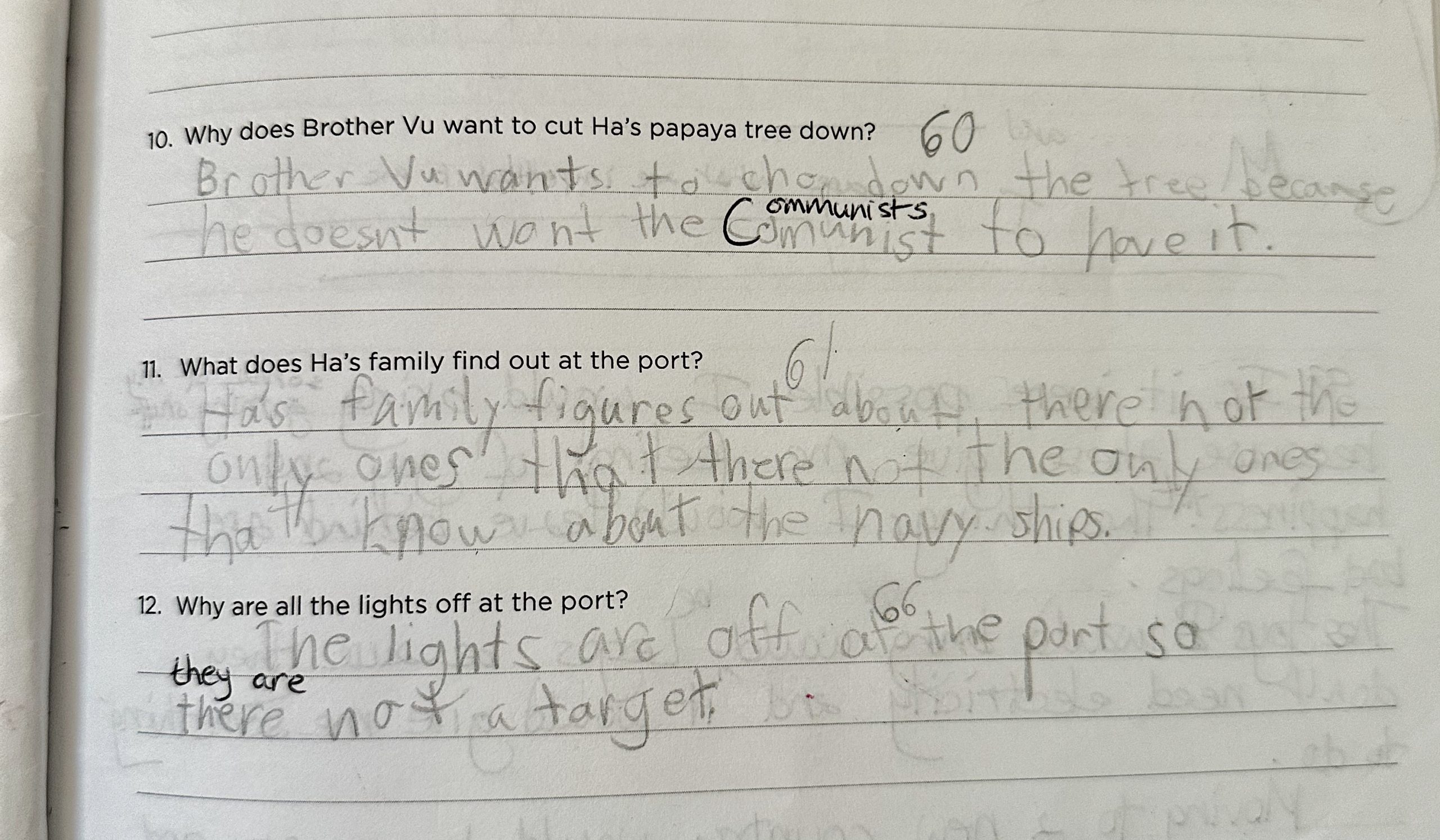
As a teacher, I scan the following sample from a student new to CORE Level 2,  and notice common spelling errors—their, there, they’re as example. Capitalization too—Communists, Navy. But what I notice first is that each response is a complete, simple sentence construction that parallels the question asked. And this confirms to me this is not the place to be heavy handed with the red pen. Refer to the Teacher Helps for more information on complete sentence responses. I might however, write a little note in the comment space on the Assignment Checklist at the front of the student guide for this section:

Here’s a trick I use to remember the difference between this set of homonyms. Here the correct spelling is used in a correct setting:  “their dog” AND “go there” (remember the’re is a contraction: they are)”they’re friends” … create your own trick and memorize the spelling of these!

When a question is asked, students are free to respond independently:

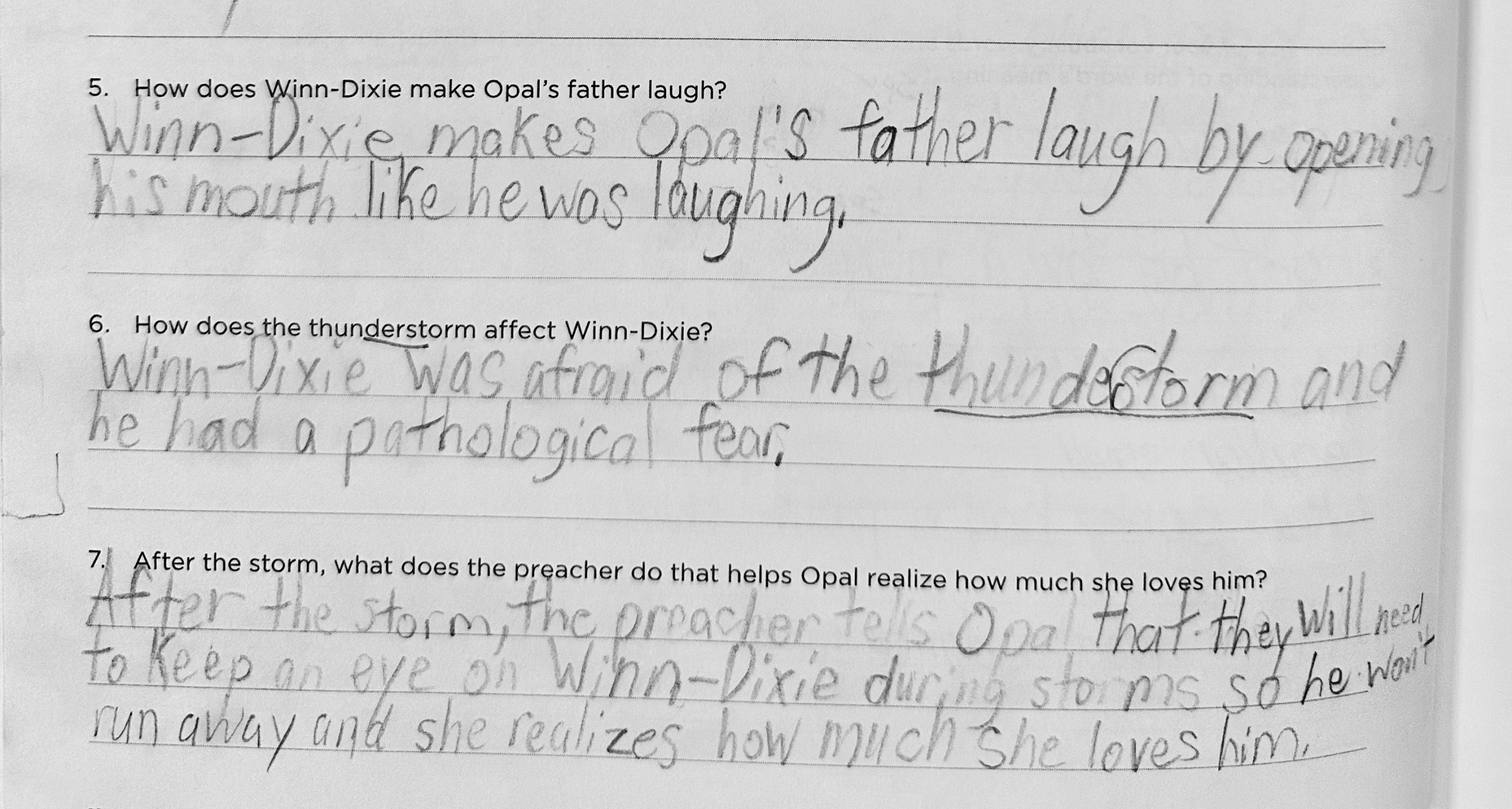
How does Winn-Dixie make Opal’s Father laugh? 

At first, sentence responses might be simple in nature copying the syntax of the question:

Winn Dixie makes Opal’s father laugh because he opens his mouth in a funny way.

[Here the teacher might suggest ways to smooth rhythm and add descriptive details: “Winn Dixie makes Opal’s father laugh when he opens his mouth in a funny way like he’s laughing.”]

Later, as students become more confident, sentences become more fluid, adopting more sophisticated syntax as in this dependent and independent clause:

When Winn Dixie opens his mouth to copy Opal’s father, he laughs.

[Here the teacher might suggest word choice: “Where you use the word “copy” you might try “mimic” instead.”]

The teacher does not need to correct every single sentence stylistically, but rather look for opportunities over time to inspire the writer to try new things. The best writing teacher will look for small opportunities over time to help students elevate their ideas. One or two suggestions modeled to the student over time is more effective than completing years and years of skill worksheets because this activity is the meaningful of work polishing students ideas.

Each year students using CORE Level 1, Level 2, and Level 3 Literature and Writing Discovery Guides will compose over 250 true sentences as they comprehend stories in comprehensive ways.  Ultimately the work—the confident, beautiful, fluid work—will speak for itself!


~Kimberly

Posted on

Treasure Trove of Words

Exploring vocabulary is so much more than an activity to check off the list! Words are the building blocks of language, are what we humans use to communicate our ideas, and each one holds certain specificity.

Specificity is a pairing of  the word “specific” (clearly defined) + the suffix “ity” (quality or state of being).  So, this word, which arrived on the scene via the French word spécifique back in the 1600s, means  to hold a special quality.

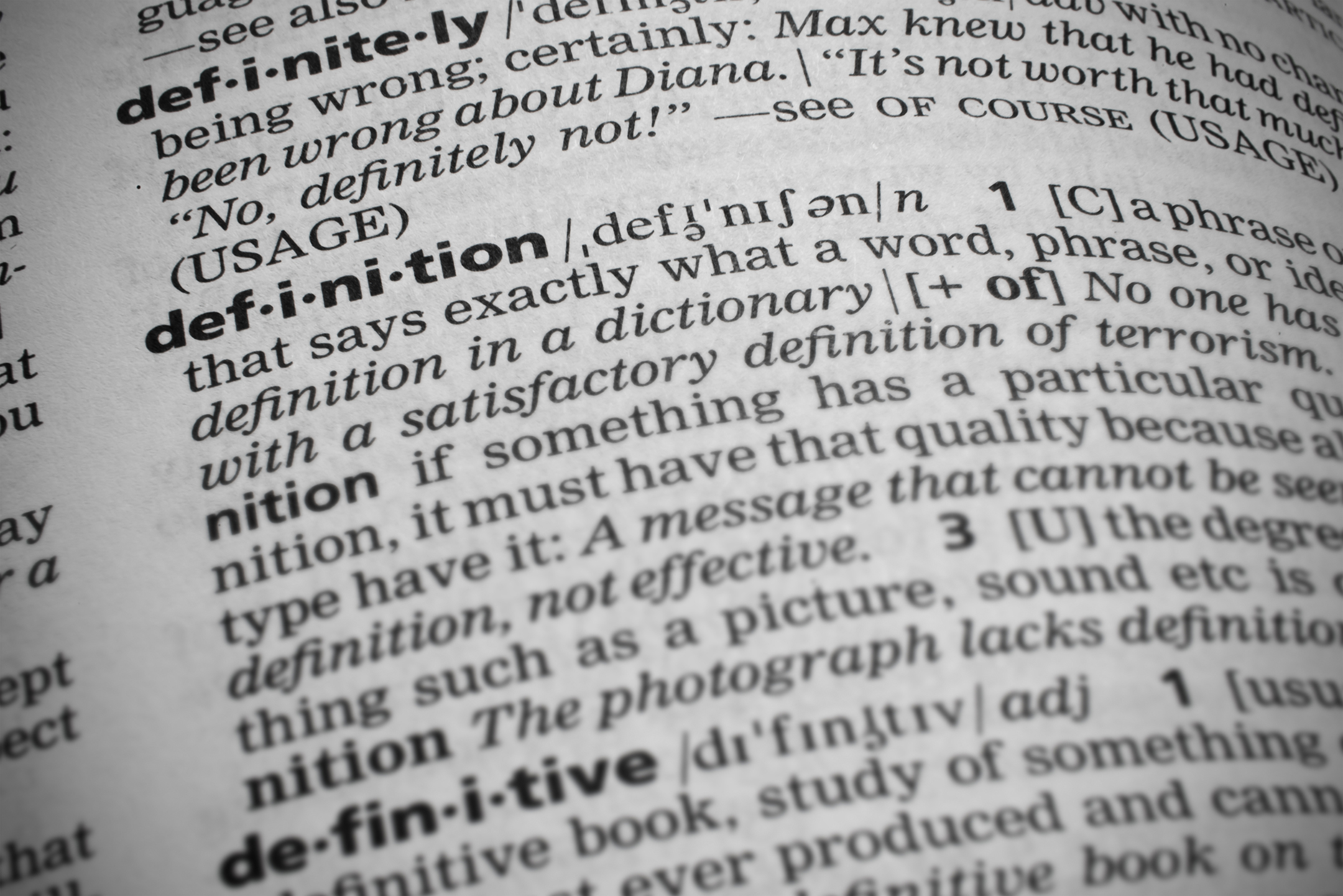
With this in mind, using a handheld dictionary becomes an adventurous treasure hunt. Students working in our CORE Literature and Writing Discovery Guides will, each week, explore a handful of singular words from the week’s reading. There are many skills embedded into this complex activity beyond the obvious, vocabulary development. The act of searching for a word in an alphabetized catalog reinforces spelling skills, strengthens the ability to problem solve, and fortifies focus. Of course, this process of working for meaning and applying new knowledge, more than anything else, sets this word into stone in the mind’s eye, and places it into a growing treasure chest of words.

This student, who was working in a Level 2 unit tied to Inside Out and Back Again, did a terrific job looking up each word in a held-by-hand Oxford English Dictionary. All of the definitions were copied accurately. Next came the difficult part, using each new word in a new way.

By the time students reach this level (4th and 5th grade), they have worked through Earlybird and Level 1 units and have had this exercise modeled for them. Still, using a word in a new context is a really difficult writing skill. But it is a skill that will empower students to write their ideas with specificity!

Notice the way this student used the word “flecked” below. Even though the definition of the word is correct, the sentence demonstrates the meaning has been confused with the word “flicked” meaning to propel something with a sharp movement. One way to support the student, is to provide an example: flicked the flecked stone. Another trick, is to send the student back to the dictionary to copy the phrase that is used to demonstrate the word in a context. Here the phrase was: whitecaps flecked the blue sea. Encourage the child to craft the phrase into an original sentence. For example: Yesterday at the beach whitecaps flecked the blue sea.

Here’s a peak at the Vocabulary Section from our Level 2 Guide tied to Because of Winn Dixie completed by an end-of-year 4th grader who is delightfully engaged in the treasure hunt and confidently using new words in golden ways!

Using our Earlybird through Level 3 CORE Literature and Writing Discovery Guides, students will explore more than 100 words per year, adding significant treasure that possesses specificity. This will serve them well as they engage in the work of constructing their ideas!


~Kimberly

Posted on

Introducing Intermediate Composition

WE ARE HAPPY TO WELCOME TWO BRAND NEW UNITS:

Intermediate Composition: Little Worlds

This intermediate unit is developed to teach high school students how to translate a BIG idea tied to a little story into an essay. Over the course of 5 lessons, students will be guided into the work of crafting 5 literary essays tied to great writers—Flannery O’Connor, Ernest Hemingway, Alphonse Daudet, Eudora Welty, and Gwendolyn Brooks.

And

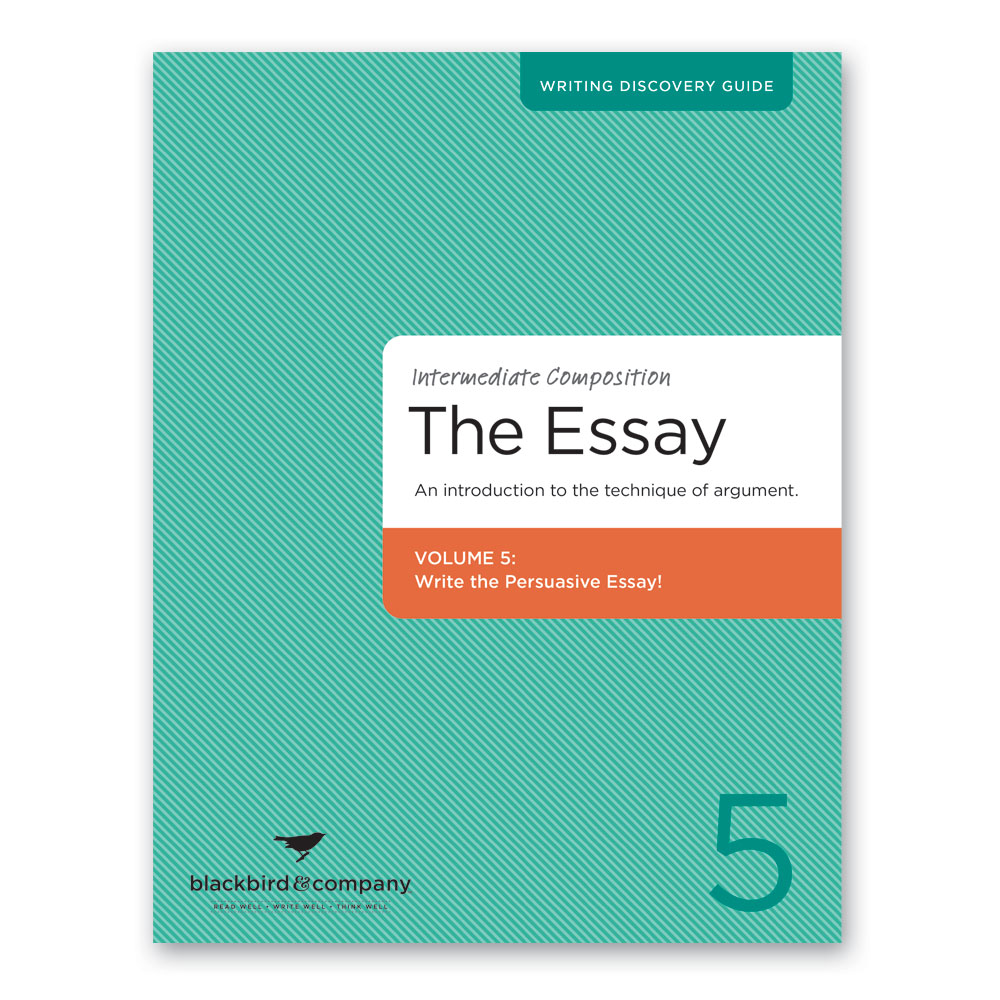
Intermediate Composition: The Persuasive Essay

The persuasive essay is an opportunity to communicate a point of view on a specific issue. Over the course of 5 lessons, students will explore two sides of an issue, choose a side and then craft details that communicate a position in an effort to convince readers to think twice.

Great essays have the power to encourage, empower, and enlighten. For this reason essay writing should not be treated as just a mechanical endeavor, but rather, as a pathway for the writer to communicate the depths of the heart and mind.

These intermediate courses for high school will focus on composing ideas building on the method middle school students experienced in our introductory units. This said, we’ve made sure that students new to Blackbird & Company curriculum will be supported to succeed in the work as well.


~Kimberly

Posted on

Person, Place, Thing: Writing Beyond the Noun

WE ARE HAPPY TO WELCOME OUR BRAND NEW UNIT:

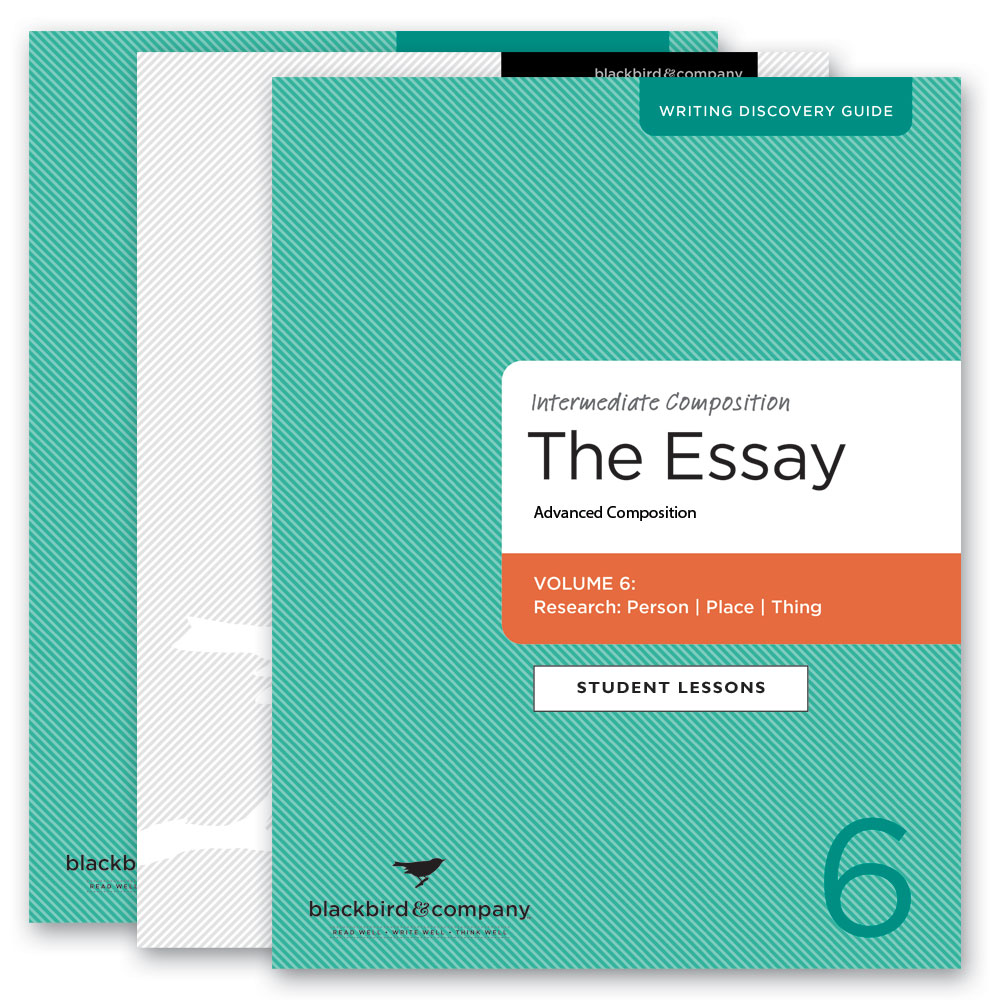
Advanced Composition: Person, Place Thing as Long Form Research

Our unique scaffolding guides 11th and 12th grade students over the course of 30 weeks, each step of the way, in the process of researching and writing a long-research paper. This creative non-fiction project is an opportunity for high school students to participate in literary writing before heading to college.

While students will use the scaffolding twice (in both 11th and 12th grade), each paper will be unique depending on the topics chosen. Each year students will choose a theme that they will explore through a person, a place, and a thing. For example, our student sample explores the theme of tragedy via Abraham Lincoln, Terezin, and escalators. Another student might want to explore joy via Henri Matisse, Disneyland, and the yo-yo. Still another might tie hope to Emily Dickinson, the library, and feathers. The possibilities are endless! And because the topic is the student’s choice, and the work is scaffolded incrementally, the 30-week project is not overwhelming. Quite the contrary, students will rise into this work!


So click through to pick up your brand new copy just in time for the coming school year.

Posted on

Jumpstart Essay Writing with Pages Online!

Using Blackbird & Company composition units? Enroll now to jumpstart fall learning! We are delighted to announce the following five classes to support students as they prepare to dive deep into the art of essay writing.

We’ve something fun planned during Session 1 and Session 2! Our Pages teachers will guide students who are using Blackbird & Company middle school and high school compositional writing units through their first lesson, offering strategies to help them succeed and encouragement to press into the art of essay writing!

Session 1

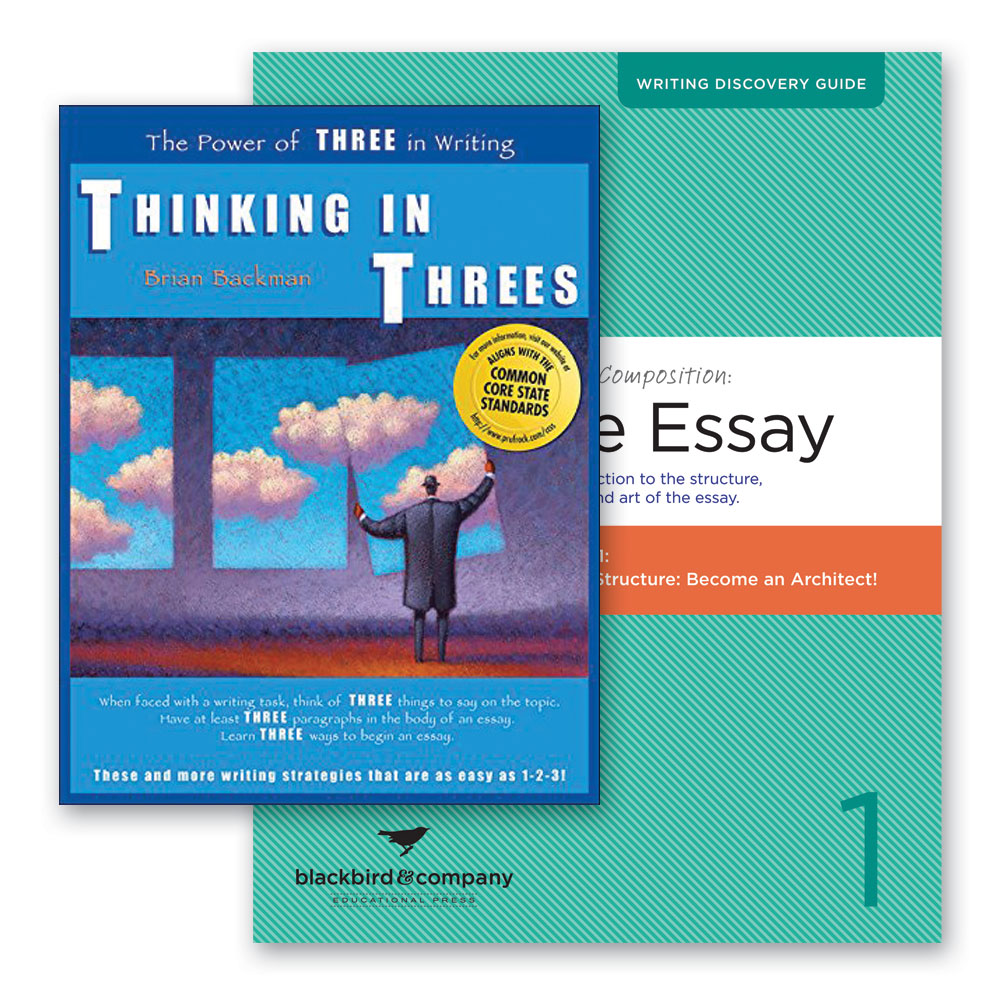
Intro to Composition Vol. 1: Structure

For Who:

Middle School Students utilizing Introduction to Composition: The Essay, Volume 1

When:

  • Starts: 9/8/2023

  • Length: 3 Weeks

  • Day: Fridays

  • Time: 9:00 – 10:00 PST

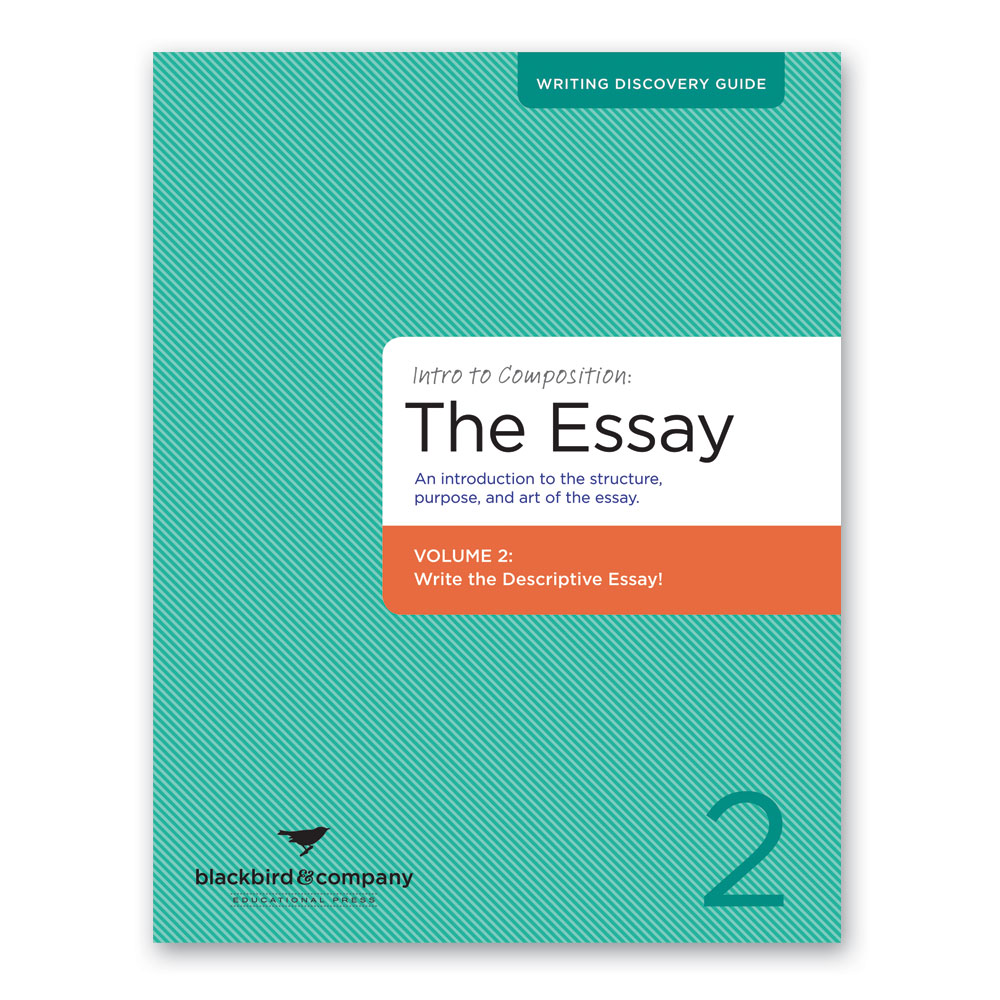
Intro to Composition Vol. 2: Descriptive

For Who:

Middle School Students utilizing Introduction to Composition: The Essay, Volume 2

When:

  • Starts: 9/8/2023
  • Length: 3 Weeks
  • Day: Fridays
  • Time: 10:30 – 11:30 PST

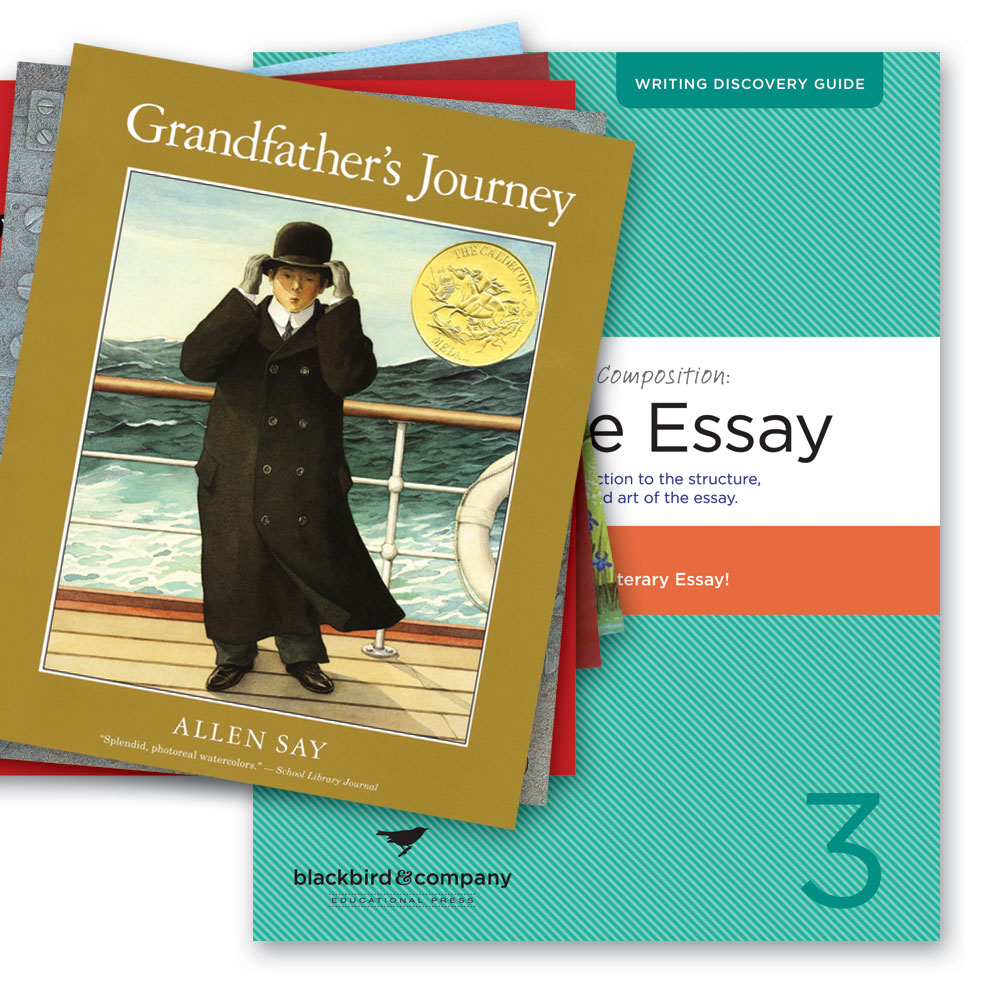
Intro to Composition Vol. 3: Literary

For Who:

Middle School Students utilizing Introduction to Composition: The Essay, Volume 3

When:

  • Starts: 9/8/2023
  • Length: 3 Weeks
  • Day: Fridays
  • Time: 12:15 – 1:15 PST

Session 2

Intro to Composition Vol. 4: Little Worlds

For Who:

High School Students utilizing Introduction to Composition: The Essay, Volume 4

When:

  • Starts: 10/20/2023
  • Length: 3 Weeks
  • Day: Fridays
  • Time: 9:00 – 10:15 PST

Intro to Composition Vol. 5: Persuasion

For Who:

High School Students utilizing Introduction to Composition: The Essay, Volume 4

When:

  • Starts: 10/20/2023
  • Length: 3 Weeks
  • Day: Fridays
  • Time: 10:30 – 11:45 PST


Posted on

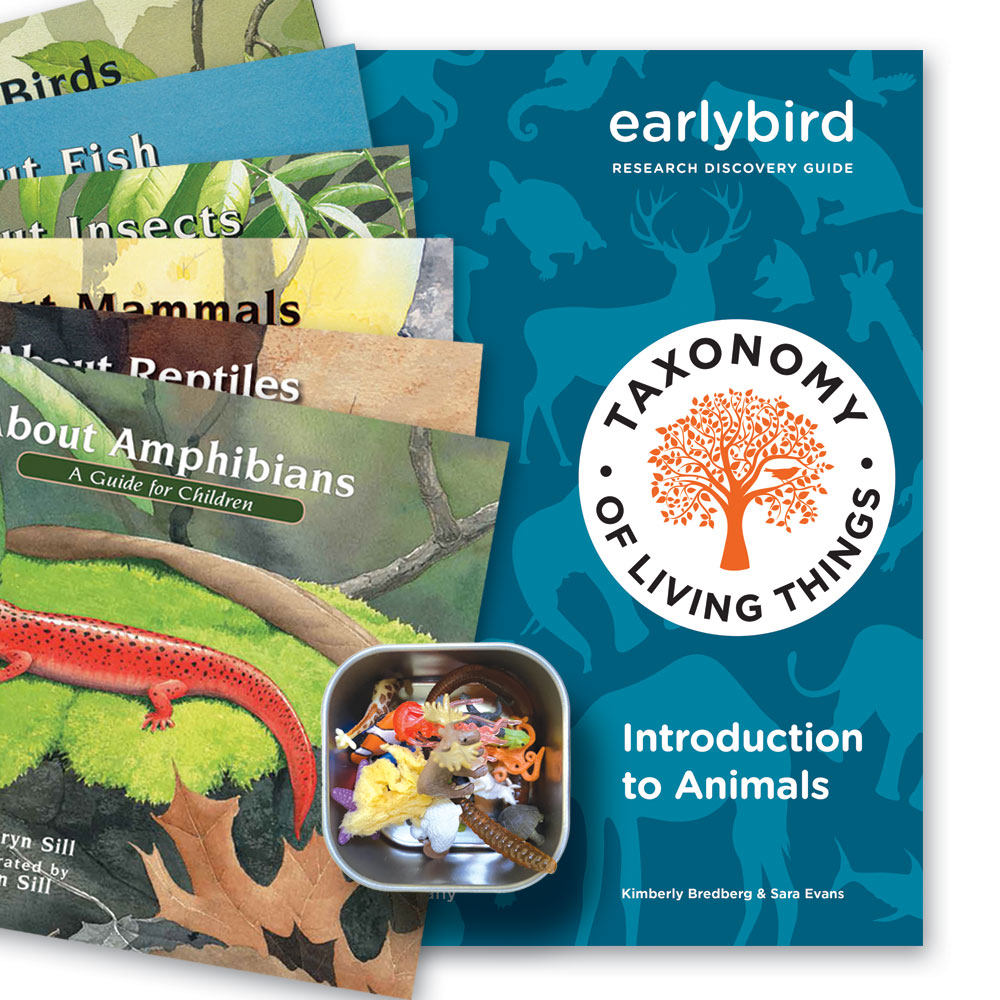
Earlybird Introduction to Animals

WE ARE HAPPY TO WELCOME OUR BRAND NEW UNIT:

Earlybird Introduction to Animals!

There are two types of things in the world: living and non-living! Everything you can imagine is one or the other. Taxonomy is the science of sorting it all out. At its basic level, taxonomy identifies, names, and classifies all living things in a systematic way.

Every species has a common name, but also a unique two-part scientific name situating it on the tree of life. In the pages ahead you will get a glimpse of the amazing order that is intrinsic to the natural world.

Over the course of 13 weeks, students will be guided into the work of learning about the animal kingdom, journaling their discoveries along the way. This opportunity to research will not only help them to gain knowledge, but also to springboard into the realm of non-fiction, narrative writing.

As with all our materials, included in the front of the journal is the instructional material. Read through this material carefully. Next, flip through the first week of the journal to familiarize yourself with the daily work of your student. Week 1 is an introduction to the science of classification. After that, students will be focusing on one class of animals every two weeks. Scan through Weeks 2 and 3, and you will notice that on the first week, the reading is tied to comprehension and note taking activities, and the second week is an opportunity to write about an animal. This ongoing, consistent opportunity for practicing constructive writing skills will help students gain confidence in their ability to communicate.

While the unit is included in our 2nd Grade Level Collection, it is perfect for both 2nd and 3rd graders, and available for purchase A La Carte.


~Kimberly

Posted on

Arts Discovery, Pages Online

Like learning phonics and grammar and punctuation and rhetoric, artists too have tools that enable them to bring shape to an idea so that a “reader” might engage and be inspired by that idea. Color is one of the important tools the enables great art to tell a story.


During Session 1 of Pages Online, we are offering our very first class in visual arts for storytellers! We are so excited! Students will not only learn about the mechanics of color, the physics of color, and how artists use color to tell stories, but they will be using color to create an original idea!


Click through to learn more and enroll. Space is limited. Don’t miss out!

Tuesdays 5th – 8th Grade, 9:00

Thursdays 9th – 12th Grade, 9:00

Visual art is language. Blackbird & Company is excited to introduce a series of visual art classes through Pages this coming year because learning to read art extends literacy—Read well! Write well! Make well! Think well!

“Color is the place where our brain and the universe meet.” ~Paul Klee

Posted on 1 Comment

Music Discovery, Pages Online

Each day a boy named Peter opens a gate and wanders into a familiar meadow and so the story begins thanks to Sergei Prokofiev. Music, like fiction always exists in the present tense.


Back in 1936, Prokofiev was commissioned to write a musical symphony for children. He had an idea. And he got to work crafting the story of Peter and an imaginative cast of characters who are sonically represented with themes played by specific instruments of the orchestra. Genius!

Children (and adults alike) across the ages simultaneously learn about the different voices of the instruments of the orchestra and the power of story through this singular work.

We are so happy to offer two classes during Session 1 to introduce Peter and the Wolf for both elementary and middle + high school:

Tuesdays 5th – 8th Grade, 10:30 PST

Thursdays 9th – 12th Grade, 10:30 PST

Music is language. Blackbird & Company is excited to introduce a series of music classes through Pages this coming year because music extends literacy.

“Where words fail, music speaks.” ~Hans Christian Andersen


~Kimberly

Posted on

Pages Enrollment is OPEN!

We hope your summer has been filled with joy and opportunities for continuous learning. We are thrilled to announce that registration is now live for our highly anticipated online workshops!

At Blackbird & Company, we understand the importance of providing resources that foster creativity, critical thinking, and a love for learning. Our carefully curated workshops offer an exciting opportunity for your child to explore a range of subjects while having fun engaging with their peers in a virtual environment.

Who are Pages classes for?

All students Earlybird through Level 4 (grades 2 through 12).

When are the classes?

Classes meet once per week and are scheduled Monday through Friday at various times for convenience. No matter the level, you will be able to find a class that works perfectly with your schedule.

  • Session 1 | 9.11.2023 – 10.13.2023
  • Session 2 | 10.16.2023 – 11.17.2023
  • Session 3 | 1.8.2024 – 2.8.2024
  • Session 4 | 2.19.2024 – 3.22.2024
  • Session 5 | 4.1.2024 – 4.29.2024

Class space is limited, so click through to reserve your space.

Register NOW!