Posted on

Smell the Roses

SeashellsJPG
Don't forget to stop and smell the roses? 

…oh, wait!

What I meant to say is, "Don't forget to stop and observe the seashells!"

And when you do, ask yourself, "What do I see?"

Notice the organic shape. Look for the complex colors. Do you see the orange and blue making each other sing?

And whenever you observe something, make note of it in your Observation Journal like Marlo does!

Observe

Do you see how she closely observes line and texture and and shape and color inherent to the Nuttalia obscurata ("purple varnish clam")? 

Now you try.

Find an object from nature in your neck of the woods. Journal your observations using words and images.

And don't forget to smell the roses.


-Sara 


Posted on

Fibonacci on the Produce Aisle

Fibonnaci
Math is everywhere. Absolutely everywhere!

When I saw this vegetable ate the market, I stopped to ogle. It was fun to learn that it is sometimes called Romanesco cauliflower, sometimes Romansch broccoli. Either way, I was not thinking of the thing as food, only sheer math! 

Can you see it?

Whoa.

Fibonacci.

And then I thought to myself, "This is math my students can get behind." So I pulled out a book:

Fibonacci

And later I stirred up some soup and called my family to dinner.


-Kim

Posted on

Happy Birthday Ben?

NOT really…!

Ben’s family birth certificate says that he was born on January 6, 1706, but when the Colonies switched to a different calendar to keep pace with the seasons, his new birthday became January 17!

Founding Father.

One of five men who crafted the Declaration of Independence.

Once, the Postmaster General.

Founded the idea of the public hospital and library.

Organized the first volunteer fire department which led to his concept of fire insurance.

The architect of Poor Richard’s Almanac.

Inventor of the glass armonica, bifocals, swim fins, Franklin Stove, and, of course the lightning rod.

Honorary degrees from Harvard, Yale, University of St. Andrews, University of Oxford, and University of Edinburgh.

Spent 27 years of his life living abroad, crossing the Atlantic 8 times!

Earned his place on the $100 dollar bill.

All this more than 311 years ago!

Celebrate this life well spent one of two ways:

Ever wonder where inventors get their ideas? As it turns out, the great inventor Benjamin Franklin got his best ideas from a mouse named Amos (not really, but make for an adventurous historical fiction)! Consider this from historian David McCullah who read the book as a child:David McCullogh says “I can never be in Old Christ Church without wondering if perhaps some of Amos’s line are still there, back behind the paneling.” Pick up a bundle today. Who knows, you might cultivate a historian!

Early to bed and early to rise… you know the rest (I hope).

Benjamin Franklin was the youngest of seventeen children. He was the inventor whose thirst for knowledge led him to constantly seek to improve the lives of his fellow men. Follow his life as a leader in the American Revolution and ambassador to both Britain and France and learn why the French hailed him as the man who “tore the lightening from the sky and the scepter from tyrants.” Explore this an so much more in the D’Aulaire recounting of the life of Ben Franklin. And over the course of 5 weeks you student will not only be guided through the crafting of an original essay, but will discover just how valuable a life can be.


-Kim

Posted on

Knit / Purl through a Great Story

earlybird winter bundle

It all begins with the sheep.

Our Earlybird Winter Discovery Guide’s fourth book, A New coat for Anna by Harriet Ziefert is a sweet story that helps readers learn just where a wool coat actually comes from.

A very fun project is to buy some white wool yarn and dye it with kool-aid packets from the market. Invite fellow students over for a learn-to-knit party!
new coat for anna earlybird winter book

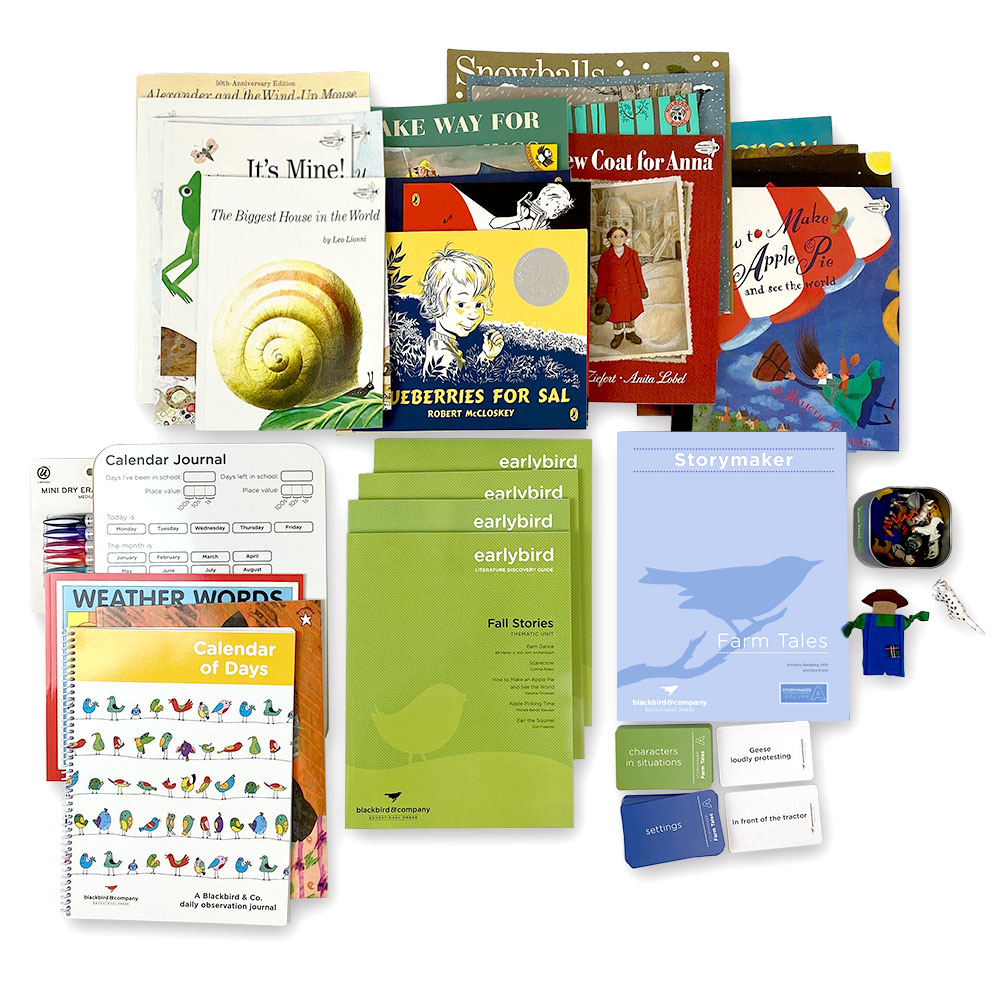
Pick up an Earlybird Winter unit and encourage your students to journal their way through all the wonderful thematic stories.

~Sara
Posted on

Wintry Lexicon, After Jasper Johns

JasperJohns

Where I live there are NEVER snow days (sad face).

But there is ALWAYS white paint!  

For this icy, project I decided to introduce the art of Jasper Johns to inspire my apprentice artists. I'm hoping to inspire yours too. We mad a really large, collaborative piece, but this would translate well into an individual work quite nicely. To begin, have your students gather a dozen or more really wonderful, extravagant words—a lexicon for winter.

You will need to gather the following supplies before you begin:

One large sheet of Cardboard (this one is 2' x 3').

A basket of assorted wood, cardboard, or sticker letters, many sizes and many different fonts.

One good pair of sharp scissors (we also used a heavy-duty paper cutter).

One hot glue gun with a large supply of glue.

A large quantity of white acrylic paint and a large paint brush.


Begin with the background, Create geometry using a random, collage technique, layering shapes on top of each other and glueing them to the background using the hot glue gun. When you are satisfied with the background, begin glueing down the words but it is a good idea to lay them all out before glueing to make sure you are satisfied with the placement. Mix and match type-faces, try placing words sideways and upside down. When the cardboard collaging is complete, the fun begins. Slather on a first layer of white paint. Let the coat dry completely then layer on a second coat, and a third! The trick to a really fun end result is to be courageously spontaneous while layering. When you think your done, keep going!  Keep layering until the work of art feels snowed in. The you will know its winter.


-Kim

Posted on

Mitten of a Tale

earlybird winter bundle

Our Earlybird Winter Literature and Writing Discovery Guide’s third book, The Mitten by Alvin Tresselt is re-telling of a folk tale about all kinds of animals trying to fit in a lost mitten! Hilarious! We love the theme that common needs can bring people together.

Carry this theme forward by reading, Unlikely Friendships: 47 remarkable stories from the Animal Kingdom by Jennifer S. Holland.

If this book doesn’t elicit a mitten-full of,  “Oh, that is soooo cute!,” we don’t know what will!


-Sara

Posted on

Courage is a Gift

complete second grade language arts

What better way to learn about courage than from a character in a book!

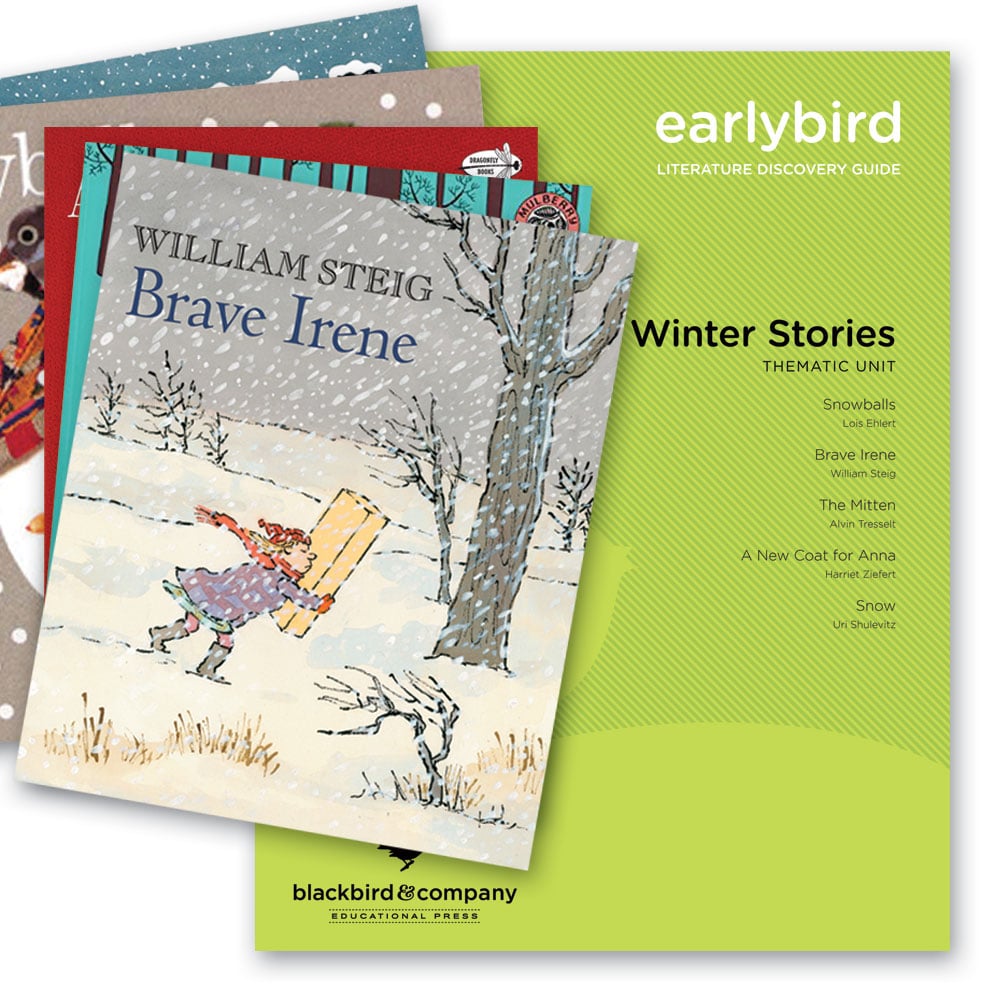
Our Earlybird Winter Literature and Writing and Discovery Guide features Brave Irene by William Steig. Irene demonstrates love and courage by helping her sick mother in the dead of winter deliver an important package.

We love stories that highlight girl heroines! For more on this theme, a fun read aloud might be Elizabeth Blackwell: Girl Doctor (Childhood of famous Americans).

Keep the conversation going. What does it mean to be brave?


-Sara

Posted on

Liquid, Solid, or Gas?

Eb_snow_bnd_LRG

For an interdisciplinary approach to literature, dive into our Winter Earlybird Literature Discovery Guide that features an eclectic mix of wonderfully told stories. It begins with Snowballs by Lois Ehlert, where your child will discover the wonders of the water cycle and how snow comes into being.

Did you know that you can watch the water cycle water cycle in a ziplock bag? For best results, make sure you hang it in a sunny window. We'd love to hear what you discover.

To extend the fun, read All the Water in the World by George Ella Lyon


-Sara

Posted on

S is for Sparkle

SparkleJPG
Sparkle! And while you are at it sparkle and spin. Add capital letters to that phrase and you've got one bling-of-a-book! 

Sparkle and Spin: A Book About Words by Ann Rand and Paul Rand is a mid-century treasure that I hope will oscillate its way into the heart of 21st century readers. Here words sparkle their images and spin their sounds and leave readers happy about the art of words. What better way to remind little and big alike that some words add sparkle to language? 


-Kim

Posted on

Apple Pie and Books

earlybird fall bundle


I’ve never understood apple pie and cheddar cheese.

For me it’s apple pie and books.

One day, after a long walk, John sat under a tree to rest—an apple tree, of course. What better way to begin pie making than reading about John Chapman, the nurseryman who seeded much of our landscape with apples. From there, my recipe calls for Apple Picking Time by Michele Benoit Slawson about a girl named Anna who cares deeply about the tradition of gathering apples from those trees that Johnnie Appleseed so carefully cultivated.

apple piocking time earlybird fall book

But it’s still not time to go to the pantry. Not yet…

My recipe calls for How to Make an Apple Pie and See the World by Marjorie Pirceman. An apple is easy to gather from the market, but where did that apple come from? And the butter? The sugar? The spices? The answers call for a journey. And this little story guides the way.

how to make an apple pie and see the world earlybird fall book

Once back…

N o w  it’s time to go to the pantry. Peel some apples, remove the cores, and slice. Add a sprinkle fresh lemon juice to enhance the apple tang. Toss with sugar, cinnamon for spice, cardamom for warmth, and a happy pinch of nutmeg. Set aside. Cut the butter into the flour until the butter makes the flour sandy. Add water to the flour mixture, form a ball, then roll the top and bottom crusts. Fill the bottom crust with prepared apples, cover it with the top crust and crimp. Bake. Enjoy.

Nothing like apple pie and books.


~Kimberly