Posted on

Ideas of the Original Variety

Taxonomy4

I've had the privilege of exploring his architectural scaffolding—Kingdom, Phylum, Class, Order, Family, Genus, Species—with my apprentices during Science Discovery. 

There are four types of sentences: Statement, Question, Exclamation, and Command. Teachers are famous for jotting that last type—command—in swarms on their chalkboards.

But imagine your science teacher marching into class and scribbling this on the chalkboard:

Devise a system for naming and classifying ALL living things. 

Imagine the buggy eyes, the tilted heads, the groans, the tears.

Never happen.

Now imagine a time way before the technological advances that our computer age has to offer. Way, way back before our Declaration of Independence was conceived in the minds of Thomas Jefferson and Benjamin Franklin there was a young man named Carolus Linnaeus. Born on May 23, 1707, in Råshult, Sweden, his father, a lover of all things botanical, introduced him to the joy of observational science. Young Carolus was encouraged to imagine possibility as he tended his very own garden over time. He looked back fondly on that garden as a place that "inflamed my soul with an unquenchable love of plants."

As Linnaeus continued to observe nature, he developed a passion for order.  Over the course of his life, Linnaeus accomplished a great many things—research, publication of scientific papers, a medical practice. Greatest of all, he devised a binomial system for naming and classifying all living things… without the prompting of a teacher's command!

Way before computers, Linnaeus was an information architect.

Discover_Research2

It's taken the better part of the year to appropriate the great lessons we chip away at on a daily basis—value silence, process is a slow and steady pacing, your-ideas-matter, work works—but now, like a spring bloom, I marvel at the fragrance of their progress. In a few short weeks, you too will be able to flip through the Science Discovery Journals to experience the wonder of this important work.

So much of education is couched in the promise that technology will ensure success. But so much of what we really desire for our children cannot develop without the passion to care about an academic work at hand and the longitude to explore. Challenging children to engage in the work of idea-making and providing the time to Discover just what it takes to bring shape to that idea, time and time again, leads to Critical Creative Thinking. Truth is, technology is a tremendous asset of our age, but the art of learning is a low-tech endeavor.

Ideas of the original variety begin with a spark of curiosity, not a command, and rarely a click.

Posted on

Flying Fish II

FishStairs

Here's another idea: click back to our Pinterest, the Write it… board. Scroll down to the boy flying through the air on the shimmering fish and put on your Poet's Cap.

Imagine that the bony on the flying fish of shimmering shades of orange takes you to a staircase pond of giant carp?

What then? 

Think humorous.

Be humorous.

Take your somewhere imaginative.

Think pun. For example, let’s say that you were to write about the following pun: “I don't trust these stairs because they're always up to something.” What might those stairs be up to? Does it have something to do with the upper floor, or could it be something unrelated?

Sky's the limit when you travel by flying fish.


Example:

I Don’t Trust These Stairs


I don’t trust these stairs; they’re always up to something.

Apart from fooling around with the well-groomed

second floor, they make a point of tripping me

at least once every day in front of someone I admire,

or stretching themselves to seem higher and longer

during those days when climbing them feels like

scaling the frosty length of Everest: and, in particular,

they seem to find undying pleasure in the task

of making me think that there are more of them,

just when I think that I’ve finished counting the number

of flat heads and sharp shoulders on each flight.


-Constance

Posted on

Little Paper Girl

LittlePaperGirl

Join the fun on our Pinterest and Write it!

It’s April—National Month of Poetry— let this  be your muse. Write a poem inspired by something that is homemade. The object in question need not be a DIY art project—you could write about homemade food, homemade clothing, homemade furniture. In the abstract, think about what habits are homemade, and which homemade ideas have influenced you significantly.


Mother’s Sandwiches


They were

Always greasy,

Sticky with lumps of butter,

Subject to lunch-hour teasing, but

They were home.

Posted on

Totem Poem

  AlainDelorme_Totem14

Take inspiration from , which centers on the juxtaposition between the traditional and modern state of China, especially Shanghai. What would it be like if everyone had to visibly drag some part of the past with them, in such enormous amounts? What would you drag with you? What would that part of your past look like? Would you proud or ashamed of it? Would you try to cover it up as you dragged it around?


Example:

Red Balloons


There is a man

who walks around

the city park

every weekend,

carrying a red

balloon. I’ve heard

people say that

he used to sell

balloons in the

park with his

wife, who always

used to wear

a large apron

that was bright red.

No one knows

what happened

exactly, but eventually

people started to

notice that the man

comes to the park by

himself now,

and sometimes

when he comes early,

the only sound

except for the chattering

of some sparrows

is the quiet squeak

of the red plastic as

he runs his hands over it.


-Constance

Posted on

Sail/Whale

Moby


Write a story inspired by this  by Max. Be sure to include a constant undercurrent of apprehension in your tone.

For example, in “The Lottery” by Shirley Jackson, a subtle mood of apprehension and suspense is built when Jackson withholds key details about the lottery from the audience. In “A Game of Chess” from “The Waste Land” by T. S. Eliot, Eliot creates an apprehensive and anxious tone through diction and sound. You can also draw inspiration from musical devices– in Florence + The Machine’s “Breath of Life,” a musical sense of apprehension is built through a prolonged build-up, increasing volume and tempo, and long extensions of notes in a minor key. How might you translate such devices into a simple lyric form such as haiku?


Example:

hungry


tiny white sailboat

below it, a whale’s black shadow

mouth already open


-Constance

And be sure to visit our Pinterest, Write it… board for more inspiration. 

Posted on

Observing Pumice

Observation

A few years ago Sara brought me a handful of pumice from Mount St. Helens and so I began the lesson with research of the volcano. We moved from there to the chemistry of carbon. When it comes to Observation, the possibilities are limitless. At last, directed the group of Observers to create a close observation drawing in conduction with the research in their Observation Journals—including a close focus section.

This little jar of fodder has proved more valuable than any textbook. This drawing by Marlo began with value—organic shapes of darks and lights. Once she was satisfied with the large shapes, she began to look for texture, began to mimic what she saw with varied lines on the page. Smaller still, she added dark marks to represent the deep bubbled areas on the volcanic stone. Most significantly, Marlo kept going—she kept looking. Perseverance is a skill that can not be be taught from a textbook.


Can anyone learn to draw like Marlo?

Indeed, YES!

Yes, yes you can. You can draw like Marlo, but first you must learn to observe.

Observation is a foundational academic. Learning to "look closely" across all domains of learning will strengthen the student's Creative Critical Thinking skills. For this reason, Observation exercises should be integrated into the weekly routine to transform this crucial skill to a Habit of Being

-Kim

Posted on

Through is a Way Out

Through


Write about an unexpected sliver of nature found in the city. Find inspiration in the dandelion between sidewalk cracks, the butterflies in South Central L.A., rain in the parched corners of downtown.


Example:

butterfly in the subway


did no one notice how you wandered in,

like that one person at a party

who came late and doesn’t know anyone,

and after tipping his hat at the birthday boy

bobs his fluorescently orange way out?


-Constance

Posted on

Write for Real

The exchange always goes something like this:

“I can’t teach writing.”

“Yes you can! If you have ever been inspired by words on a page, then you can teach writing.”

If you can read and ask questions when you read something that is not clear, you can be a writing mentor. Whether we are reading a newspaper article, a scientific journal, a novel, or a poem, who wants to read words that are void of ideas?

Great writing begins with an idea crafted to words on a page by a courageous writer.

Madeline L’Engle in, Walking on Water: Reflections of Faith and Art, confides, “I am grateful that I started writing at a very early age, before I realized what a daring thing it is to do, to set words on paper, to attempt to tell a story, create characters.”

The most important thing we can do when it comes to teaching a child to write is to value their imagination and to teach them to do the same.

In my book, Habits of Being: Artifacts from the Classroom Guild I’ve collected snapshots from my experience teaching my own children and students in my Guild to demonstrate just what happens when they engage their curiosity.

Ask yourself, “Do I want my child to write formulaically or to write for real?”

Teaching children to write for real begins by teaching them to believe that their ideas are important enough to do the work of shaping words on a page.

Teach your children to become storytellers. Regardless of domain—fiction to non-fiction—great writing tells a story. Writing is a wonderfully tedious process. Provide writing opportunities that teach children the cardinal rule of real writing: Imagination first. After all, imagination is the seat of great ideas. When children discover that their imagination is valuable and relevant, they will work diligently to refine their voice. Purpose helps writers develop habits of being that motivates them to move through the writing process:

  1. Come up with an idea
  2. Write your idea
  3. Re-read and refine your idea
  4. Have someone else re-read and refine your idea
  5. Polish your words on the page

Moving from reading and recognizing ideas, to engaging in personal expression through writing, develops an awareness of the world at large. When students are encouraged to engage in the process of writing, they will discover the power of words.

Great writing is work connected to the soul. Great writing brings shape to imagination. Great writing evokes, engages, and inspires human curiosity.

Students who engage in the process of real writing will develop confidence in their voice, strengthen their ability to communicate new ideas and become keen observers of their world. Authentic voice is a one-of-a-kind fingerprint. And those are words on the page that are worth reading.


-Kim

Posted on

Journal BIG Ideas Inspired by Books

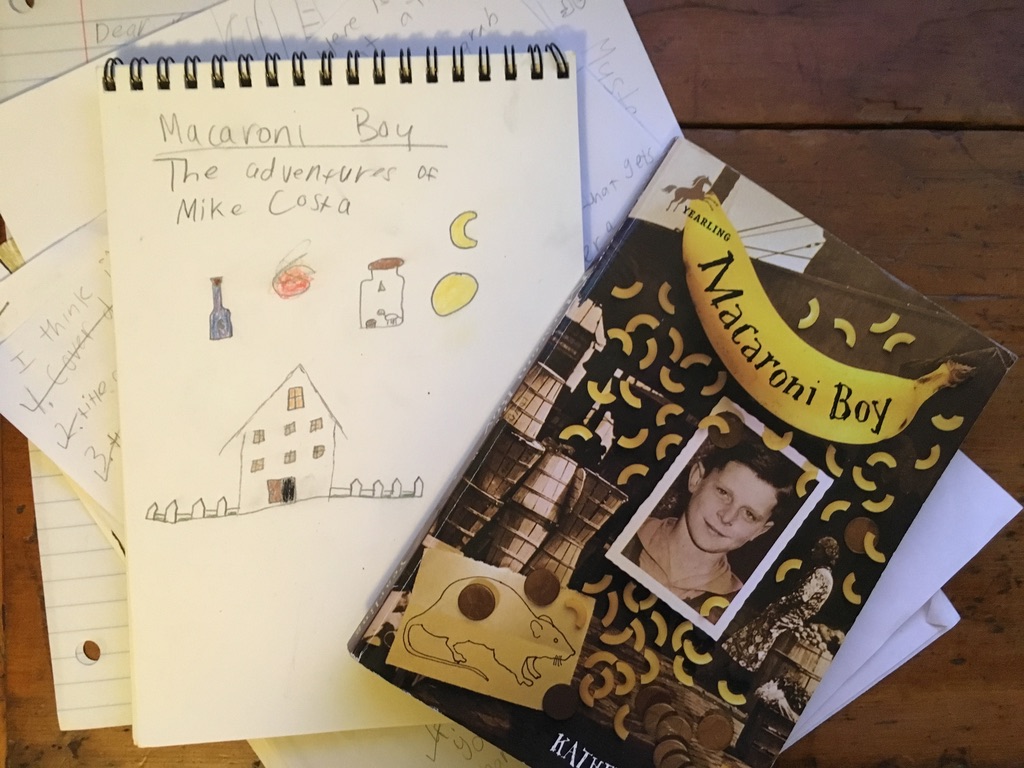
Taking notes is a foundational skill that will accompany your student through their entire educational journey and beyond. Even though there is no right way of taking notes, it is important to learn how to extract relevant and pertinent information from a text in a neatly organized, concise manner. This takes practice. As students are encouraged to practice over time the art of capturing the most important details from their reading, they will begin to recognize how the intricacies of a story fit into a larger picture. This is precisely how a Habit of Being is established.

When readers take note of character development, trace a setting, and watch a plot thicken, they are learning more than just the skill of recording facts, they are actually beginning to realize the potential of storytelling. Teaching students to dig into a story, to do the work of reading for meaning, enables them to discover how language has the power to communicate significance. Learning to take notes helps to lay the foundation for rich, clear, and organized writing.

Some might argue, when faced with a classroom of 30 students, or even when faced with one student sitting at a kitchen table stubbornly refusing to write, that teaching from a textbook that tells the student what to learn is an easier method than pulling teeth trying to nurture the independent skill of note taking. We would argue that learning to extract information from a story trains students to do the hard work of, not only attending to the details of reading, but more importantly to develop the skill of integrating knowledge into life outside of the book.

As students discover the details and framework that make a story great, they will apply this new-found knowledge to broader academic pursuits in all subject areas.

~Kimberly

Posted on 1 Comment

Haiku for the First Day of Spring

Spring3

On this first day of spring step outside, celebrate the blossoming and craft a haiku greeting.

How to craft haiku:


five syllables

s e v e n  s y l l a b l e s

five syllables


1. Haiku poems consist of a three-line stanza—16 to 18 syllables total—written in the following pattern:

Line 1: 5 syllables
Line 2: 7 syllables
Line 3: 5 syllables

*Slight variations in syllabication is appropriate as this helps the poet maintain “one thought in three lines”

2. Haiku poems are typically observations of nature (though the form welcomes other topics), often making reference to the seasons.

3. Haiku poems are tiny snapshots capturing moments in time.


So, a  “haiku moment” describes a scene that leads the reader to a feeling.

But, remember, your three lines should be woven to a single thought:


and I croon in the

scent of Spring’s dotted song, swoon

in her blossoming colors

Spring4
Spring2
 -Kim