Posted on

Crafting a Poem of Thanksgiving

I shrink in the company of Sarcasm. I’m admittedly deficient, two steps behind when it comes to her volley of shrill phrases. When she enters the building, I chuckle a bit but rarely participate. I acknowledge that, on edge of her spectrum, chatter is light-hearted, friendly. Still, try as I might, I can’t quite squeak a giggle in the midst of her raucous presence.

Recently two students in my guild moved on to explore new education paths. Both students had been part of the guild for many years. My idea was to provide an opportunity for closure by challenging writers to craft a farewell phrase. I decided to incorporate this exercise into our regular writing workshop. What better way to put my “writing is a gift” motto into action?

So we began, “Let’s craft kind words to encourage our friends as they set out on a new adventure.” Sounds simple, right?

As I watched the card I provided move from writer to writer, I anticipated reading the messages before posting them the old fashioned way. But later that day, when I sat down with a cup of tea excited to read the phrases inscribed on the card, my heart sank. There she was, Sarcasm, smirking in all her glory, “Have fun wandering the halls,” and “Happy Easter (jk),” and “Yeah, whatever, thanks for leaving me behind,” and “Life is good (not),” …not a single kind word. There were careless spelling, capitalization, and punctuation errors.

Decibels peaking, Sarcasm crossing over to the caustic zone, I wanted to shrink. At one point in the reading, I wanted to cry. Our guild is not a typical classroom where children come and go annually, most of these children have been learning together for many years. These children are respectful of and grateful for friendship. Still, not a single phrase in the card was crafted vulnerably. What in the world? I knew that this group would really miss their friends who had moved on. I knew this must be something else. Maybe they did not know how to craft vulnerable words.

Continue reading Crafting a Poem of Thanksgiving

Posted on

Look!

Pelletbones1

One week into the adventure, our errands accomplished, we were still in the van at twilight. Moving to the city was not what my husband and I had envisioned for our family, but food on the table is always a good thing! As we loaded our boxes into the U-haul we promised each other to look on the bright side of the concrete, but that particular night, after fighting traffic for 45 minutes, there was a shortage of positive thoughts. Rounding the corner into our brand new neighborhood I think it was Liam, then an animated three-year-old, who was first to spot them, “Mommy, look!” I slowed the van to a whispering tiptoe. In hushed tones, we watched as a mama raccoon and her kit crossed the street, “Wildlife in the city!” This was the moment we began to feel at home. From that day on we kept our eyes wide open, documenting our discoveries in the Observation Journal.

Pelletbones3

We’ve been city dwellers for nearly twelve years now. This past weekend our country folk friends ventured to the city to celebrate the beginning of fall. On Saturday, we were just about to begin breakfast when we heard a great commotion. We ran to the yard to find a murder of crows mobbing a Great Horned Owl snoozing in our tree. While I must admit this was an extravagant sighting, I was not surprised. My friends, on the other hand, were flabbergasted by this display of wildlife. Even the neighbors were drawn from their autonomous spaces, cameras and binoculars in hand, to observe the owl and her mortal enemies.

Pelletbones4

On Sunday morning Sara collected pellets from the base of the tree, “…a dissection opportunity for the Observation Journal.” And as you can see from the photos, the pellets provided a treasure trove of interesting material for scientific inquiry and discovery…not to mention a lot of ohhs and ahhhs.

The owl and the crows spent the weekend with us, then disappeared as mysteriously as they appeared.

Read more about starting an observation journal in the latest issue of Heart of the Matter's online magazine (see page 22).

Note: Should you not be so fortunate as to have a Great Horned Owl nesting nearby you can find owl pellets readily on the internet.

Posted on 1 Comment

Leaving Ticonderoga In the Dust

We use a whole-lotta-lead in our little cooperative school. This year I got wise, I go directly to Dixon for the goods! But sometimes, especially as young ones are honing their reading and writing skills, they need work that does not involve gripping a pencil. We call this type of work “Discovery” because it affords the opportunity for the primary student to make a choice, attend to the work involved in that choice, and ultimately, discover something in the process. 

We dedicate shelf space and time in each day to this type of work. Discovery provides an opportunity to focus on an independent activity without dividing the effort between two skills, the academic task at hand and the developing fine motor, which is a task and a half for many children.

Discovery activities are usually hand made, or assembled from treasures found at the dollar store or at yard sales. We also mix in prepared materials designed for the Montessori and Waldorf style classroom. The possibilities are truly only limited by your imagination. Once the work is complete, the student has the work checked then attends to the task of placing the materials back in its place on the shelf until next time.

Here are some ideas from our little group, and as time goes by we'll be sharing additional activities. Please contribute your own ideas too in the comments section…learning from eachother is a gift!

Line

Sock Paring Basket

Materials:
– medium size basket
– 8-10 pairs of colorful ankle socks (easier to fold together)

Instructions:
Mix up sock collection in basket. Child finds pairs and folds them together. Talk about what a pair is, count the pairs aloud together, talk about the colors and patterns, etc. When finished, child separates socks and places them back in basket.

Sockzd
Sockzc
Sockzb

Pom Pom Sorting

Pom poms are by definition fun and full of delight! Now something to do with that large bag from Michael's that was calling your name…

Materials:
– small basket
– muffin tin
– pom poms in various sizes and colors
– small tongs

Instructions:
Child builds fine motor skills by using tongs to sort pom poms into muffin cups. They can play with sorting by either size or color. When finished, child places pom poms back in basket.

Poma
Pomb
Pomc

Posted on 1 Comment

The Spider That Did Not Skip a Beat

Web copy

At the end of back-to-school week #3 I was exhausted and, frankly, a bit discouraged.

The tower of blocks was skewed and teetering: Three sons and a daughter on top of Laundry with a capital L on top of an empty refrigerator on top of a rat in my garden on top of dusting on top lesson plans on top of a sore throat and a stuffy nose.

So early Saturday morning, I made a cup of tea and called my friend Shirean who has three grown children, only one left in the nest. I was sure she would have an offering of remedy words.

You know the call…”I’m so tired… I can’t…!”

Shirean patiently nodded across the miles,” I have been there,” while gently prompting me to scoop myself out of wallowville.

All the while, sipping tea, breathing in a healthy dose of fall fresh air, I pondered a spider on her intricately woven web basking in ray of morning sunshine. Just as my telephone conversation was nearing the end, the tiniest breath of breeze destroyed the web. I still marvel at the spider’s response. Instantly she dropped on a long silky thread and began the climb to weft and warp anew.

What’s a spider to do?

Perspective.

– Kim

Posted on

Yet Another Reason to Draw

KennedayA
This past week Søren added JFK to his Book of 100 Heads. This time I noticed that he drew in two sessions instead of one. He told me that after he set it aside the first time and looked back at the drawing, he noticed that he needed to add more range of value.  As luck would have it, I had photographed the drawing after the first session of drawing.

At the end, Søren was inspired to read a book about the man he had spent a couple hours drawing. He may even write a little report.

Creativity inspires the mind.

KennedayC copy

Posted on 10 Comments

Haiku for a Change in Season

Haiku are the little powerhouses of the poetry world! They are a fun challenge involving the best of word play, mixed with a little finger counting to get the syllables just right! Here's a brief "Haiku 101" to help you and your kids get started.

1. Haiku poems consist of a three-line stanza that has a total of 17 syllables written in the following pattern:

Line 1: 5 syllables
Line 2: 7 syllables
Line 3: 5 syllables

 *Slight variations in syllabication is appropriate as this helps the poet maintain "one thought in three lines"

2. Haiku poems are observations of nature, often making reference to the seasons. 

3. Haiku poems are like photographs, which capture moments in time. A  "haiku moment" describes a scene that leads the reader to a feeling. 

4. Haiku poems were originally written as introductions to longer works of poetry and should be written as one thought in three lines.

Consider these haiku written by the Japanese poet, Matsuo Basho:

Yellow rose petals
Drop one-by-one in silence:
Roar of waterfall.

Within plum orchard,
Sturdy oak takes no notice
Of flowering blooms.

Ready to write? Try crafting three original haiku inspired by any of these photographs. Share them with us in the comments section, we'd love to read them!

3264638084_5723ede8f3

3260995619_b251eeea59
4863479926_7a8838742f
IMG_1758
4863480472_63f7805c1d

Posted on

Pearls in the Sky

Web

I know this has nothing to do with my usual posts, Home Ec, but I just had to share this little garden delight with you.

Almost everyday when I go into the garden, I run into this very industrious spider's web with my head because I can’t see the intricately woven strands. This spider weaves a web to collect a nightly feast between the branches of my apple tree and the vine on the fence. But it’s always in a slightly different place. I’m sure the neighbors can hear me mumbling a malediction as I plow headlong into it on a daily basis!

Today my attitude changed completely as I was greeted with rain and the miracle and beauty of a web adorned with pearls.

Now, was that web the same yesterday and the day before?

Of course it was!

Isn’t it amazing how just a little shift in perspective changes everything?

– Sara

Posted on 1 Comment

Yes They Can!

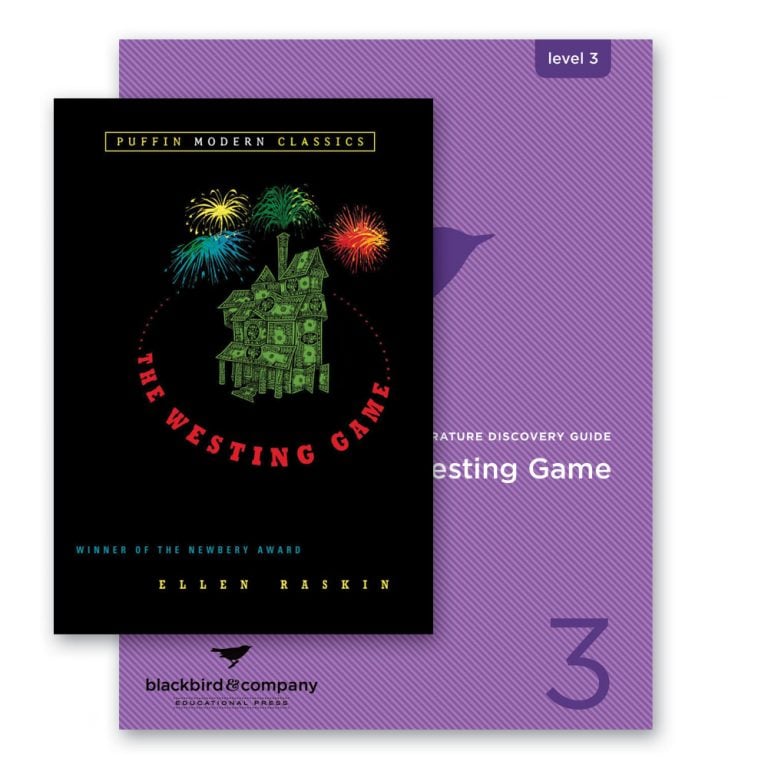
This past week my students completed reading the first book of the year, The Family Under the Bridge. I was delighted that my youngest son not only knew what to do but dove into the work headfirst! He began by removing all the sandwich bags from their box in the drawer, piling tape, glue, scissors, colored pencils and a plethora of art paper on the kitchen table. I watched him move from idea to finished product as I washed dishes and prepared dinner. In the end he smiled with satisfaction and proclaimed joyfully, “Tomorrow I will write a report to go with my diorama.” My son just turned 10! Not only is he self-motivated, he is delighted to do the work. Why? Routine.

No matter the subject, establishing a routine is a painstaking process, but once rooted, students thrive. Our literature products are developed with this truth in mind, providing students with the framework to guide them through the discovery process in a consistent manner that will, over time, develop the disciplined routine that leads to self-motivation.

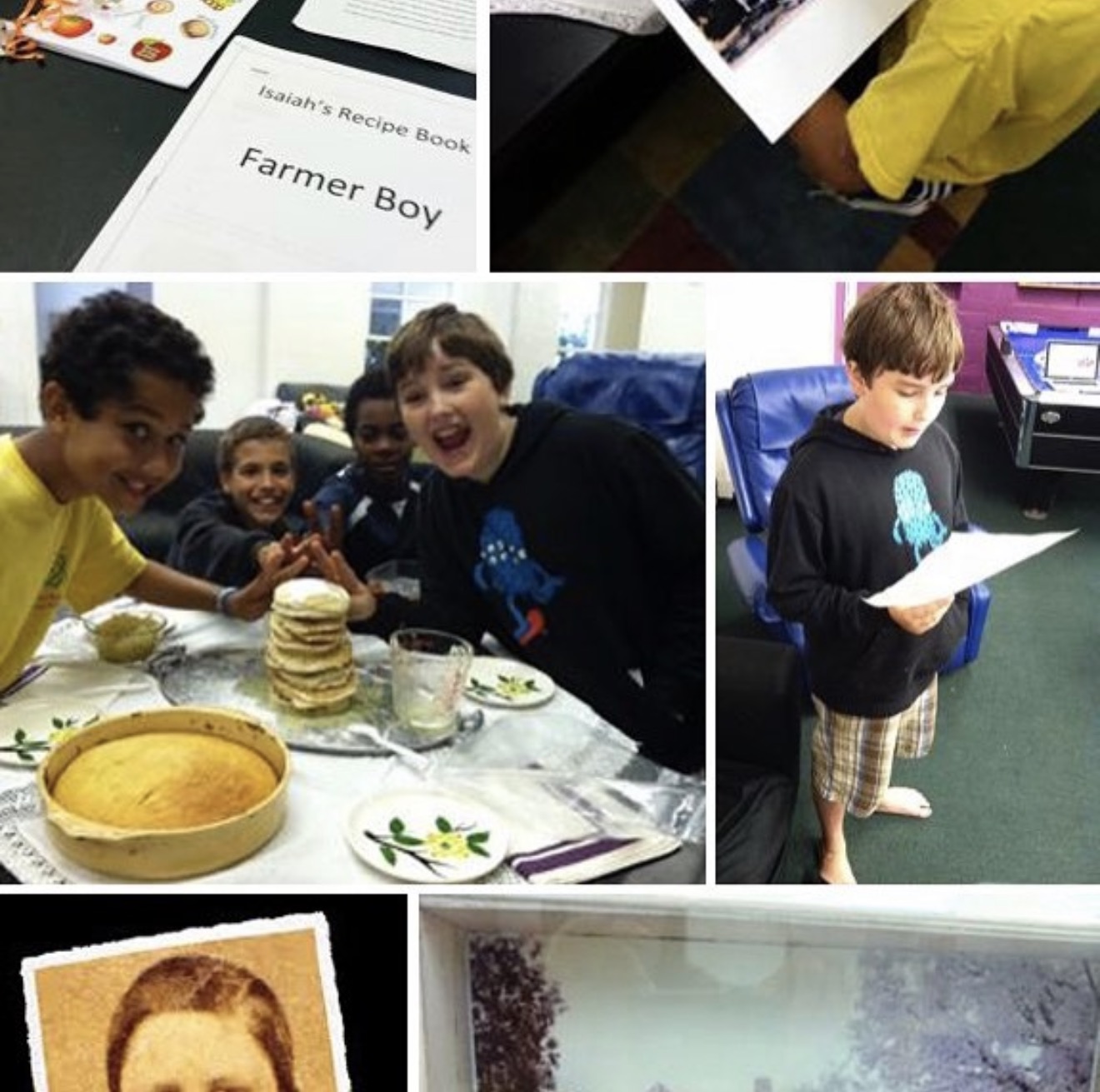
With our approach, each book is read and explored over the course of four weeks. During the fifth week, students develop a creative culminating project with options that provide a variety of ways for them to demonstrate deep understanding of the book. Students not only get a chance to demonstrate their originality, organization, clarity of purpose, and critical thinking skills, more importantly this culminating endeavor will allow them to show off what they have learned in their own, uniquely creative way.

Whether you are using our literature discovery guides in an individual mentoring situation or in a group setting, students really love sharing their culminating thoughts about great stories. Encouraging readers to create final projects with a high level of execution teaches them that their ideas are valuable and builds integrity into their work habits. Connecting your students with other students and the work produced in response to great stories is motivating and raises the bar on the end product. For this reason, we have created a Flickr group where students can share visuals of how great stories spark creativity. We encourage you to join this group, to add your own work samples, and to visit often!


~Kimberly

Posted on

Pages From a Third Grade Observation Journal

Almost exactly a year ago we posted about observation journaling (A Closer Look – Part 1 & Part 2). Working on this kind of journal is an important and holistic endeavor that builds science, reasearch, art, and writing skills. At the end of the year, if done with regularity, you'll find it's not only a precious memento of pictures and words but a rich and informed body of work.

Revisit our posts for a how-to, and be inspired by these pages from Hannah's third grade journal. I especially love how she takes note of her "fore frecels." Precious indeed!

IMG_4712
IMG_4714

IMG_4715
IMG_4717
IMG_4718
IMG_4719
IMG_4720
IMG_4721
IMG_4723