Posted on

Print Shop for Elementary and Middle School

Campfire Tip #6: Offer Independent Writing Skills Practice

Print Shop is a Blackbird & Company New Year Resolution!

Print Shop downloads offers an awesome opportunity to set your students into independent writing activities.  We are building a collection of downloadable activities designed to engage students, 3rd through 8th grade, in focused, independent work pinpointed on specific writing academic skills with opportunities to build upon the fund of knowledge. Click through to see our offerings, and check back often this month as we add more bundles—lessons on crafting exceptional sentences, extras tied to Tools of Style, activities exploring etymology and so much more. Each downloadable activity comes with instructions. We are so excited to grow this offering!

Now through the end of January 2026 all  Print Shop downloads will be FREE!


~Kimberly

Posted on

Print Shop for Primary

Campfire Tip #5: Inspire Independence

Print Shop is a Blackbird & Company New Year Resolution!

So what is Print Shop for Primary? It’s an awesome collection of downloadable Discovery activities designed to engage students, Kindergarten through 2nd grade, in focused, independent work pinpointed on specific academic skills with opportunities to build upon the fund of knowledge. Click through to see the first bundle of pumpkin activities, and check back often this month as we add more bundles—frogs and rainclouds and zippers and kites! And soon we will be adding an ABCeDarian Journal, beautifully illustrated by artist Sandra Ronda with dip pen and ink especially for your students to watercolor and learn from. Each downloadable activity comes with  a materials list and instructions. We are so excited to grow this offering!

Now through the end of January all  Print Shop downloads will be FREE!


~Kimberly

Posted on

Blasting-off an IDEA

Tip #4 IDEAS Motivate Writers

Writing is an art form achieved via a series of steps:

1) It all begins with an IDEA. Without an idea, the writer will simply stare at the blank page.
2) Once there is an idea in the mind of the writer, the PENCIL steps in to translate thoughts to words on the page.
3) When the pencil’s work is complete, the job of the writer is to become a READER. Encourage your students to RE-READ everything they write.
4) Empower students to use the RED PEN as they re-read to REVISE. Teach them to use strong words, to fearlessly re-arrange, to make corrections, and to not be afraid to strike through.
5) Polish the draft, preferably in cursive by hand.

Children have enormous creative potential.

This potential will flourish and they they will thrive as writers when they are inspired to revel in the important work of IDEA making.

THINK Tortoise (not the hare). Learning to write is a long journey, we know this to be true.

Michaelangelo said:

“If you know how much work went into it you wouldn’t call it genius.”

At the core of each child’s being is some form of genius.

We inspire genius as we inspire children to bring shape to their IDEAS.


~Kimberly

Posted on

Why We Publish Student Work

Campfire Tip #3: Writing is a Gift

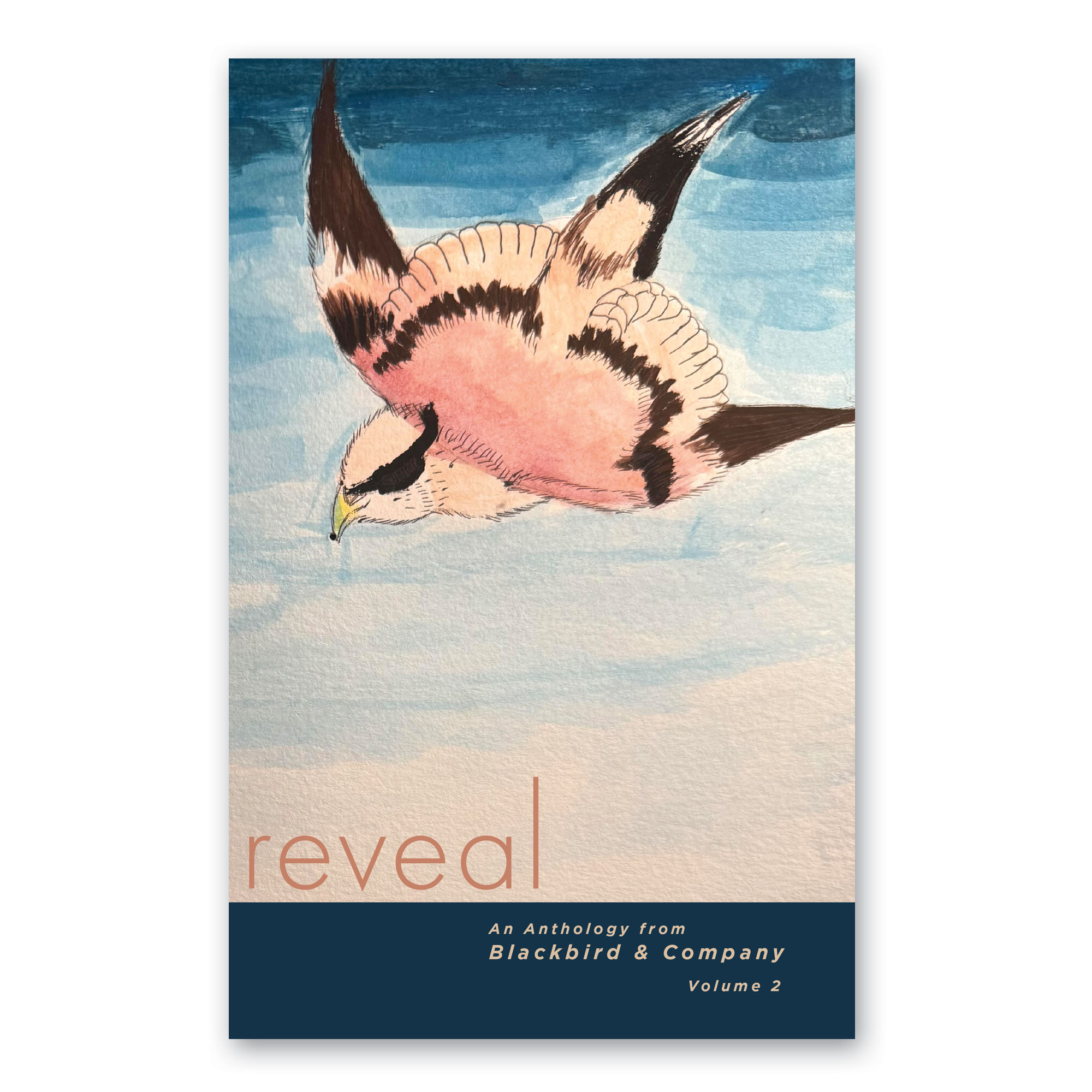
Hopefully you’ve heard about Reveal by now, Blackbird & Company’s annual anthology of student work. But do you know why Reveal is so important? Why we talk about it every chance we get?

It comes down to confidence. We like to remind students that writing is a gift. When polished student writing is published, your students are giving a wonderful gift to readers. Being published is the hallmark of legitimacy in the field of writing. True. But more importantly, published writing is a courageous and generous offering—so how better to prove to your students that their voices matter than to publish their ideas? 

I’ve always found the link between intrinsic motivation (or motivation that comes from within) and self-confidence fascinating. They feed each other. The more intrinsically motivated a person is, the more satisfaction is gained from completing goals.  People with higher self-confidence are simply motivated to attempt tasks for the sake of accomplishing.  Work itself becomes meaningful.

These psychological principles translate directly to writing. The best way we can help our blackbirds gain confidence in writing is to help them become personally motivated. The best way we can help them become personally motivated is to build up their confidence by publishing the polished ideas they have brought to shape. 

As the editor of Reveal, I’ve seen firsthand the pride that swells within students’ chests when their work comes out in print, when they know that their voice has been chosen and has merit and value. Fostering this budding belief in oneself is one of the most important tasks we can take upon ourselves as educators—it just might be the fuel that keeps young writers writing. 

That’s why we publish Reveal. To show young writers what becomes possible when they spread their wings. 

Submitting work to Reveal 2026 is super easy. And, if you submit work accomplished via any of our materials now through March 31st, 2026, you will be automatically entered to win a Solo Stove S’Mores Bundle.


~Claire S.

Posted on

Revealing a Giveaway

Campfire Giveaway

What would make our annual virtual campfire gathering even more wonderful? An actual campfire, of course!  Enlist your students to choose a favorite polished draft from this year’s work from Blackbird & Company curriculum, submit the work to our journal of student writing: Reveal. Simple!

We invite writers, Kindergarten through 12th grade, who courageously write from the heart using our curriculum to submit! And, now through March 31, 2026, each submission will earn your family a submission to our Giveaway!

And the prize? A Solo Stove S’Mores Bundle!

From the very first flicker of the tabletop fire bowl, you’ll be ready to roll into seasonal storytelling with this S’Mores kit from Solo Stove! This tabletop “Fire Bowl” + sticks, fuel, & bamboo tray is sure to add s’more fun to this year’s story making!

Posted on

New Year / New View

Campfire Tip #2: Be on the lookout for wonder!

When my oldest son was a toddler, I watched him make his way toward our back yard fence toward a knothole. I watched to see what he would do. Funny thing, he just stood there. He stood there for the longest time in the silence of mid-morning. I wondered what my son was seeing. I wondered about the other side of the fence. So I tiptoed into the house, grabbed my film camera and made my way to the other side of the fence.

This is the face of wonderment.

Here at the dawn of 2026, light a candle! Madeline L’Engle gave me this idea. She once said: “There is nothing that makes me happier than sitting around the dinner table and talking until the candles are burned down.” Me too!

So I’m following her lead. Today, on the second day of the year, I’m going to light a candle and let it burn down while I read a book. There is something so WONDER-full about candles and time. “Candle Clocks” are a once-upon-a-time thing. Let’s bring back the candle timer and tie it to the tradition of reading books.

A Wrinkle in Time

So here’s to wonderment. Light a candle. Find a knothole. Have a look see.


~Kimberly

Posted on

Editing Student Writing

writing

Campfire Tip #1: Empower Students to SELF-Edit

We’ve got you! Head over to Print Shop to download for FREE our student self-editing checklists—Writer’s ChecklistLevel 1, Writer’s Checklist Level 2, and Writer’s Checklist Level 3. These resources are designed for use with writers at three levels: Early Elementary (CORE Level 1), grades 3, sometimes 4 or 5 depending on the writer, Upper Elementary (CORE Level 2), grades 4 and 5, and Middle School (CORE Level 3), grades 6 through 8. At each level, the goal is for writers to re-read the first draft, the rough, and to self-edit, looking for issues ranging from indentation and capitalization to spelling errors, to run-ons and fragments and much more. The checklists will gently encourage writers to engage in writing as an artform and to raise their voice accordingly!

It’s important that we help students, early on, to engage in the process of writing—all the stages. Real writing is not a one-and-done activity. Real writing is sparked by curiosity, simmers in the imagination, and is brought to shape through a process of steps: brainstorming, writing it down, reading it over, self-editing, teacher-editing, refining, and polishing.

We’ll talk about role as Teacher soon enough… until then, hand your students a checklist and get them self-editing!


~Kimberly

Posted on

Welcome to the Campfire

It’s that time of year again. A new year is dawning and the long stretch of educating looms ahead! I love that word loom” because it is a very specific verb. Of course, the noun is a machine for weaving, but the verb means to come into sight in an indistinct, atmospheric way. When something looms ahead, it is sort of unknown. And the unknown can sometimes be daunting. I know, as a teacher, January makes me catch my breath, knowing the work ahead is BIG. And when something BIG is looming on the horizon, I don’t know about you, but I want to run away!

Here at the campfire though, we have a moment to catch our breath, look back, prepare, and look forward again with a less blurred view, “Hey, that looks like an adventure to me!”

So join us these next four weeks as we offer a dozen or so tips and tricks to carry with you on the 2026 adventure!


~Kimberly

Posted on

Join a Pages Online Class this Winter

“So many things have gone out of date. But after all these years, words are still important. Words are still needed by everyone. Words are still needed to think with, to write with, to dream with, to hope and pray with. And that is why I love the dictionary. It endures. It works. And as you know, it also changes and grows.”   ~Mrs. Granger, Frindle

Recently during a Pages Level 2 CORE Class, we explored Frindle, by Andrew Clements. The above quote was offered by Mrs. Granger, Nick’s, 5th grade teacher. Mrs. Granger has quite the reputation for the laser eyes, no messing around, lots of homework and her great love of words. Mrs. Granger has 30 dictionaries in her classroom and one massive one that takes center stage. Her battle cry is, “Look it up! That’s why we have the dictionary.”

The students in my class, similar to Nick, expressed a dislike for Mrs. Granger’s style of teaching. But they also shared a dislike of the dictionary. They didn’t enjoy looking up words and thought of it as chore. We started off the beginning of class by sharing dictionaries we used at home and suggestions for new ones. It had us looking up facts before you knew it!

During the first class we learned a ton from Nick’s report on dictionaries! Many people thought that the first English dictionary was put together in the 1700’s by a man named Samuel Johnson. But there were dictionaries before this. The things that were different about Johnson’s dictionary was the size. He included over 43,000 words! He chose words he thought were important and gave many examples on how they were used. The word “take”, for example, can be used 113 different ways! All of this prompted me to look it up the largest dictionary in the world, the Oxford English Dictionary, which comes in 12 volumes and contains 415,000 words!

In every one of our CORE units, we offer a list of vocabulary to look up in each section, usually 5-6 words. Typically, we infer meaning of words from context when reading. But ask a student, or adult for that matter, to tell you what that same word means, and we usually encounter struggle. Looking up a word helps us truly learn it and then be able to use it within our daily language or writing. We offer example sentences for your student to learn from in our Answer Keys, plus the sentence where the word is used by the author in the book. And we always point our students to the hand-held dictionary. The dictionary, as Johnson started, will give example sentences along with the definitions. These are useful to point out.

We also offer Operation Lexicon, which assigns the student daily vocabulary from exceptional writers, like E.B. White or Ted Hughes. The student will read words used by an author and how the word is used in their writing. They will explore the definition and then craft their own sentences. The week ends with students  choosing their favorite words learned and using them in a micro-story. We will offer Operation Lexicon Pages classes every year and go through these exercises with the students online. Once, I challenged my students to find another definition of the words given and then use the word multiple times in their micro story demonstrating the different meanings. It was quite fun! While talking with one of my past students I was delighted to learn she still used this challenge in her micro-stories.

“At time it felt like even the buntings were laughing at her (they probably were, buntings are crude and obnoxious creatures).”

“Gustavo hated all of the bunting and festivities of the circus, for it was truly nothing more than a prison for poor, kidnapped animals.”

We often discuss words we made up in our families, words we have used over the years, words that are gibberish but we know mean something. You know the words that are said over and over and after a while, we accept as words? “Pank” for pancake, “squishly” for the soft toy. The examples are endless. These are the familial words we know but the outside world might not recognize, words that are not in the dictionary but have meaning because we decide they do!

In a recent Pages Poetry class, we learned fun facts about Dr. Suess, then created found poetry and pastiche poetry. We then Dr. Suess’s poetry to spring into poetry of our own. We challenged our students to use two of Dr. Suess’s made-up words in their poetry. Something Dr. Suess was quite good at is inventing words, creative language and rhyming schemes. We had fun using words like: beczlenuts, hoobub, kwuggerbugs, thanders, sneedle, glikker, wumbus and yuzz.

There are also words that are frowned upon, words we are asked not to use when we are children but are words with meaning all the same. Nick points out the word, “ain’t” is not an approved word by most grown-ups but you can find it in the dictionary. I was told growing up that “ain’t” wasn’t a word. I was asked not to use it because it was not proper English. I had never looked up the word as a child, but now I sure am motivated! I learned that the word is defined as, am not: are not: is not or have not: and has not. I found this really interesting as I am teaching one of my children to use contractions this week. At the bottom of my dictionary there is a note.

Hint: Most people feel ain’t is not proper English. When you are trying to speak or write your best you should avoid using ain’t. Most people who use “ain’t” use it especially when they talk in a casual way, or in familiar expressions like “you ain’t seen nothing yet.” Authors use it especially when a character is talking to help understand what the character is like.

Even as I write this the spell check wants to tells me “ain’t” is wrong and give me other word suggestions!

“Who says dog means dog? You do, Nicholas. You and I and everyone in this class and this school and this town and this state and this country. We all agree. We decide what goes in that book.”   

                                                                                               ~Mrs. Granger-answering Nicks question on how a word becomes a word.


In Chapter 12 of Frindle, it brings up the belief of many that the word “quiz” was made up in 1791 by a Dublin theatre manager named Daly. He bet someone that he could invent a brand-new word in the English Language and chalked the letters q-u-i-z onto every wall and building in town. The next day, and throughout the next week, people all over Ireland were wondering what it could mean. Quiz was the only English word invented by one person for no particular reason. I confirmed this story on the internet! Doesn’t this get you curious about words?

Sure enough, my students who do not enjoy using the dictionary tried looking up the word “frindle” because they were curious if it was a real word you could find in the dictionary. Sadly, it was not there. This confirmed it is a great made-up word for this fictional story. This inspired me to do more internet searching! How many words are added to the dictionary each year? I was surprised to find that an estimated 800 to 1,000 new words are added each year! Frindle might one day become one of those words.

Words, words and more words!

By the age of 5 years old children recognize at least 10,000 words. By 10-years old children can speak and write an average of 20,000 words and learn on average 20 new words a day. They can understand that words have multiple meanings. A High school student may know anywhere from 25,000 to 50,000 words. When I looked up the average vocabulary for adults it was a range from 20,000 to 35,000 words. Wow. If most 10-year-olds can speak and write an average of 20,000 words and some adults average a vocabulary of 20,000 words, what happened? Did the learning of words stop? Why do we stop being curious, intrigued, and playful with words?

One of my students came to class once and shared that in the publication, The Week Jr., Frindle was listed as one of the Number 1 Most Read Books in New Hampshire.

In my Pages classes, I always introduce the author of the book. Frindle, was Andrew Clements first novel. He began trying to write the book in 1990 and it was eventually published in 1996. I like to give timelines when I can because I think it demonstrates to students that writing, editing, actually having something published takes time. Frindle became more popular than any of his books before or since and turned Andrew Clements into a full-time writer.

Sometimes kids ask him how he has been able to write so many books::

“The answer is simple: one word at a time. Which is a good lesson, I think. You don’t have to do everything at once. You don’t have to know how every story is going to end. You just have to take that next step, look for the next idea, write the next word.”


~Clare

Posted on

Twelve Days Giveaway: Let’s Go Middle School!

Welcome, folks, to the last few days of giveaway! You’ve experienced the sweetness of primary picture books and the elegance of elementary’s, so get ready for the magic of middle school’s illustrated stories! Though some middle schoolers might object that they’re too old for picture books, no one is too old to feed their fund of knowledge though visual wonder and well-crafted words—and our slew of middle school illustrated books do just that. From the delicate prose of Owl Moon to the scientific wonder of The Story of Snow, every reader can learn something new in these four lovely texts. 

Read on for a synopsis of each book and for ways to use them as springboards for learning.

The Story of Snow by Mark Cassino with Jon Nelson, Ph.D.

When snow starts to fall, we’re often caught up with what that means for us—but what if snow itself had a story? In The Story of Snow, Cassino outlines how snow crystals form, starting with a cold speck that accumulates water vapor, freezes into ice, and grows into different shapes like stars, plates, and columns. Like humans, snow crystals have a lot of variation; no two are alike. 

We chose this story because although the winter season can be dreary at times, there’s also a lot of natural wonder to be found there. The photographs of snow crystals within The Story of Snow are so detailed and delicate that one can’t help but feel dazzled by their elegance. The best part of the snow crystals? That they’re completely unexaggerated! After reading this book, turn to pages 32-33 to learn how to capture your own snow crystals in the next snowstorm or ski trip. Or, if snow isn’t in your near future, take a moment to cut your own snowflakes out of white paper, the six points of the paper snowflake paralleling how real ones form!

Owl Moon by Jane Yolen

When you go owling, you have to be quiet. And make your own heat. And be brave. At least, that’s what Pa always says. On the narrator’s first owling expedition with Pa, she follows her father into the cold, snowy, nighttime expanse of forest, silent and observant. “Whoo-whoo-who-who-who-whooooooo,” Pa calls. Sometimes you find an owl when you go owling, sometimes you don’t. Which kind of time will this one be?

Jane Yolen’s beautiful poetry and John Schoenherr’s soft, evocative illustrations dance together to create a peaceful, serene mood reminiscent of owling. The expertly crafted atmosphere makes the reader want to speak in a hushed voice, evokes feelings of awe at the splendor and solitude of this elusive bird. Once you’ve read this book with your student, set them out on a research journey to learn more about the Great Horned Owl. Research this creature’s habitat, food, and physical traits. Look up a video of the Great Horned Owl’s call and try your hand at it!

Winter Bees by Joyce Sidman and Rick Allen

Winter in the north is no joke. As temperatures drop below freezing and snow blankets the ground, each animal and plant must adopt a survival strategy to weather the extreme conditions. From the tundra swan’s 2,000 mile migration to the garter snake’s “hibernaculums” to honeybees’ hivebound huddle, each organism finds a creative way to make it to spring. 

Winter Bees marries poetry to nonfiction prose on each page. Sidman gives us two lenses through which to marvel at the tenacity of nature: poems that capture the heart behind each creature and prose that communicate information. Between the two, readers leave with a deep appreciation for nature and a little bit more knowledge. 

After reading Winter Bees, have your student write a free verse poem about an animal they’re interested in. Next to the poem, have them write a few complete sentences of facts about the animal. The prose and nonfiction should complement each other!

Snowflake Bentley by Jacqueline Briggs Martin and Mary Azarian

Wilson Bentley was born in 1865 in Jericho, Vermont. As a boy, he loved snow and found it beautiful. His mother gave him an old microscope, which he used to study ice crystals and other natural objects. When Willie was seventeen, his parents spent their savings and bought him a camera with its own microscope. Using this new tool, Willie photographed snow crystals and studied snowstorms; the photographs would be his gift to the world.

Picture book stories don’t have to be fantastical tales; they can also be biographies! And Snowflake Bentley is the perfect example. The story of Snowflake Bentley’s tenacity and pursuit of natural beauty is inspiring because it’s real. Illustrating his journey shows that even lived experiences can take on a magical quality—they’re not just relegated to fiction. After reading this book, discuss these questions: What qualities in the natural world are you interested in studying? What do you think the people in Bentley’s town thought about his interest in snow? What character traits helped Bentley become the leading expert on snow? 


And with that, enjoy these lovely, snow-themed picture books! We hope you come to cherish them as much as we have. 

We’ll plan to draw 3 winners on December 30 and announce them on December 31—a fun way to close out the year and start the new one with great books in hand. So stay tuned!

And remember, more actions = more chances for you to win! Click through and enter to win today!


~Claire