Posted on

Big Reveal: Giving Thanks for Community

A crisp nip in the air, leaves dancing from green to yellow to orange, the scratch of claw on earth as squirrels dig hiding places for acorns—this can only mean one thing: Thanksgiving fast approaches!

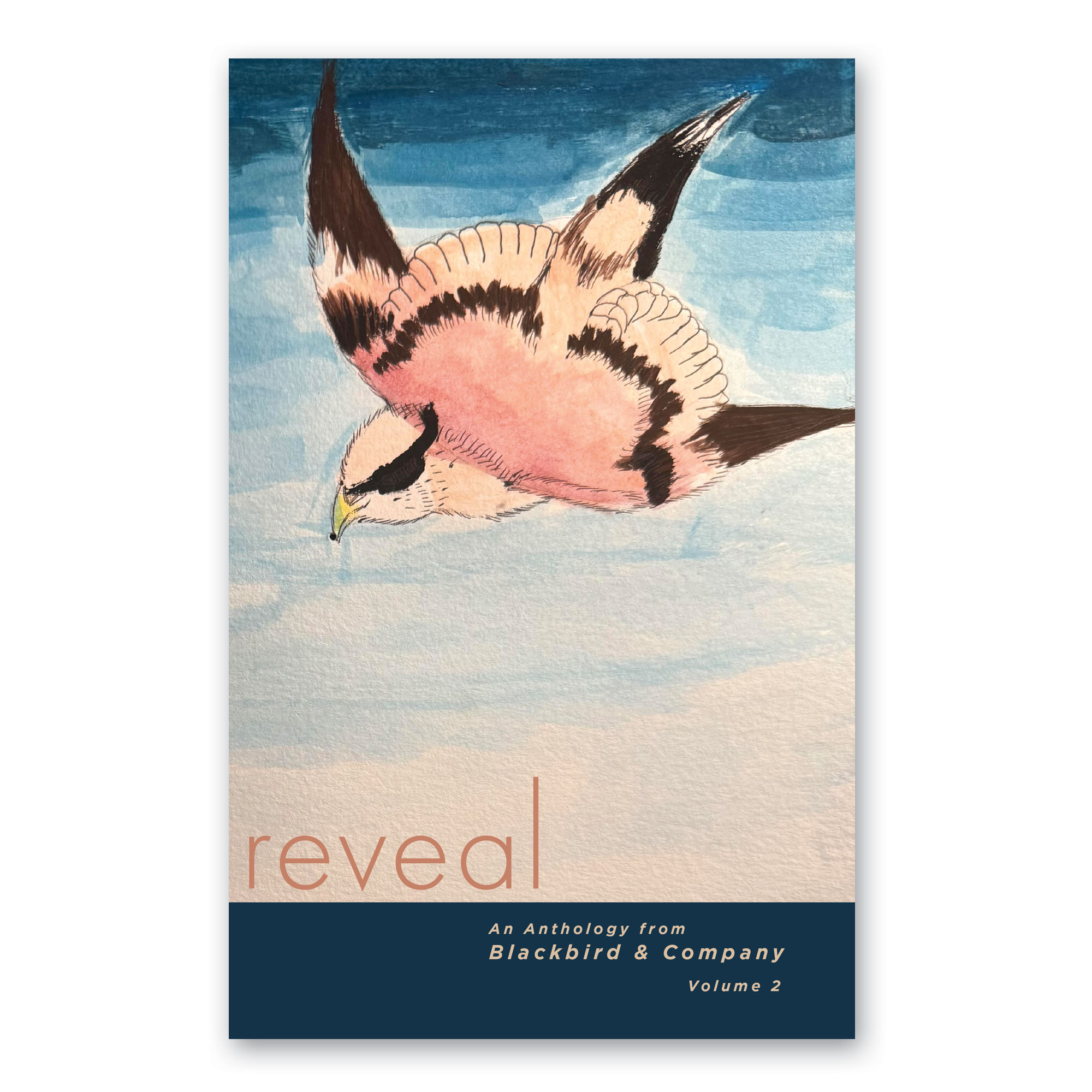
If you ask me what I’m thankful for during this season, and if I had been reflecting on Reveal (Blackbird & Company’s annual student anthology), I would probably say, “amalgamation.”

What a pretentious answer, you think but are too polite to say aloud.

I would explain: an amalgamation is a combining of multiple elements to create a new, unique blend. When the elements come into contact with each other, they change to create something new, like iron and carbon superheating together to form steel. Or a slightly different but related concept—as Aristotle said, “The whole is greater than the sum of the parts,” which emphasizes the power of unity over individual strength.

How does all of this relate to Reveal? Reveal represents an amalgamation of Blackbird & Company writers, a combination of work that elevates each piece to form an inspiring whole. Reveal doesn’t represent one person’s foray into the literary world—rather, Reveal is a communal effort on the part of young writers and scholars who insist that their voices matter, that they have big ideas worth sharing. Encourage your students to submit their Blackbird & Company work here!

By combining our talents in ways that compliment and inspire each other, we can together create something greater than any of us could accomplish individually.

So what am I thankful for?

I’m thankful to be a part of a community that uses writing as a medium for connection, as a way to give voice to the whisperings of the soul. When we all bring our talents to the table, the amalgamation of our art is greater than what any of us could create alone.


~Claire S.

Posted on

Start the New Year with Pages

January 2026 is right around the corner!

Pages classes are designed to foster competence, creativity, and confidence in students as they press into the important work of becoming literate.  Being able to communicate an original, BIG idea is the ultimate goal of English Language Arts.

Get the most out of Blackbird & Company’s materials and methods! Classes run in 5-week sessions, and will kickstart your student’s work with skills, tips, and tricks to help them succeed. We offer a wide range of humanities classes, all designed to explore the art of idea making:

  1. CORE – Read and Write and Discuss! These classes are tied to individual Literature + Writing Discovery units (2nd grade through 12th grade). Students will receive weekly feedback on their writing via the one-on-one conference!
  2. The History Opt-in – These classes will provide extra historical background tied to specific CORE Level 3 (middle school), and Level 4 (high school) units. Students must be enrolled in CORE to participate.
  3. Research – Learn to explore the life of a famous person, extract facts, and write a unique biographical essay. Students are supported each step of the way.
  4. The Essay – Explore and construct topical essays and inspire your students to communicate big ideas.
  5. Poetry – Each session we are offering short thematic classes that will apply writing skills in beautifully creative ways.
  6. Visual Arts – Explore great works of art and their makers. Students will learn about and practice art making while gaining skills that will transfer to all areas of academic pursuit, especially the art of writing.
  7. Music – Explore the works of great composers and the language of music. Students will gain skills that will transfer to all areas of academic pursuit, especially the art of writing.

Enroll today!

What parents are saying about Pages:

“Thank you for making class so enjoyable and personal. My daughter’s writing has really expanded since being in classes with you.” ~Brit Riddle

“I really appreciate you going through the different areas of reading and writing in class as opposed to having him do it all on his own at home. It sets a good example of what to do (i.e. what to look for and pay close attention to as he reads) and how to do it (i.e. organize his thoughts and get ready to write into paragraphs).” ~Paulina Yeung


~Kimberly

Posted on

How to Find What you Need

Alphabetical Annotations are HERE!

A is for About Authors

All About Blog Categories – You are HERE!

Announcing – Click through to find out what’s new and happening at Blackbird & Company.

Arts Guild – All things visual and musical and pertinent to learning.

Campfire – Join us in January for inspiration and offerings to start the long leg of the school year off right.

CORE ELA – Tips and Tricks and Tools

Discovery – Key insights into the important work of building the fund of knowledge.

Hatching & Earlybird – Insights and inspiration for little ones in Kindergarten, 1st, and 2nd grade.

First Post

Habits of Being – Foster perseverance and you will weave a habit.

Operation Lexicon – Words, words and more words to grow a vibrant vocabulary.

Litropolis – Read Well = Well Read

Maker – Made by hand is an essential skill.

Momologue – Philosophical musings from the women of Blackbird & Company.

Observation – Da Vinci said it best: “All our knowledge has its origins in our perceptions.”

One True Sentence – Let’s follow Hemingway’s advice and write one true sentence.

Pages – Learn about our LIVE online classes.

Pencils – When it comes to technology, the pencil rules.

Print Shop – Downloadable mini-lessons to enrich ELA learning.

Remediation – Strategies for students who need to strengthen reading and writing skills.

Wax Poetic – All things poetic.

Write Ideas – Ideas are the foundation of all written work: Form Follows Function.

Writing Resources – Helps for the writing teacher or parent-teacher to mentor students in the art of writing well.


A) CORE Integrated Literature & Writing (Phonics, Reading, and Writing for K and 1st grade),

B) APPLICATION: Grammar, Mechanics & Style

C) APPLICATION: Research, Composition, Creative Writing.


CORE ELA

Pencils

APPLICATION

  Operation Lexicon

  One True Sentence

Posted on

Print Shop Coming Soon!


Come January, Blackbird & Company will be launching Print Shop!  Our awesome collection of downloadable Discovery activities are designed to engage students, Kindergarten through 8th Grade, in focused, independent work pinpointed on specific academic skills with opportunities to build upon the fund of knowledge.

This month we are releasing a sneak peak, three great Print Shop activities for primary students tied to the letter P for FREE! What is more quintessentially Fall than pumpkins? These multi-sensory activities are sure to engage and enrich learning.

Simply click through, print, and let the Discovery begin!

And, please stay tuned for  more details during our January Campfire 2026.

Posted on

Read a Book / Solve a Problem

“Mom, I sat by myself today at the park. Nobody was playing anything I was interested in. I tried to talk to Luis but he never listens; the game always has to go his way. Mom, Tommy says he has been playing football for 10 years, but he just had his 8th birthday. I don’t understand why he won’t just pass the ball. Gabby kept taking Carlos’s hat. She said it was a game but Carlos didn’t seem to like it.”

When Grady is driving in the car with me or sitting at the dinner table or when his head hits the pillow at night this is the usual conversation or maybe I should say download. I realized during this time how much I just needed to listen. Grady needed time to process these different situations and relationships that came across his path during his day.

How confusing, mystifying, uncomfortable human relationships can be—whether we are 8 or 80.

I was recently introduced to an author named Jon Klassen. The words and the pictures are very simple yet carry a lot of wisdom concerning human relationships.

Three books I read Grady over the course of nights were:

1 ) I want my Hat Back

 2) This is not my Hat

 3) We found my Hat

Grady would smile and laugh out loud. In I want my Hat Back, the main character, a bear, is running around asking other animals if they have seen his hat. He asks another character, a rabbit, (who, by the way, is wearing the bear’s hat) and the rabbit, in a suspicious way, says he hasn’t seen the hat. The bear continues his search until he realizes he has seen the hat… that rabbit was wearing it! He goes back to confront the rabbit, “You stole my hat!” There is a long look between the two. Then comes a picture of bear sitting down, saying he loves his hat, wearing it on his head. Then a squirrel comes passing by asking if he has seen rabbit. Bear answers in a suspicious way, “Who me?” “Why are you asking me? I wouldn’t eat a rabbit, don’t ask me anymore questions.” This story ends with no clear ending. Could the bear have sat on the rabbit? Ate the rabbit? Could the rabbit have run off? Really anything is possible.

I read an interview with Jon Klassen and he discussed these micro-dramas from childhood. He used the example of Frog and Toad books. How these two characters had unresolved, uneven relationships, where one of them needed one of them more than the other. The underlying thoughts, “I have friends who could leave me or I have friends I could leave. I don’t like them as much as they like me or vice versa.” I researched the author of Frog and Toad after reading Jon Klassen’s interview. Frog and Toad happened to be my childhood favorite as well. It was interesting to find that Arnold Lobel wrote Frog and Toad based on his experiences from second grade. Lobel was sick and out of school for most of that school year and kept himself busy by drawing. He used his animal drawings as a way of coping with the insecurity of his return and making friends. He used these experiences to write Frog and Toad.

Kids don’t want to analyze these relationships. In stories, like in life at this young age, they want to watch them play out—Jon Klassen reminds: validate that they exist.

Isn’t this part of human nature, to want to feel we are not alone in our experiences?

Jon Klassen goes on to explain that children don’t need to know the motivations of characters and can understand questionable behavior in an unexamined way. Kids don’t ask “why did he do that”, like us adults who like to analyze and pull out the meaning or morality.

How would an author answer the why?

Isn’t that for the reader to get too or not get too?

Is there really only one answer to what motivates human behavior?

Children don’t have to ask all of the whys to understand it can happen. Grady didn’t need to ask why the bunny took the bear’s hat or how the bear got the hat back. He related in the human experience, of having something taken and wanting it back, of finding it and getting it back. This is Not my Hat, shows a small fish taking a hat from a big fish and all his internal thinking about it why he does it. What a beautiful example of what we do as humans when we want something and dance into our internal justification. We laugh while reading because we all relate on some level. No story needs to be added to why stealing is wrong. We can all understand the higher moral value but also total relate with the very human behavior.

We Found a Hat, beautifully demonstrates the inner conflict when two friends find something they both want but there is only one. Our desire for something for ourselves mixed with our feelings of wanting to share and be honest is, again, common human nature. It is rarely just a clean action of what’s right.  It’s a pull and push to serve ourselves and someone we care about.

And then there is Jon Klassen’s book, The Rock from the Sky, that pushes us adults right off the ledge! The book is about what we cannot control.

Where a rock will land. What could happen in our day. What the future might bring. How things we can imagine will change and all the things we can’t imagine and all the questions that go with it, the what, why, how, when and where! There is SO much we can look up for children now, so much on-the-spot-access to information. We can know a lot of interesting facts. But in the case of our lives, the unknown is our future and the daily things that can happen that are out of our control. This book is addressing the fact we don’t know everything and we are not supposed to know. Part of life happenings are luck, timing, paying attention, listening, trusting, asking for help, admitting we don’t know!

So when I sit down to read Grady a book, especially a Jon Klassen book, I remember that Grady has had a full day with really big experiences. When Grady talks I listen. When we read I let the story be felt. I don’t have to pull the moral or give him instruction on who he should be. I watch him smile and laugh and I let the moment be. I give up my adult longing to know why and I sit on the ledge with the unknown. I become friends with the right now and that is enough.

-Clare Bonn

Posted on

The Art of Integrating Literacy


Blackbird & Company Discovery Literature & Writing Guides are designed to integrate the skills of reading and writing.
Over time, the curriculum will enable your children to develop the tools necessary to independently analyze and respond to great stories. Our goal is to help the child work independently freeing up your expertise.

Think in Threes:

ONE. Read the section to facilitate discussion, helping your readers tap into the heart of the story. Our guides have discussion questions built into every section, providing the framework for weekly interaction between you and your children. Questions are designed to spark student’s memories, trigger their interpretations, and get them thinking beyond the page about how a story can relate to their actual lives. In time, students who participate regularly in a discussion circle will become excited and amazed about what they glean from books.
TWO. Conference with the writer, lending expertise necessary for the emerging writer to gain the skills necessary to articulate an original idea on paper. Encourage young writers in Levels 1 through Level 3 to develop the skill of self-conferencing —having drafted, re-read, and made self-edit marks in red.
THREE. Establish a routine. The comfort of routine, once established, will set roots deep into soil, establishing a framework for the tree to grow strong. The following schedule—45 minutes to 1 hour per day—will allow your children to pace (not RACE) through the Discovery Guide.

Saturday & Sunday – Read the new section over the weekend… Create a tradition of cozy reading!
Monday– Complete the vocabulary Acquire and begin taking notes in the Journal (Characters, Setting, Plot)
Tuesday– Complete notes Journal (Characters, Setting, Plot) and begin comprehension Recollect
Wednesday– Complete the rough draft Explore, re-read and make edits with a red pen
Thursday– Conference with an adult mentor and complete comprehension Recollect
Friday– Complete the final draft, carefully re-reading and implementing all edit suggestions

We remember the things we discover for ourselves. As your children grow, the intensity of the important work that will enable them to discover, increases. Work is GOOD!

Remember, no child is able to do the work of bringing an original idea into the world without the tools. You can present a child with oil paint, for example, but without the skill to utilize the tool properly—color theory, practice mixing, good brushes and so on—the child will produce muddy colors.

Nothing fosters the higher-level thinking that allows students to form new ideas and opinions about real life more than hashing through a story in a discussion circle. What begins as an imagining in the mind of the writer is translated to story, and in turn, transferred to real life through group discussion. Integration is a powerful tool.

~Kimberly

Posted on

A Reason for Handwriting

About a dozen years ago, a friend shared with me that she decided to bypass teaching her children the art of penmanship. Her children would jump straight to keyboarding: “This is the computer age. Cursive handwriting is archaic. Why do the work?”

What about beauty?

When I pressed her, my friend agreed that handwriting is an art form. She simply did not see the value of her young children expending effort to master an art form that would not be useful in college a decade or so in the future. This was my first encounter with creative illiteracy.

Mastering the art of handwriting fosters the ability to concentrate, to contemplate, and to communicate confidently.

Let’s face it. We are a distracted people. We are technology-centric, and our children are at risk. We are obsessed with digital signals that tickle our attention.

But we all, somewhere deep down, appreciate ideas that are beautifully inked by hand. I, for one, long for this personal touch. Of course, there are countless typographical fonts that mimic hand-written text. We download them for free. Sometimes we even pay for these fonts. But can the illusion of written-by-hand really fill the void?

Technology is here to stay. We all need to be technologically literate. I’m connected to my iPhone because I value the many benefits this technology offers.

But what if a technological world without the balance of human artistry is shrinking individuality?

My eldest son is a composer. Until recently, he composed all his pieces by hand on archival paper. When he was a college student, his professor pulled him aside and praised his melodic compositions that are equally beautiful to the eye. However, while he crowned Taylor one of the last “by-hand” composers, he suggested that purchasing a notation program such as Sebelius would be imperative. This is not because the program will make Taylor’s work easier, but because most musicians who will read his work have never played music that is handwritten and the foreign individual nuances are challenging to interpret. Taylor purchased the program, but assured the professor that he will always begin the process of composing by hand hoping to, in the end to also be known for the individuality of his hand on the page.

This got me to thinking, how many times do children come to me and say, “I can’t read cursive.”

Handwriting is an extension of the writer’s voice. Lettering by hand—whether it’s verbal or musical—is beauty, is unique voice. C.S. Lewis and J.R.R. Tolkien encouraged one another as writers, still, their voices on the page are vastly different. Voice is the fingerprint of the writer, that one-of-a-kind something that no two writers have in common.  Our handwriting is a beautiful extension of that voice. We are known by the whisper of our loops on the page.

Remember, “All you have to do is write one true sentence. Write the truest sentence you know.” That’s Hemingway, of course, from A Moveable Feast. I want to add:  Ink your one-true-sentence by hand onto paper in the most beautiful way you can!

Try carving out fifteen minutes a day to compose one true sentence, but not just the truest sentence you know, the truest-most-beautifully-handwritten sentence you know!

Begin with these things in mind:

Choose the right writing implement and the right
paper
. The feel of the pencil or pen on the page is a personal choice. The balance of resistance and flow has to be just right. Take time to explore the options.

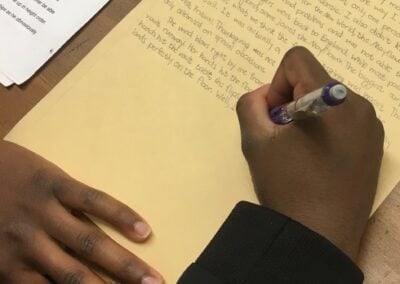
Consider grip and posture. While I don’t believe there is a single right way to grip the writing implement, I do believe the pressure of the grip matters. The grip should always be relaxed, not cramped. The posture should be upright, comfortable, and the arm should rest on a table so that the arm directs the stroke, not the wrist.

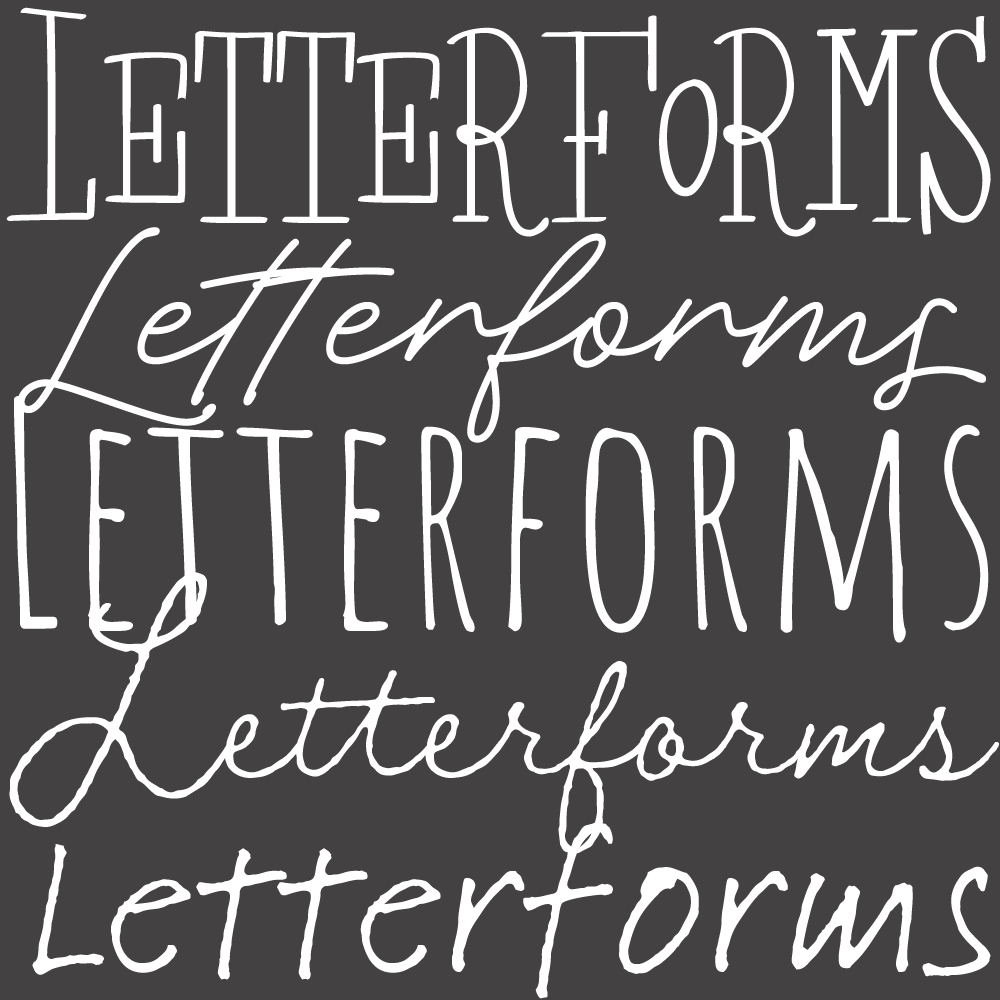
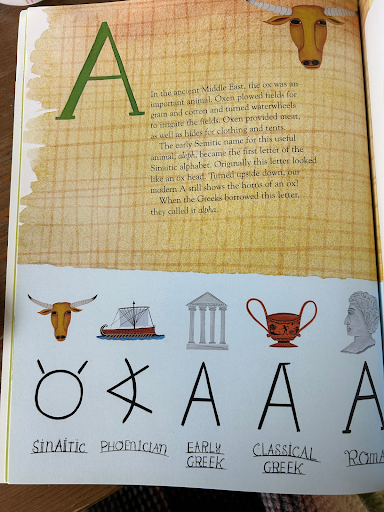
Beautiful handwriting begins with beautiful lines. Remember, our alphabet is a set of symbols developed by human beings to represent spoken sound. The symbols, from an artist’s standpoint, are arbitrarily looped and curved lines that
represent the spoken word. There are many letter forms in the world. You might even add one of your own!

Be the tortoise. Slow handwriting is nimble. Slow and steady is non-chaotic. Fast handwriting is mindless, awkward. Fast and rickety is chaotic. Consider the metaphor. An investment of time practicing the art of handwriting will generate much more than beautiful strokes on the page.

Click through to access our FREE lettering by hand activity to get the tradition started.


~Kimberly

Posted on

Stitching Picasso

Stitchery builds cognitive plasticity.

Embroidery is a practice that will empower students to be aware of fine motor potential, overcome the short attention span, and to have a growth mindset. The nervous system controls all of the body functions. But it is a complicated system with diverse potential. by tapping into all potential and possibilities while learning, students will develop diverse thinking skills.

Enhanced performance of the brain ensures that all of the other body systems perform accordingly. Metabolism, for example, is a complex task that makes sure the body has minerals when needed and ensures that toxic waste is extracted from the body. Creative endeavors help the brain to engage in focused, relaxed work, improving nervous system performance. Embroidery is good for the brain. And this is good for learning.

Here’s a thought… Stitch a Picasso!

For this project we began by observing Picasso’s Owl:

Next, students made original drawings inspired by Picasso’s drawing. After each child had a drawing they were settled with, the drawing was transferred to the burlap flap. We used the running stitch since these were made by 1st and 2nd graders. But running stitch is great place to start with all ages.

One hint: Have two needles threaded for your student, “unthreading” is common with new stitchers!

Embroidery is academic. So put down the pencil, pick up a needle and thread. Next time its time for pencil work, the hand-eye connection will be much stronger!

While stitching, think interdisciplinary: Read a book about owls! Write an owl poem.


~Kimberly

Posted on

Imagine a Big Idea: A State Quilt

The big idea was to study our state in detail for one full school year, learning its basic geography and all the state symbols. There was no pattern. We just designed it the way we wanted it as we journeyed through our study. We decided to spell C-A-L-I-F-O-R-N-I-A on little pillows to create a relief effect. Each letter was cut out of different fabrics that had Wonder Under applied to the back. Different embroidery stitches were used to embellish the ironed on letters. The pillows were then hung on little safety pins.

Along the left of the quilt are laminated hand drawn watercolored state symbols—state rock, flower, bird and so on. Our children were delighted to safety pin each symbol randomly.

The middle of our quilted California is made of muslin and is a quilt all it’s own with two sides and batting in the middle. Using a large state map as a guide, major features like deserts, mountain ranges, valleys and lakes were either applied using fabric or paints.

We had children bring in photos of themselves from different places in the state or just photos they had taken in different places. We cut them small, then laminated them and attached them with safety pins. All the quilters painted California poppies and signed their names.

For the finishing touch we used bright yarns to tie the quilt together at random spots. We entered our geography unit in the Mid-state fair and won a first prize ribbon!

It’s pretty obvious that a project like this takes hours and hours. Really, there was no rush… except the deadline for the fair!


~Sara

Posted on

Moving BEYOND the Topic Sentence

Squirrels are everywhere. That’s for sure! Most young writers have had a squirrel encounter or two. Tapping into a rich storehouse of knowledge is a great place to learn to craft a HOOK—not a topic sentence, a HOOK! The best place to begin a writing lesson is to tap into what the writer knows and to read a book.

Nuts to You by Lois Ehlert is a gorgeous and simple story of a quintessential city squirrel who, naturally, zips mischievously through life. Told in lively rhyming verse with beautiful collage illustration, the book is sure to capture the attention of students. At the back of the book the author includes some terrific facts about squirrels. We chose five facts to focus on:

Five Facts About Squirrels

1. Squirrels are rodents

2. They have front teeth—incisors—that NEVER stop growing.

3. They live in big nests or hollow trees.

4. They have five toes on their front feet, four on their back.

5. Their bushy tail is as long as its body.


Often times, when facing the blank page, students are intimidated and resort to simplistic, and, well, let’s face it, BORING solutions! Young writers resort to what they have been taught: Open your paragraph with a topic sentence. This is not technically wrong. But we can BETTER equip them!

For example these perfectly fine topic sentence are boring:

Squirrels are cute animals.

Squirrels are everywhere.

And my least favorite topic sentence of all:

I am going to write about squirrels.

So how do we teach our students to make topic sentences sparkle and shine?

We teach the to transform the topic sentence into a HOOK!

To help them get there, I gave them a BIGGER squirrel fact: Did you know that squirrels are everywhere in the world except Madagascar and Australia? We looked at a globe together and marveled at this interesting fact!

Next, I asked them what kinds of noises squirrels make. I got some very fun responses, too! I told them that we writers like to create words that represent sounds and, when we do it’s called: onomatopoeia. They liked that word! Now it was time to craft a HOOK for our paragraph about squirrels.

“Let’s imagine what it would sound like if we could hear all the squirrels all over the world.”

We generated a significant list:

Barking, Chirping Squeaking Squawking, Whistling Scampering Scratching Gnawing Grinding, Rattling, Buzzing, Crying

Next I said, “Let’s include our BIG fact via an Em Dash,” and went on to remind them that this special punctuation mark helps the reader take a long pause while adding some important information to the sentence.

Now we had our fodder and were ready to craft a HOOK! Here’s were we landed:

They are chattering, chirping,  squawking  all over the wide world—everywhere except Madagascar and Australia.

That’s the way to open a paragraph about squirrels!


~Kimberly