
When Grady is driving in the car with me or sitting at the dinner table or when his head hits the pillow at night this is the usual conversation or maybe I should say download. I realized during this time how much I just needed to listen. Grady needed time to process these different situations and relationships that came across his path during his day.
How confusing, mystifying, uncomfortable human relationships can be—whether we are 8 or 80.
I was recently introduced to an author named Jon Klassen. The words and the pictures are very simple yet carry a lot of wisdom concerning human relationships.
Three books I read Grady over the course of nights were:
Grady would smile and laugh out loud. In I want my Hat Back, the main character, a bear, is running around asking other animals if they have seen his hat. He asks another character, a rabbit, (who, by the way, is wearing the bear’s hat) and the rabbit, in a suspicious way, says he hasn’t seen the hat. The bear continues his search until he realizes he has seen the hat… that rabbit was wearing it! He goes back to confront the rabbit, “You stole my hat!” There is a long look between the two. Then comes a picture of bear sitting down, saying he loves his hat, wearing it on his head. Then a squirrel comes passing by asking if he has seen rabbit. Bear answers in a suspicious way, “Who me?” “Why are you asking me? I wouldn’t eat a rabbit, don’t ask me anymore questions.” This story ends with no clear ending. Could the bear have sat on the rabbit? Ate the rabbit? Could the rabbit have run off? Really anything is possible.
I read an interview with Jon Klassen and he discussed these micro-dramas from childhood. He used the example of Frog and Toad books. How these two characters had unresolved, uneven relationships, where one of them needed one of them more than the other. The underlying thoughts, “I have friends who could leave me or I have friends I could leave. I don’t like them as much as they like me or vice versa.” I researched the author of Frog and Toad after reading Jon Klassen’s interview. Frog and Toad happened to be my childhood favorite as well. It was interesting to find that Arnold Lobel wrote Frog and Toad based on his experiences from second grade. Lobel was sick and out of school for most of that school year and kept himself busy by drawing. He used his animal drawings as a way of coping with the insecurity of his return and making friends. He used these experiences to write Frog and Toad.
Jon Klassen goes on to explain that children don’t need to know the motivations of characters and can understand questionable behavior in an unexamined way. Kids don’t ask “why did he do that”, like us adults who like to analyze and pull out the meaning or morality.
Children don’t have to ask all of the whys to understand it can happen. Grady didn’t need to ask why the bunny took the bear’s hat or how the bear got the hat back. He related in the human experience, of having something taken and wanting it back, of finding it and getting it back. This is Not my Hat, shows a small fish taking a hat from a big fish and all his internal thinking about it why he does it. What a beautiful example of what we do as humans when we want something and dance into our internal justification. We laugh while reading because we all relate on some level. No story needs to be added to why stealing is wrong. We can all understand the higher moral value but also total relate with the very human behavior.
We Found a Hat, beautifully demonstrates the inner conflict when two friends find something they both want but there is only one. Our desire for something for ourselves mixed with our feelings of wanting to share and be honest is, again, common human nature. It is rarely just a clean action of what’s right. It’s a pull and push to serve ourselves and someone we care about.
And then there is Jon Klassen’s book, The Rock from the Sky, that pushes us adults right off the ledge! The book is about what we cannot control.
Where a rock will land. What could happen in our day. What the future might bring. How things we can imagine will change and all the things we can’t imagine and all the questions that go with it, the what, why, how, when and where! There is SO much we can look up for children now, so much on-the-spot-access to information. We can know a lot of interesting facts. But in the case of our lives, the unknown is our future and the daily things that can happen that are out of our control. This book is addressing the fact we don’t know everything and we are not supposed to know. Part of life happenings are luck, timing, paying attention, listening, trusting, asking for help, admitting we don’t know!
So when I sit down to read Grady a book, especially a Jon Klassen book, I remember that Grady has had a full day with really big experiences. When Grady talks I listen. When we read I let the story be felt. I don’t have to pull the moral or give him instruction on who he should be. I watch him smile and laugh and I let the moment be. I give up my adult longing to know why and I sit on the ledge with the unknown. I become friends with the right now and that is enough.
-Clare Bonn
We remember the things we discover for ourselves. As your children grow, the intensity of the important work that will enable them to discover, increases. Work is GOOD!
Remember, no child is able to do the work of bringing an original idea into the world without the tools. You can present a child with oil paint, for example, but without the skill to utilize the tool properly—color theory, practice mixing, good brushes and so on—the child will produce muddy colors.
Nothing fosters the higher-level thinking that allows students to form new ideas and opinions about real life more than hashing through a story in a discussion circle. What begins as an imagining in the mind of the writer is translated to story, and in turn, transferred to real life through group discussion. Integration is a powerful tool.
~Kimberly

About a dozen years ago, a friend shared with me that she decided to bypass teaching her children the art of penmanship. Her children would jump straight to keyboarding: “This is the computer age. Cursive handwriting is archaic. Why do the work?”
When I pressed her, my friend agreed that handwriting is an art form. She simply did not see the value of her young children expending effort to master an art form that would not be useful in college a decade or so in the future. This was my first encounter with creative illiteracy.
Let’s face it. We are a distracted people. We are technology-centric, and our children are at risk. We are obsessed with digital signals that tickle our attention.
But we all, somewhere deep down, appreciate ideas that are beautifully inked by hand. I, for one, long for this personal touch. Of course, there are countless typographical fonts that mimic hand-written text. We download them for free. Sometimes we even pay for these fonts. But can the illusion of written-by-hand really fill the void?
Technology is here to stay. We all need to be technologically literate. I’m connected to my iPhone because I value the many benefits this technology offers.
But what if a technological world without the balance of human artistry is shrinking individuality?
My eldest son is a composer. Until recently, he composed all his pieces by hand on archival paper. When he was a college student, his professor pulled him aside and praised his melodic compositions that are equally beautiful to the eye. However, while he crowned Taylor one of the last “by-hand” composers, he suggested that purchasing a notation program such as Sebelius would be imperative. This is not because the program will make Taylor’s work easier, but because most musicians who will read his work have never played music that is handwritten and the foreign individual nuances are challenging to interpret. Taylor purchased the program, but assured the professor that he will always begin the process of composing by hand hoping to, in the end to also be known for the individuality of his hand on the page.
Handwriting is an extension of the writer’s voice. Lettering by hand—whether it’s verbal or musical—is beauty, is unique voice. C.S. Lewis and J.R.R. Tolkien encouraged one another as writers, still, their voices on the page are vastly different. Voice is the fingerprint of the writer, that one-of-a-kind something that no two writers have in common. Our handwriting is a beautiful extension of that voice. We are known by the whisper of our loops on the page.
Remember, “All you have to do is write one true sentence. Write the truest sentence you know.” That’s Hemingway, of course, from A Moveable Feast. I want to add: Ink your one-true-sentence by hand onto paper in the most beautiful way you can!
Begin with these things in mind:
Choose the right writing implement and the right
paper. The feel of the pencil or pen on the page is a personal choice. The balance of resistance and flow has to be just right. Take time to explore the options.
Consider grip and posture. While I don’t believe there is a single right way to grip the writing implement, I do believe the pressure of the grip matters. The grip should always be relaxed, not cramped. The posture should be upright, comfortable, and the arm should rest on a table so that the arm directs the stroke, not the wrist.
Beautiful handwriting begins with beautiful lines. Remember, our alphabet is a set of symbols developed by human beings to represent spoken sound. The symbols, from an artist’s standpoint, are arbitrarily looped and curved lines that
represent the spoken word. There are many letter forms in the world. You might even add one of your own!
Be the tortoise. Slow handwriting is nimble. Slow and steady is non-chaotic. Fast handwriting is mindless, awkward. Fast and rickety is chaotic. Consider the metaphor. An investment of time practicing the art of handwriting will generate much more than beautiful strokes on the page.
Click through to access our FREE lettering by hand activity to get the tradition started.
~Kimberly
Embroidery is a practice that will empower students to be aware of fine motor potential, overcome the short attention span, and to have a growth mindset. The nervous system controls all of the body functions. But it is a complicated system with diverse potential. by tapping into all potential and possibilities while learning, students will develop diverse thinking skills.
Enhanced performance of the brain ensures that all of the other body systems perform accordingly. Metabolism, for example, is a complex task that makes sure the body has minerals when needed and ensures that toxic waste is extracted from the body. Creative endeavors help the brain to engage in focused, relaxed work, improving nervous system performance. Embroidery is good for the brain. And this is good for learning.
Here’s a thought… Stitch a Picasso!
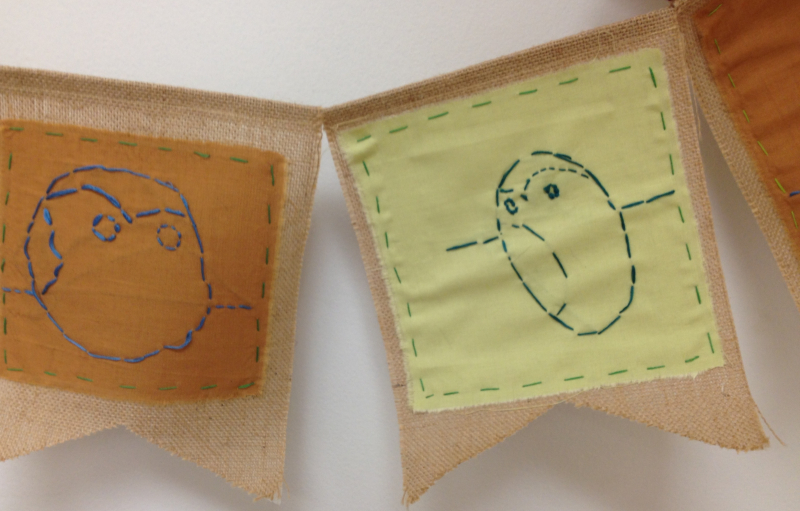
For this project we began by observing Picasso’s Owl:
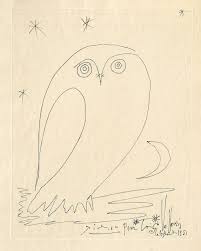
Next, students made original drawings inspired by Picasso’s drawing. After each child had a drawing they were settled with, the drawing was transferred to the burlap flap. We used the running stitch since these were made by 1st and 2nd graders. But running stitch is great place to start with all ages.
One hint: Have two needles threaded for your student, “unthreading” is common with new stitchers!
Embroidery is academic. So put down the pencil, pick up a needle and thread. Next time its time for pencil work, the hand-eye connection will be much stronger!
While stitching, think interdisciplinary: Read a book about owls! Write an owl poem.
~Kimberly
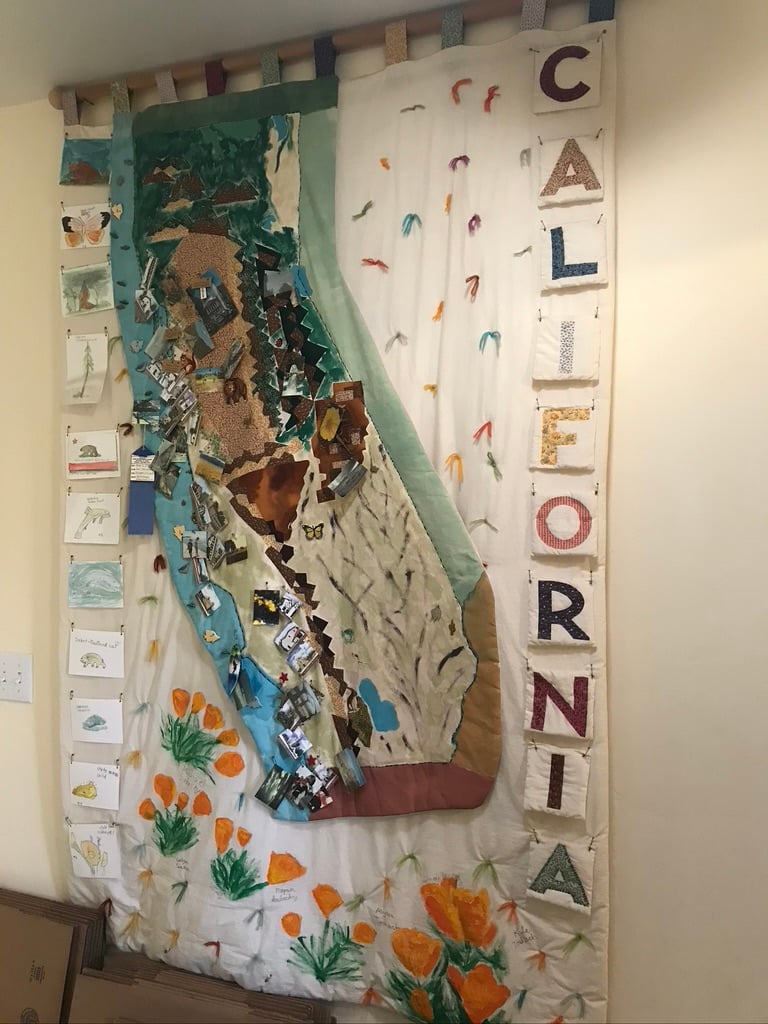
The big idea was to study our state in detail for one full school year, learning its basic geography and all the state symbols. There was no pattern. We just designed it the way we wanted it as we journeyed through our study. We decided to spell C-A-L-I-F-O-R-N-I-A on little pillows to create a relief effect. Each letter was cut out of different fabrics that had Wonder Under applied to the back. Different embroidery stitches were used to embellish the ironed on letters. The pillows were then hung on little safety pins.
Along the left of the quilt are laminated hand drawn watercolored state symbols—state rock, flower, bird and so on. Our children were delighted to safety pin each symbol randomly.
The middle of our quilted California is made of muslin and is a quilt all it’s own with two sides and batting in the middle. Using a large state map as a guide, major features like deserts, mountain ranges, valleys and lakes were either applied using fabric or paints.
We had children bring in photos of themselves from different places in the state or just photos they had taken in different places. We cut them small, then laminated them and attached them with safety pins. All the quilters painted California poppies and signed their names.
For the finishing touch we used bright yarns to tie the quilt together at random spots. We entered our geography unit in the Mid-state fair and won a first prize ribbon!
It’s pretty obvious that a project like this takes hours and hours. Really, there was no rush… except the deadline for the fair!
~Sara

~Kimberly
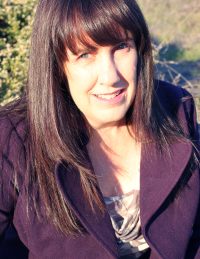
Me?
What if I told you that the day my grandmother gave me a dinky white portable typewriter I made each of my family members mailboxes for The Friday Night Flash out of a Captain Crunch cereal box? What if I told you that I can still feel the tin keys, hear the comforting “plunk, plunk, plunk” as I whiled away childhood? What if I told you that the day the typewriter came into my life was the day that I became a writer?
What if I told you that when my grandmother died I stumbled upon a box that contained a sizeable archive of those newspapers that continue to twitter, “imagination matters” … what if I told you this is why I decided to set off on an incredible journey into the world of education?
Would you believe me if I told you that I became a teacher at a tag sale, transformed 100-square feet of our flat roof bungalow to a one-room school house, invited 7 families to join my Guild, and delivered my third child a week before the first day of class?
True story.
Fast forward…
I spent a good deal of my life , nearly 30 years, bringing shape to the Guild Method. This is where i centered my work. Though we eventually moved from the shelter of flat roof bungalow anymore, our guildschool was a cluster of cozy spaces where children engage in their important work. Having retired Waterhouse Guild, I often pause to soak in the memory of that glorious hum. Founding academics on creativity was at times chaotic, often loud, but it affords our students ample opportunity to bring shape to their ideas. And this is worth every bit of the swirling motion, every single elevated decibel!
I suppose you’d say I’m a visionary, the founding director of an academic amalgamation.
I’m a wife— 37 years and counting. I’m the mother of four amazing adult children.
Long ago I received my bachelor’s in biological psychology and fine art, graduate training in clinical art therapy, and later in life chased down an MFA in writing. My book, Habits of Being: Artifacts From the Classroom Guild recounts the many observations and ideas that sprang from schooling my children and others.
I’m a founding partner of Blackbird & Company and love bringing shape to the curriculum we offer.
I’m often puzzled when asked, “How do you keep all those plates in the air?”
My response? “It’s either that or stand barefoot in shards of porcelain.”
Guess I see life teeming with possibility. I’m with the Red Queen on this one, “Why sometimes I’ve believe as many as six impossible things before breakfast.”
So that’s me.
I suppose it all boils down to that dinky white portable typewriter.
——————————-

Observation of simple objects is the best way to begin your Observation Journal—think shell, spoon, marshmallow, apple. Begin this activity in kindergarten and continue through 12th grade! Create an annual binder of student observations—The Observation Journal. These will become terrific keepsakes.
One.
Trace the edges with your pencil follow along with your eyes.
Two.
Begin your sketch, following the outline edges (very s l o w l y). Let your hand “see” all the curves and bumps that your eye sees as you look back and forth from your drawing to the apple. Don’t rush. Making a connection between the eyes and the hand is a slow motion exercise.
Three.
Simple observational drawings can be embellished with a wash of watercolor. Always paint from a puddle, never directly from the pigment tiles. When creating a wash of color for a red apple, Sara reminds us that the red is not the red directly from the tile. “Red in nature is complex. Make a puddle of red and add a tiny drop of green.” It’s the same process for an orange pumpkin, add drops of the complimentary color of the object into the prominent color—a splash of blue— to achieve the natural complexity of the object’s color. Here is an advanced observation where the pinecone color is actually a blend of yellow with a touch of purple!:


As students complete observations, encourage them to engage in clean-up—putting away materials and washing brushes and paint trays. Encourage them to reflect on what was gleaned. It’s likely that what was gained is far more than art, far more than science.
~Kimberly & Sara
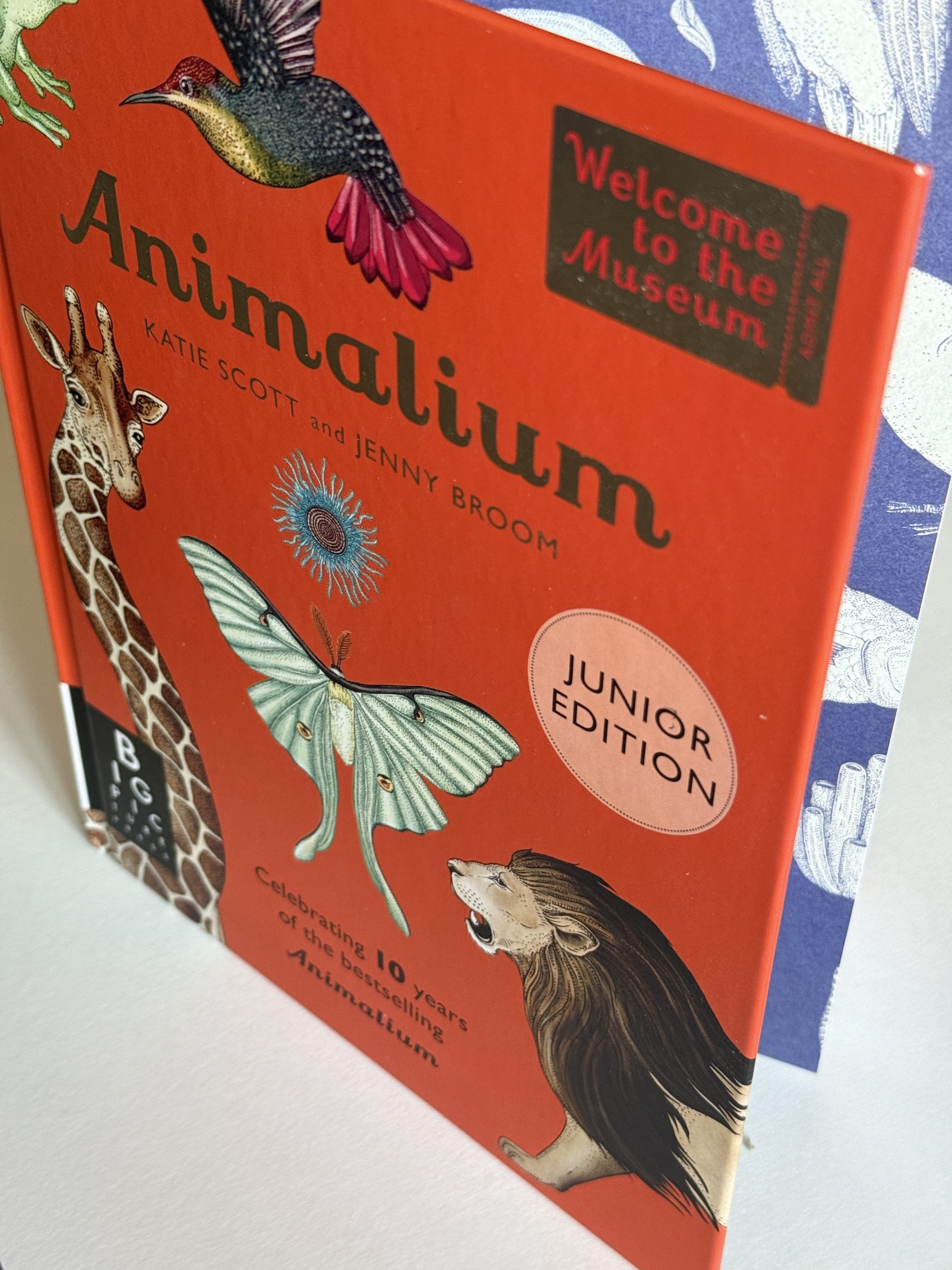
When faced with the blank page, first things first, press into food for thought. For this lesson, we dove into Animalium for Kids, by Kate Scott and Jenny Broom. With over 160 specimens to explore in this wonderful biological compendium, we are narrowing our focus to Owls. We don’t need an exhaustive study here—this is a sentence writing exercise after all. We need just enough information to become curious and inspired to write. Getting ready to focus on composing even a single sentence requires gathering intriguing information.
The owl entry in this book is just enough to spark curiosity. After reading, focusing in on the amazing illustrations, sharing what we found amazing about owls—storing new facts in our memory, adding to our growing knowledge of owls—we made a list:
A our first attempt at “NOW, let’s write a statement together,” I listened and wrote the group consensus on the board:
Here’s where writing get’s fun! Add details, rearrange, think about word choice to make the above statement a tale that will turn heads. Follow the W Rule:
For this sentence, I had a basket of blocks all different shapes but only two colors that I poured out onto the floor, asking my students to quickly sort by color. We, obviously, ended up with two colors. Then I gave them another fact about owls—there are 200 species in the world—and asked them to help me add this detail to our statement. Here’s what the group came up with:
~Kimberly