Posted on

Stitching Picasso

Stitchery builds cognitive plasticity.

Embroidery is a practice that will empower students to be aware of fine motor potential, overcome the short attention span, and to have a growth mindset. The nervous system controls all of the body functions. But it is a complicated system with diverse potential. by tapping into all potential and possibilities while learning, students will develop diverse thinking skills.

Enhanced performance of the brain ensures that all of the other body systems perform accordingly. Metabolism, for example, is a complex task that makes sure the body has minerals when needed and ensures that toxic waste is extracted from the body. Creative endeavors help the brain to engage in focused, relaxed work, improving nervous system performance. Embroidery is good for the brain. And this is good for learning.

Here’s a thought… Stitch a Picasso!

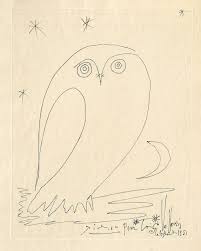
For this project we began by observing Picasso’s Owl:

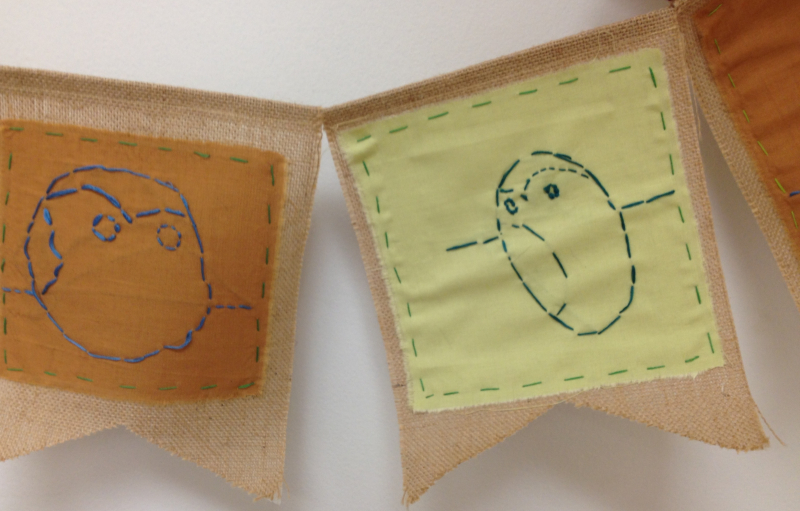
Next, students made original drawings inspired by Picasso’s drawing. After each child had a drawing they were settled with, the drawing was transferred to the burlap flap. We used the running stitch since these were made by 1st and 2nd graders. But running stitch is great place to start with all ages.

One hint: Have two needles threaded for your student, “unthreading” is common with new stitchers!

Embroidery is academic. So put down the pencil, pick up a needle and thread. Next time its time for pencil work, the hand-eye connection will be much stronger!

While stitching, think interdisciplinary: Read a book about owls! Write an owl poem.


~Kimberly

Posted on

Imagine a Big Idea: A State Quilt

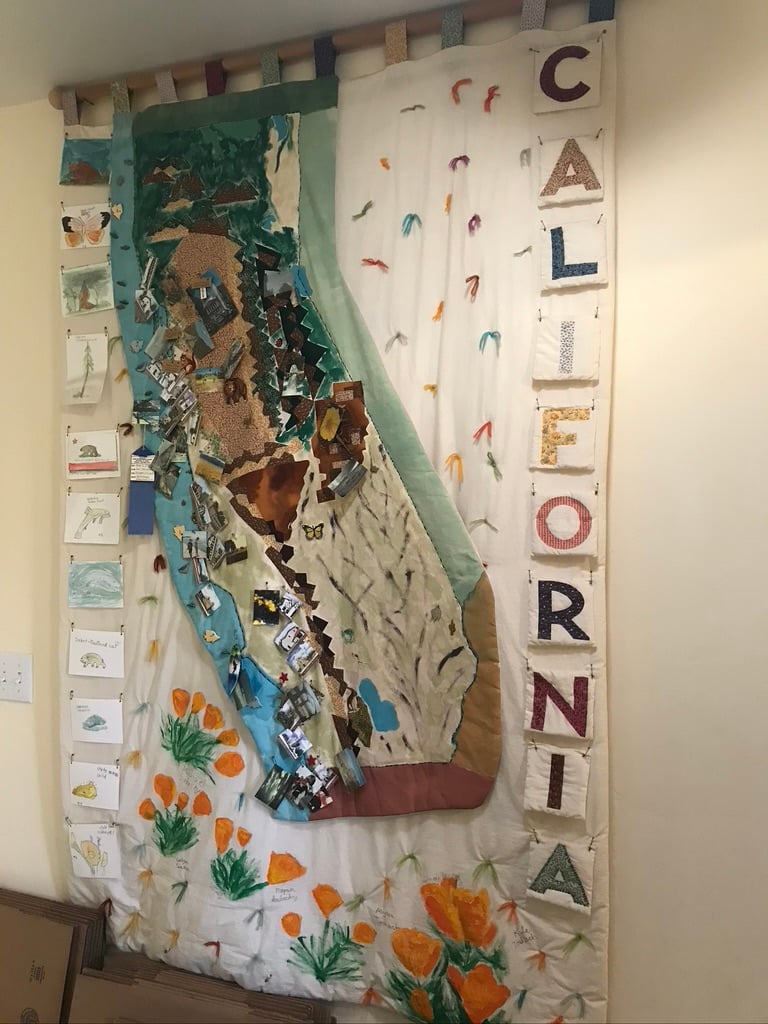
The big idea was to study our state in detail for one full school year, learning its basic geography and all the state symbols. There was no pattern. We just designed it the way we wanted it as we journeyed through our study. We decided to spell C-A-L-I-F-O-R-N-I-A on little pillows to create a relief effect. Each letter was cut out of different fabrics that had Wonder Under applied to the back. Different embroidery stitches were used to embellish the ironed on letters. The pillows were then hung on little safety pins.

Along the left of the quilt are laminated hand drawn watercolored state symbols—state rock, flower, bird and so on. Our children were delighted to safety pin each symbol randomly.

The middle of our quilted California is made of muslin and is a quilt all it’s own with two sides and batting in the middle. Using a large state map as a guide, major features like deserts, mountain ranges, valleys and lakes were either applied using fabric or paints.

We had children bring in photos of themselves from different places in the state or just photos they had taken in different places. We cut them small, then laminated them and attached them with safety pins. All the quilters painted California poppies and signed their names.

For the finishing touch we used bright yarns to tie the quilt together at random spots. We entered our geography unit in the Mid-state fair and won a first prize ribbon!

It’s pretty obvious that a project like this takes hours and hours. Really, there was no rush… except the deadline for the fair!


~Sara

Posted on

Moving BEYOND the Topic Sentence

Squirrels are everywhere. That’s for sure! Most young writers have had a squirrel encounter or two. Tapping into a rich storehouse of knowledge is a great place to learn to craft a HOOK—not a topic sentence, a HOOK! The best place to begin a writing lesson is to tap into what the writer knows and to read a book.

Nuts to You by Lois Ehlert is a gorgeous and simple story of a quintessential city squirrel who, naturally, zips mischievously through life. Told in lively rhyming verse with beautiful collage illustration, the book is sure to capture the attention of students. At the back of the book the author includes some terrific facts about squirrels. We chose five facts to focus on:

Five Facts About Squirrels

1. Squirrels are rodents

2. They have front teeth—incisors—that NEVER stop growing.

3. They live in big nests or hollow trees.

4. They have five toes on their front feet, four on their back.

5. Their bushy tail is as long as its body.


Often times, when facing the blank page, students are intimidated and resort to simplistic, and, well, let’s face it, BORING solutions! Young writers resort to what they have been taught: Open your paragraph with a topic sentence. This is not technically wrong. But we can BETTER equip them!

For example these perfectly fine topic sentence are boring:

Squirrels are cute animals.

Squirrels are everywhere.

And my least favorite topic sentence of all:

I am going to write about squirrels.

So how do we teach our students to make topic sentences sparkle and shine?

We teach the to transform the topic sentence into a HOOK!

To help them get there, I gave them a BIGGER squirrel fact: Did you know that squirrels are everywhere in the world except Madagascar and Australia? We looked at a globe together and marveled at this interesting fact!

Next, I asked them what kinds of noises squirrels make. I got some very fun responses, too! I told them that we writers like to create words that represent sounds and, when we do it’s called: onomatopoeia. They liked that word! Now it was time to craft a HOOK for our paragraph about squirrels.

“Let’s imagine what it would sound like if we could hear all the squirrels all over the world.”

We generated a significant list:

Barking, Chirping Squeaking Squawking, Whistling Scampering Scratching Gnawing Grinding, Rattling, Buzzing, Crying

Next I said, “Let’s include our BIG fact via an Em Dash,” and went on to remind them that this special punctuation mark helps the reader take a long pause while adding some important information to the sentence.

Now we had our fodder and were ready to craft a HOOK! Here’s were we landed:

They are chattering, chirping,  squawking  all over the wide world—everywhere except Madagascar and Australia.

That’s the way to open a paragraph about squirrels!


~Kimberly

Posted on

Meet Kimberly

Me?  

What if I told you that the day my grandmother gave me a dinky white portable typewriter I made each of my family members mailboxes for The Friday Night Flash out of a Captain Crunch cereal box? What if I told you that I can still feel the tin keys, hear the comforting “plunk, plunk, plunk” as I whiled away childhood? What if I told you that the day the typewriter came into my life was the day that I became a writer?

What if I told you that when my grandmother died I stumbled upon a box that contained a sizeable archive of those newspapers that continue to twitter, “imagination matters” … what if I told you this is why I decided to set off on an incredible journey into the world of education?  

Would you believe me if I told you that I became a teacher at a tag sale, transformed 100-square feet of our flat roof bungalow to a one-room school house, invited 7 families to join my Guild, and delivered my third child a week before the first day of class?

 True story.  

Fast forward…  

I spent a good deal of my life , nearly 30 years, bringing shape to the Guild Method. This is where i centered my work. Though we eventually moved from the shelter of flat roof bungalow anymore, our guildschool was a cluster of cozy spaces where children engage in their important work. Having retired Waterhouse Guild, I often pause to soak in the memory of that glorious hum. Founding academics on creativity was at times chaotic, often loud, but it affords our students ample opportunity to bring shape to their ideas. And this is worth every bit of the swirling motion, every single elevated decibel!  

I suppose you’d say I’m a visionary, the founding director of an academic amalgamation.  

I’m a wife— 37 years and counting. I’m the mother of four amazing adult children.

Long ago I received my bachelor’s in biological psychology and fine art, graduate training in clinical art therapy, and later in life chased down an MFA in writing.  My book, Habits of Being: Artifacts From the Classroom Guild recounts the many observations and ideas that sprang from schooling my children and others.

I’m a founding partner of Blackbird & Company and love bringing shape to the curriculum we offer.

I’m often puzzled when asked, “How do you keep all those plates in the air?”

My response? “It’s either that or stand barefoot in shards of porcelain.”

Guess I see life teeming with possibility. I’m with the Red Queen on this one, “Why sometimes I’ve believe as many as six impossible things before breakfast.”

So that’s me.

I suppose it all boils down to that dinky white portable typewriter.         

——————————-

Kimberly Bredberg has been an advocate for reform in education for nearly four decades. She is a founding partner of Blackbird & Company Educational Press, an ELA curriculum expert and author. Her book Habits of Being: Artifacts from the Classroom Guild is currently in its second printing. Her writing and visual art students have won numerous awards, have been recognized on the regional and national level by the Scholastic Alliance for Arts & Writing, and have been published in international writing journals. Kim has been recognized nationally for her role as an arts and writing mentor. The California resident, mother of four, long ago received her Bachelor of Arts degree from the University of California at Santa Barbara in biological psychology and fine art, graduate training in clinical art therapy from Loyola Marymount University, and received her Master of Fine Arts in  writing from Antioch University.

Posted on

On Looking Closely…

The habit of observing is habit worth developing—a habit of being.

Observation of simple objects is the best way to begin your Observation Journal—think shell, spoon, marshmallow,  apple. Begin this activity in kindergarten and continue through 12th grade! Create an annual binder of student observations—The Observation Journal. These will become terrific keepsakes.

And getting started is easy as 1, 2, 3…

One.

Trace the edges with your pencil follow along with your eyes.

Two.

Begin your sketch, following the outline edges (very  s l o w l y). Let your hand “see” all the curves and bumps that your eye sees as you look back and forth from your drawing to the apple. Don’t rush. Making a connection between the eyes and the hand is a slow motion exercise.

Three.

Simple observational drawings can be embellished with a wash of watercolor.  Always paint from a puddle, never directly from the pigment tiles. When creating a wash of color for a red apple, Sara reminds us that the red is not the red directly from the tile. “Red in nature is complex. Make a puddle of red and add a tiny drop of green.” It’s the same process for an orange pumpkin, add drops of the complimentary color of the object into the prominent color—a splash of blue— to achieve the natural complexity of the object’s color. Here is an advanced observation where the pinecone color is actually a blend of yellow with a touch of purple!:

A good way to get your students ready for a complex observation like this pinecone, is to engage them with simple hand held objects from the kitchen to the natural world. It is also a good idea to engage students with already flattened objects as demonstrated in the photos below:

Furthermore, have students copy drawings of artist’s. This activity helps them develop observational skills and while learning how great artists use lines.

Once the observational drawing is complete, encourage your students to do some research on the object that was observed, date the entry and add it to the Observation Journal.

As students  complete observations, encourage them to engage in clean-up—putting away materials and washing brushes and paint trays. Encourage them to reflect on what was gleaned. It’s likely that what was gained is far more than art, far more than science.

Developing the skill of observing is a habit of being that invites us to imagine possibility.


~Kimberly & Sara

Posted on

Crafting a Wonder-FULL Sentence is Courageous

Staring down the blank page is a courageous endeavor.

Where to begin?

We say: Begin with a BOOK!

BIG ideas are sparked by knowledge + curiosity.

“All you need to do is write one TRUE sentence,” so said great American author,  Ernest Hemingway. But what exactly did he mean? Let’s face it, accuracy of expression may be learned in a grammar book, but depth of expression begins when a writer decides to pick up a pencil and scratch an original idea onto a blank sheet of paper. The first, BEST lesson, is to teach your students that writing about wonder leads to wonderful writing.

Here are four ways to compose a wonder-FULL sentence about owls.

First let’s gather information.

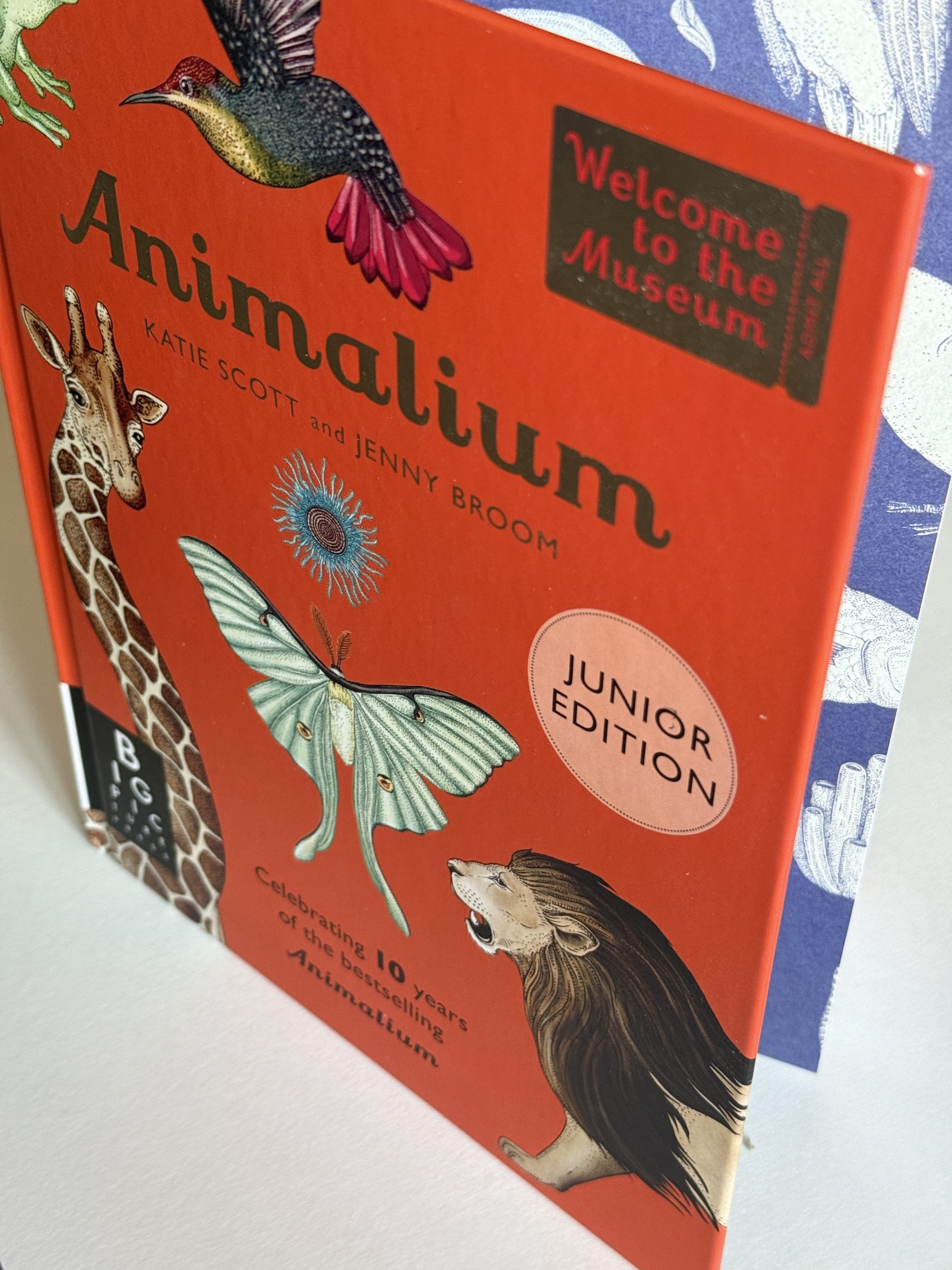
When faced with the blank page, first things first, press into food for thought. For this lesson, we dove into  Animalium for Kids, by Kate Scott and Jenny Broom. With over 160 specimens to explore in this wonderful biological compendium, we are narrowing our focus to Owls. We don’t need an exhaustive study here—this is a sentence writing exercise after all. We need just enough information to become curious and inspired to write. Getting ready to focus on composing even a single sentence requires gathering intriguing information.

The owl entry in this book is just enough to spark curiosity.  After reading, focusing in on the amazing illustrations, sharing what we found amazing about owls—storing new facts in our memory, adding to our growing knowledge of owls—we made a list:

  1. There are two main families of owls within the order Strigiformes: Tytonidae (barn owls) and Strigidae (typical owls).
  2. Huge owl eyes are stationary, fixed in their sockets—no eye rolling!
  3. Owls can rotate their head 270 degrees.

Next, let’s review the four types of sentences:

Statements are declarative. Statements tell us something.

Are questions interrogative? (Yes.) Questions ask.

Commands are imperative. Commands demand action.

Exclamations are exclamatory! Exclamations roar!

Now, let’s get writing.

A our first attempt at “NOW, let’s write a statement together,” I listened and wrote the group consensus on the board:

There are two types of owls, typical and barn owls.

Here’s where writing get’s fun! Add details, rearrange, think about word choice to make the above statement a tale that will turn heads. Follow the W Rule:

WHO, WHAT, WHERE, WHEN, WHY, to WOW the reader!

For this sentence, I had a basket of blocks all different shapes but only two colors that I poured out onto the floor, asking my students to quickly sort by color. We, obviously, ended up with two colors. Then I gave them another fact about owls—there are 200 species in the world—and asked them to help me add this detail to our statement. Here’s what the group came up with:

All 2 million owls in the world (200 species) can be sorted into two BIG piles—Strigidae (typical) and Tytonidae (barn owls).

Finally, let’s translate the statement to a question, command, and an exclamation:

Statement:

All the owls in the world (all 200 species) can be sorted into two BIG piles—Strigidae (typical) and Tytonidae (barn owls).

Question:

Isn’t it amazing that all 2 million owls in the world (all 200 species) can be sorted into two BIG piles—Strigidae (typical) and Tytonidae (barn owls)?

Command:

Please sort the 2 million owls, all the owls in the world (all 200 species) into two BIG piles—Strigidae (typical) and Tytonidae (barn owls).

Exclamation:

All 2 million the owls in the world (all 200 species) can be sorted into two BIG piles—Strigidae (typical) and Tytonidae (barn owls)—Wow!

There you have it, all four sentence types in one fell swoop! Once you’ve tackled this exercise a few times as a group, it’s easy-peasy to make it an independent activity—from gathering information to four TRUE sentences!  Ernest Hemingway would be proud.


~Kimberly

Posted on

Flourishing an Idea: Before & After

Mozart Season Bundle

Aesthetics is a set of principles that inform the outcome of a work of art. Aesthetics taps into that part of our being that connects with beauty. After reading The Mozart Season,  students knew right away the section of the story that would inspire the most creativity. I saw this in action. And when readers stumble upon this three-page passage, well, Section 5 happens.

As the story goes, when Allegra and her mother’s friend, Diedre spend an afternoon in the Rose Garden, well, music happens. Nestled atop a hill in the park is a silvery aluminum sculpture. There are tall columns and arched columns, smaller columns and water uniting them all.

“It was Diedre who started the song. She began slowly, BONG bong Bong bong with her knuckles on the three big columns, walking between them.”

Now I’ve seen some fantastic creative responses to The Mozart Season (some that have won awards), but when this past year, one of my students finished the book and brought in her Section 5 project to share, I marveled that, yet again, it was in response to this specific music-making passage.

And the project she brought in was not only “nique” (as Allegra and her friends would say), but also a perfect opportunity to share some tips to elevate the Section 5 project artistically.

With a cardboard box, some discarded bottles, aluminum foil, a few scraps of notebook paper, one green marker, Scotch tape, and a pitcher of water, my student made a musical instrument! While I have seen many musical instruments (even musical compositions) inspired by this little section of The Mozart Season, this one captured my imagination. Think “don’t judge a book by its cover” for a moment. This homely little project surprised me with rich sounds made from filling the bottles with different levels of water and blowing gently across each the neck. Oh! I was simply tickled, “My favorite Mozart invention so far!”

But the poor dear was in desperate need of a makeover. So I gave the maker a simple lesson.

So following is the simple make-over:

BEFORE


  1. To begin, if you are going to use a box (and boxes are a great way to begin), always paint the box! Give yourself a blank canvas upon which you can build your idea. A coat or two of gesso or acrylic paint will do just fine.
  2. Use more than one art medium. Here for example, using green marker and green paint on both folded and crumpled paper makes the viewer read ‘foliage” more clearly.
  3. Give the reader an anchor to the book where the idea originated by posting quotes around the project.

You don’t have to be an artist to make your idea beautiful. And, think about it, ideas are meant to be appreciated. So, go on, beautify.

AFTER

One last thought… There is a trend in all sectors of education to discount the reading of pure fiction. This is not wise. This quiet little story is, in my opinion, powerful proof why we all need to read across many genres, read all kinds of stories. Every time I’ve led students through this purely fictional story set in a very real setting (the competition that Allegra is working toward is a real competition that happens annually in Oregon), they read a few pages and groan. But by the time they get to the end, they have a deep appreciation for the rich story and significant fodder for their creativity to unfold.

~Kimberly Bredberg

Posted on

Let’s Talk Books

Nothing fosters the higher-order Critical Creative Thinking that allows students to form ideas and opinions about real life, more than hashing through a story in a discussion circle. What begins as an imagining in the mind of the writer is translated to story, and in turn, transferred to real life through group discussion.

Blackbird & Company integrated literature and writing guides have discussion questions built into every section, providing the framework for weekly interaction between you and your students. These questions are designed to spark student’s memories, trigger their interpretations, and get them thinking beyond the page about how a story can relate to their actual lives. Add to this the opportunity to cultivate a cozy book-minded community and share original ideas during the fifth week of culminating projects and you will have a crafted a literary tradition. In time, students who celebrate books regularly will become excited and amazed about the potential of the written word.

Consider the following when putting a group together:

COMFORT & SIZE
Gathering in a comfortable area, whether in chairs or sitting on the floor, helps set discussion time aside as special and relaxed. Groups of 6-8 work best for allowing everyone to participate.

READING ABILITY
Clustering students with similar reading skills alows the group to coalesce. As students begin to feel comfortable with their group even reluctant speakers will share what’s on their mind.

CONSISTENCY
Having a regular scheduled time each week helps students pace through their reading and builds anticipation.

DIRECTION
Be inspired by student responses and guide the discussion where it wants to go naturally. Don’t worry if things get a little off track as long as students are thinking creatively.

FLEXIBILTY
Feel free to use the questions creatively. For example, assign each question to a different student for presentation to the group; allow two groups to take sides and debate the pros and cons of a particular question; use the questions as writing prompts for paragraphs or essays; allow students to role play their response to a question. Use your imagination. The possibilities are endless.


~Kimberly

Posted on

Coming this APRIL: The Wonderful World of Phonics

Do your students shut down at the mention of reading?

Do they cringe when you gently hand them a freshly sharpened pencil, suggesting it’s time to write an idea?

Some students need a little extra support to unlock the code that is key to engaging in the act of reading and the art of writing. Our targeted and systematic approach will bridge the gaps. The goal here is for students to overcome challenges, and to ultimately enhance comprehension and spelling skills.

Reading is the act of translating code on a page to speech—spoken aloud or silently to one’s self.

Writing is the act of crafting code to a page in order to communicate an idea.

                                 So let’s begin at the beginning:

Phonemic Awareness  is the ability to hear and manipulate the individual sounds that make words.

Phonics is the relationship between the sounds we speak and the alphabetic letters or combination of letters that represent those sounds.

Morphology is the study of how words are formed and possess specific meaning.

Etymology is the study of word origins and the way meaning evolves throughout history.

Fluency is the ability to read fluidly and with expression.

These five elements of literacy are the foundation of our remediation toolkit.

Once the student has worked through the initial placement, the journey begins. From assessment, through instruction, to mastery—our toolkit will guide your students every step of the way and beyond.

Posted on

Leonardo Coming Soon!

Look

Imagine

Create

“All our knowledge has its origins in our perceptions.”

                                                  ~Leonardo da Vinci

Observation begins with a question: What am I seeing? In a world filled to the brim with stimulation, it is easy to take our senses for granted. Though we are usually quick to have thoughts on things that we taste and smell, sight (of all things) can often be overlooked. We see so many things on a daily basis that it’s easy to forget to stop and really look.

You might assume that this is true for things we only see once, but oftentimes this overlooking occurs with things we see on a daily basis. Think about the patience of your front door. It’s waiting every single day for a passerby. Surely you walk by it and through it several times a day. But when was the last time you truly observed your front door? Are there new cracks? Has the paint faded? Has the metal of the hinges or doorknob tarnished? Most of us probably couldn’t answer these questions without going to have another look.

Observation is not just for the artist making masterpieces or the scientist performing meticulous experiments. It is for us to better understand and know the world we live in. It is for us to learn to move past assumptions and fill our minds with sighted knowledge. Our world with is briming with sights to see, so let’s dive into the art of observation.

There is nothing like art-making to engage students in active learning. Leonardo da Vinci, the quintessential Renaissance Man, made over 13,000 journal observations during the course of his lifetime, and as he did, he not only gained an enormous body of knowledge, but also created masterworks and made significant discoveries that he generously shared with the world. His influence is far reaching.

In our brand new interdisciplinary 20-week unit, students will research the life of the extraordinary Leonardo da Vinci, taking notes along the way in preparation for the culminating biographical essay. They will also learn to slow into the art of observation via weekly drawing exercises. All of the exercises will be supported by online videos that can be accessed at the convince of the student.  Watch our social media for our April website drop date.